


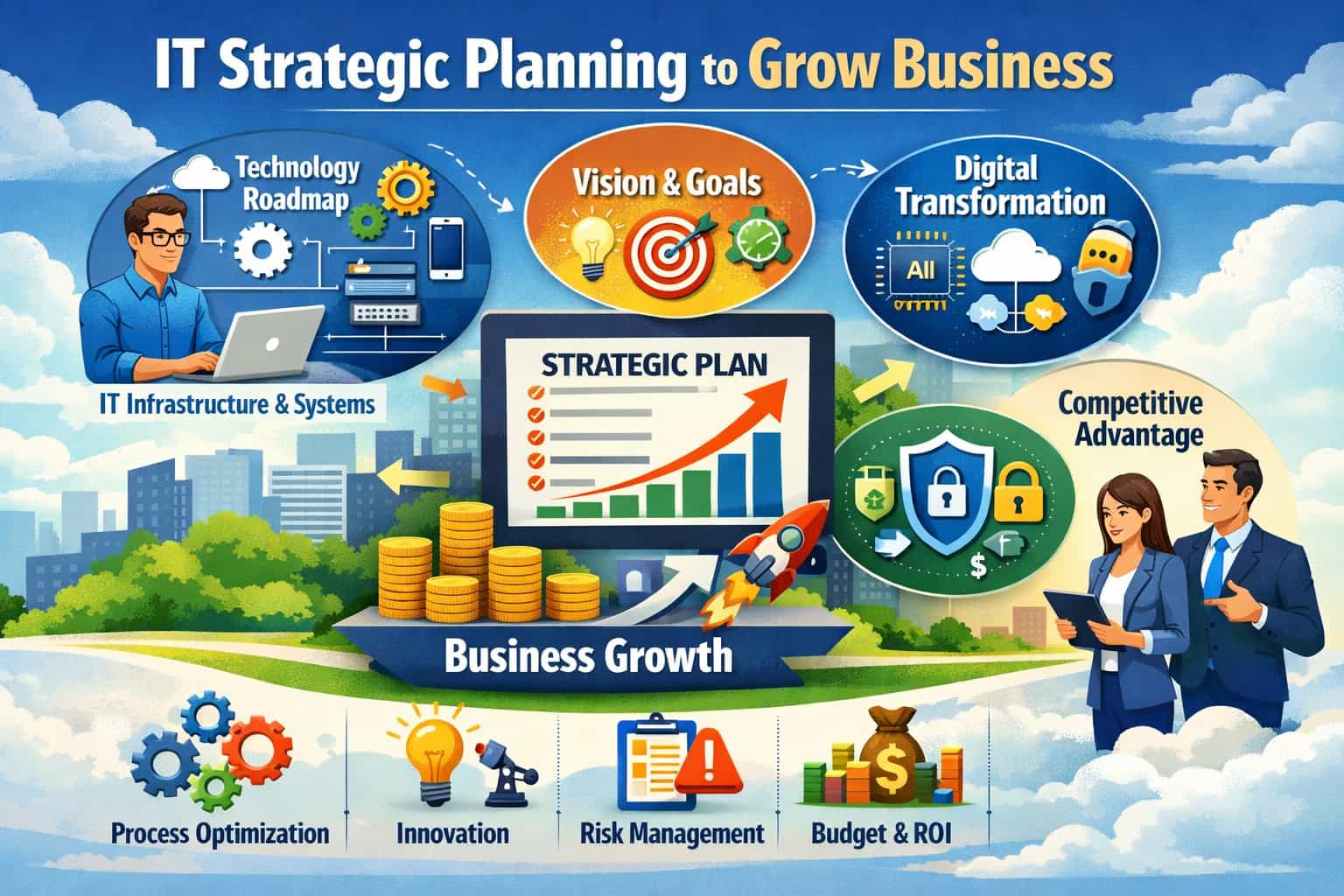

An IT strategic plan is the roadmap of how a business will achieve its future goals and visions. A granular IT strategic plan plays a pivotal role as it is the key that makes technology the core of long-term competitive advantage and success of the organisation.
In the current scenario, where business and technologies are rapidly changing, a business needs to have a properly developed, comprehensive IT strategic plan.
On this page
What is an IT Strategic Plan?
To maintain clarity, an IT strategic plan tends to involve objectives, key initiatives, current state analysis, and risk management. IT strategic planning is the process of creating a roadmap to align the vision and mission of a company, its information, data, and operations. The core of a strategic plan is technology initiatives that support business objectives.
The indispensable pillars of a strategic plan are built on factors like performance metrics, resource allocation involves the necessary budget, personnel, and other resources needed for IT projects.
The ability of an IT strategic planner is to analyse where the business is currently positioned, where the business will see itself in the future, and what the goals, visions of the business are. A well-structured, planned IT strategic plan plays a pivotal role in upscaling the business and perhaps makes ends meet.
What are the Key Pillars in the IT Strategic Plan?
The pillars in strategic planning integrate the idea of what the plan tends to involve, which tends to define a clear mission and vision, monitoring performance, and balancing goals and investments.
In the rapidly changing and evolving IT landscape, it is pivotal to have a well-planned and streamlined, and granular strategic plan that aligns with the vision, mission, goals, and objectives of the business and an understanding of the landscape.
- Artificial Intelligence Integration and Governance: In the constantly evolving society, AI is the future and holds a lot of power in the formation of a well-developed and structured business model.
- Cyber Security and Risk Management: Complexity and geopolitical factors tend to increase; a calibrated and granular strategic plan knitted around cybersecurity, business continuity, and risk management is pivotal.
- Digital Transformation: Redesigning the services and using the data in order to improve transparency. A complete transformation according to the plan, aligning with mission, vision, and growth.
What is the Plan Guide in IT Strategic Planning?
From a technical standpoint, a strategic plan tends to help a business model by boosting efficiency, keeping in mind the security protocols, and enabling data-driven decisions. The step-by-step planning guide furnishes a roadmap to align all the plans, to structure them, and to align technology with the business goal.
The core purpose of step-by-step planning is:
- Mitigate Risk
- Agility Enhancement
- Optimize Resources
- Aligning Technology with Business
How to Create an IT Strategic Plan? A Step-By-Step Guide!
1. Defining Business Objectives
The first step on the way to creating a strategic plan for a business is to identify the goal, challenges, and opportunities that the business wants to achieve or wants the plan to achieve. The idea is to identify the strategic priority and to engage with leaders and stakeholders.
2. Environmental Analysis
Market trends, competitive landscapes, regulatory requirements, and technological advancements are the pivotal factors that determine the future and form the base for strategic planning. An internal and external analysis tends to affect the IT strategy. Perhaps environmental analysis tends to play an important role.
3. Evaluating Current Situation
The examination of the existing technological environment, infrastructure, and capabilities. The idea is to analyse the strengths, weaknesses, threats, and opportunities that affect or help in the formation of an IT strategic plan.
4. Setting Goals and Objectives
After analysing, doing the backend research, it is time to set the goals and targets. The main idea is to identify the strengths and weaknesses, opportunities, and threats that are related to the business, its capabilities.
5. Developing an IT Strategic Roadmap, Framework
From defining the business objectives, performing the environmental analysis, examining the situation of the business, and setting goals and objectives, the business now develops an IT strategy. IT strategy is knitted around these pillars, forming a strong foundation. A roadmap that leads to the ultimate goals and visions of the organization.
6. Implementation of the Plan and Allocation of Resources
Developing a detailed plan, including the projects, timelines, resources available, and their allocation. Final stages of the plan are decided, including the availability of resources, budget, skill sets, and IT resources.
7. Risk Management Framework Establishment
IT threats like data breaches, talent gaps, and cyber attacks, hence it is extremely important to align risk management that involves identification, mitigating risks in order to achieve organisational goals, and it intends to ensure the long-term success of the organisation.
8. Governance and Security
Security governance focuses on leading; it is important as it forms a structure that ensures the business goals, manages risks, and ensures accountability. The idea is to monitor and govern the execution, which aligns with business objectives.
9. Tracking Performance
It is important to govern, monitor the performance metrics. Evaluating the effectiveness of the plan determines its ability to reach the final goal and mission of the organization.
Conclusion
An IT strategic Plan is extremely essential for any business willing to grow strategically to achieve the desired and planned goals, vision of the organisation. From a technical point, IT strategic planning is the critical orchestration layer bridging business objectives. IT strategy safeguards cyber resilience, enhances enterprise performance, and drives data optimization.
The strategy is a game-changer as it tends to provide the structure, agility, and security necessary to innovate faster, and tends to validate sustainability growth in the unpredictable IT realm. The combination of resilience, efficiency, innovation, transformation, and security takes the company to different heights.
An IT strategic plan is a blueprint that takes the business to another level. A good strategic plan can take the business to different heights. It is important to analyse and build a granular strategic plan to achieve the future growth, mission, and vision of any business.
Read more from Business
- Speed Up Real Estate Deals with Salesforce Sales Cloud Consultant
- When a Personal Phone Setup Starts Holding a Business Back?
- IT Strategic Planning in 2026: A Complete Guide for Future-Ready Business
- The Future of ERP in the AI-Driven Business Landscape
- What Enterprises Are Learning the Hard Way About Insider Threats?
- I Filtered 17 Best B2C CRM Tools for You (With Some Shocking Entries!)
- How Unstoppable Leaders Think Decide and Win Consistently?
- 7-Step Guide to B2C Branding Strategy
- Mastering Resource Allocation: Tools and Strategies for Maximum Efficiency
