


For a long time, SEO audits followed the same rhythm. Open Search Console. Open a crawling tool. Export data. Scan pages one by one. Write notes. Repeat. The process worked, but it was slow, and more importantly, it demanded mental energy on tasks that were mostly pattern recognition. But now SEO using AI is getting quite a popularity.
When AI tools became reliable enough to understand context, I started using them as an extension of my audit process. I did not replace tools or instincts. I replaced repetition.
On this page
What changed everything was learning how to prompt properly. The moment I stopped treating AI like a chatbot and started briefing it the way I would brief a junior SEO analyst, the output quality shifted. It stopped giving surface-level suggestions and started returning structured insights that were genuinely useful.
Today, AI sits between raw data and final decisions in my workflow. It reviews pages before I do. It flags gaps before I manually spot them. It helps me validate assumptions quickly. I still make the calls, but I make them faster and with more clarity.
This article documents how I actually use AI prompts for SEO audits and improvements. These are prompts I reuse, refine, and trust because they have been tested across different websites, niches, and stages of growth.
How I Think About AI Prompts as an SEO?
I think of them as context documents instead of commands.
Every useful SEO prompt answers four questions clearly:
- What role should the AI assume
- What kind of website or page is it analyzing
- What specific task should it perform
- How the output should be structured
When any of these are missing, the output becomes generic. When all four are present, the output starts resembling an internal SEO audit note.
When I do SEO using AI, I rarely use one-line prompts. In SEO work, clarity is more important than brevity. A detailed prompt saves more time than a short one because it reduces back-and-forth corrections.
Over the months, I have learned that prompts work best when they:
- Include business and page context
- Define the scope of the review clearly
- Ask for reasoning, not just recommendations
- Request structured output that can be reviewed quickly
This mindset applies to every SEO task, from audits to content optimization.
Why AI Works Well for SEO Audits in Practice?
SEO audits are fundamentally about identifying patterns across many pages. That is exactly where AI performs well.
When I run an audit today, AI helps me in three ways.
First, it accelerates the initial review. Instead of staring at a page and mentally checking elements, I let AI surface potential issues first. This gives me a SEO checklist that I can validate rather than create from scratch.
Second, it improves consistency. When auditing multiple pages or multiple websites, AI applies the same logic each time. That consistency is valuable, especially in agency environments or large sites.
Third, it provides a neutral perspective. After working on a site for weeks, it becomes easy to overlook obvious gaps. AI reviews content without attachment and often highlights missing explanations, unclear sections, or weak alignment with search intent.
This does not mean the output is perfect. It means it is a strong first pass that allows me to spend my time on judgment, prioritization, and execution rather than detection.
How I Use AI for SEO Audits in Practice?
Technical SEO Diagnostics, Before Touching Any Tool
Before I open a crawler or look at Search Console, I use AI to establish a theoretical risk baseline. This does not replace data. It prepares me to interpret it faster.
The prompt I use is intentionally descriptive because I want AI to reason about platform behavior, scale, and SEO mechanics.
Here’s a prompt that might help while doing SEO using AI:
Act as a senior technical SEO consultant who audits websites at scale.

I am reviewing a website with the following characteristics:
- Business model and website type: [describe clearly]
- Platform or CMS: [include known limitations, if any]
- Primary organic acquisition channel importance: [low, medium, high]
- Approximate site scale: [number of indexable pages if known]

I want you to reason through the most likely technical constraints that suppress organic performance for this type of site.

Focus specifically on crawl efficiency, indexation control, internal linking logic, and structural signals that influence topical authority distribution.

For each issue you identify, explain the SEO mechanism involved, how it typically manifests in real audits, and why it becomes a ranking or crawl problem at scale.

Where possible, describe how these issues interact with each other rather than treating them in isolation.

Structure the output so it can be reviewed alongside crawl and Search Console data.
For example, I used this prompt to analyze my website. Once I added all the necessary information, it offered me a detailed report of what’s working and what needs to be fixed.
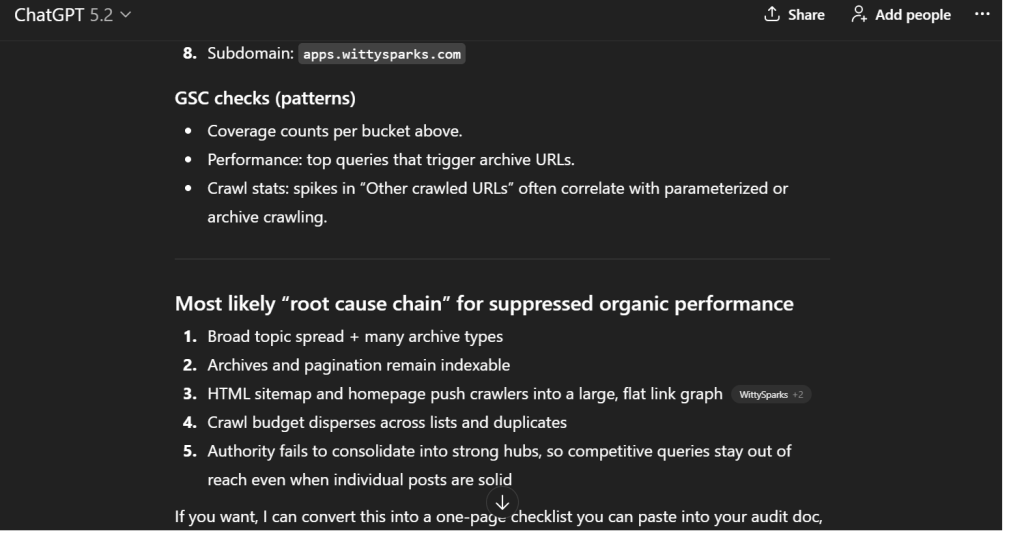
The reason I do SEO using AI tools like ChatGPT is that it helps me know what to look for first. And that saves time.
On-Page SEO Evaluation as an Intent Diagnostic
When a page ranks but does not improve, the issue is rarely keywords alone. It is almost always intent alignment or information hierarchy.
This is where you can do SEO using AI to evaluate the page as a searcher would, but with SEO reasoning layered on top. For example, one of my articles on zero-click search was in the top position, as you can see in the image below.
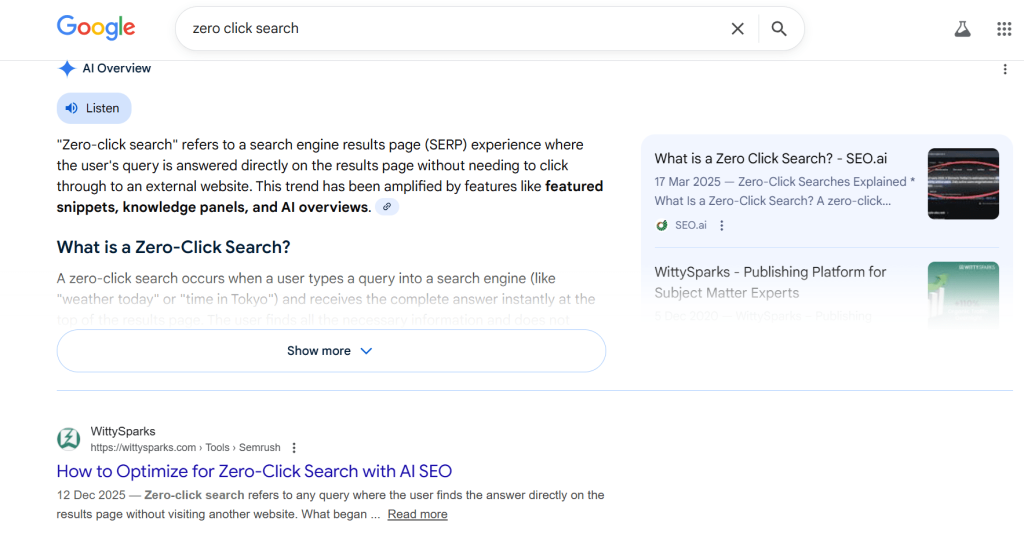
But then it started to falter, and now I can’t even find it on the 2nd page. In such cases, I use the following prompt to identify the problem.
Prompt:
Act as an SEO specialist who reviews underperforming ranking pages.

Page context:
- URL: [URL]
- Page type and role: [blog, category, service, landing page]
- Primary query intent you believe this page targets: [informational, commercial, transactional]
- Observed issue: [ranking plateau, low CTR, high bounce, weak conversions]

Task:
- Evaluate whether the page satisfies the dominant search intent behind the primary keyword.
- Assess how the title, headings, content sequencing, and depth shape searcher expectations.
- Identify where the page creates friction, uncertainty, or incomplete understanding for users.
- Explain how these gaps affect relevance signals and engagement rather than focusing on keyword placement alone.
This prompt consistently surfaces structural weaknesses that are invisible in keyword reports. And ChatGPT gets the job done pretty well.
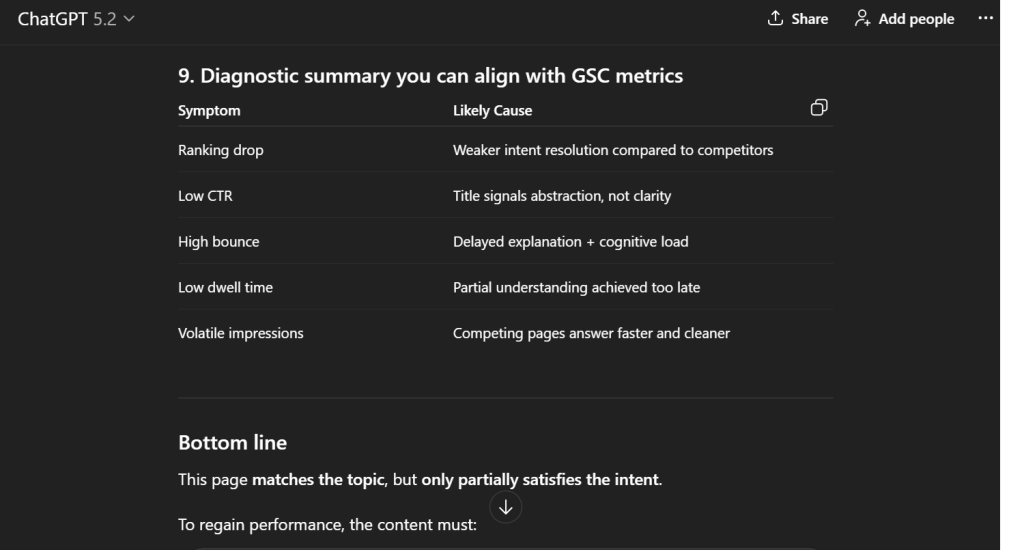
It came up with a very detailed explainer on what’s working and what’s not for this page. But in summary, it explained to me what was causing what. Now that I know what the issue is with the blog, I can easily fix it and get my article back on track.
Content Quality Audits
Now let’s get to the content quality audits. One of the most common SEO traps is assuming that longer content equals better content. I see pages with high word counts fail every week because they lack clarity, depth, or applied understanding.
AI tools for SEO, like ChatGPT, Gemini, and more, can evaluate your content quality.
Prompt I generally use:
Act as an SEO content reviewer who evaluates content competing in saturated SERPs.

Content context:
- Topic and scope: [describe clearly]
- Primary keyword: [keyword]
- Competitive intensity: [low, medium, high]
- Intended reader sophistication: [beginner, intermediate, advanced]

Evaluate whether the content demonstrates sufficient topical understanding to compete in this landscape.

Identify areas where explanations remain surface-level, where assumptions are left unexplained, or where concepts are introduced without resolution.

Pay attention to how information is sequenced and whether it mirrors how users logically explore the topic.

Highlight where authority signals feel implied rather than demonstrated.
This prompt often explains why content “looks good” but still fails to earn trust or rankings. Recently, I created a blog on Canva Alternatives. The target keyword had a good search volume, but I was not getting enough. And I ran it through ChatGPT using the above prompt. It explained to me what’s wrong with my blog and what fixes might help.
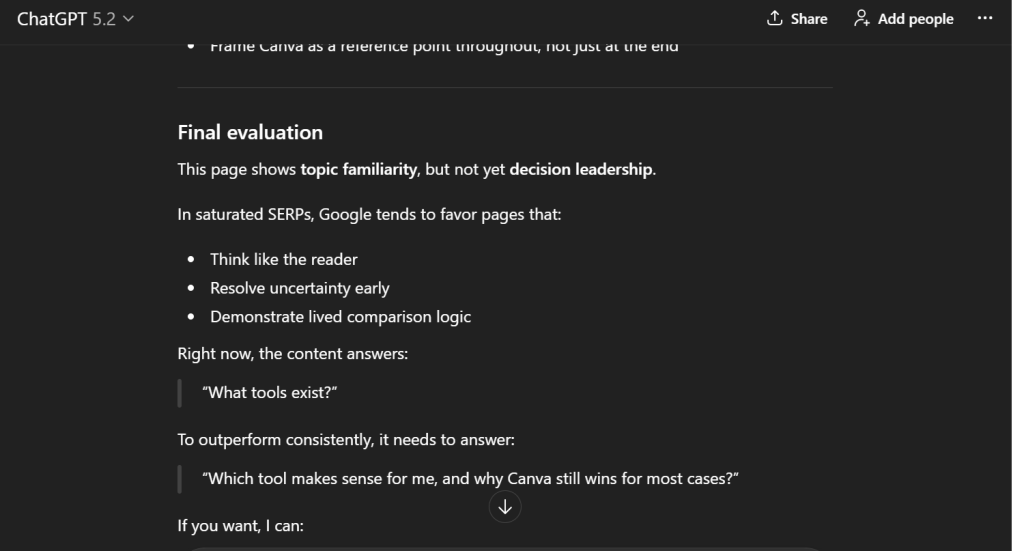
As you can see, it explained how I should create something that helps readers make decisions and focus on their core problems.
Keyword Integration as Semantic Reinforcement
Keyword work becomes dangerous when it is treated mechanically. I use AI to check whether language reinforces meaning rather than repeating terms.
Prompt I generally use:
Act as an SEO strategist focused on semantic relevance and language precision.

Page context:
- Content type and purpose: [describe]
- Primary keyword: [keyword]
- Supporting concepts the page should implicitly cover: [list concepts, not just keywords]

Evaluate whether keyword usage strengthens topical clarity or distracts from it.

Identify sections where language weakens perceived expertise or creates ambiguity.

Suggest improvements that increase conceptual density without introducing repetition or forced phrasing.
This prompt can help you refine the content without stripping it of personality or clarity. So if you think your content is not performing as you expect it to be, this prompt can come in handy.
Competitive Analysis That Explains Ranking Gaps?
This is the biggest challenge for website owners and SEOs! Time and again, it happens that your competitor has a similar authority to yours, but they rank higher.
The issue here generally stems from the structure of your website or the concept.
If you are dealing with such a problem, you can use AI to compare pages at the level of information delivery, not features. Here’s the prompt I generally use.
Prompt I generally use:
Act as a competitive SEO analyst focused on SERP behavior.

This is my page: [url]
This is my competitor’s page: [url]

Compare my page against competing pages ranking for the same query.

Focus on how competitors structure information, reduce cognitive load, and demonstrate topical confidence.

Identify where their pages answer questions earlier, more clearly, or with stronger contextual framing.

Explain how these differences influence both rankings and user satisfaction.
You can use this prompt, and ChatGPT will give you a clear roadmap that can help improve your performance. While this will not be the one-and-all solution, it can surely help you start working.
How I Use AI Prompts for SEO Content Work?
Once audits are done, AI becomes most useful during content planning and optimization.
I rely on prompts to help me think through structure, coverage, and intent before writing or editing. The key is treating AI output as a draft framework, not a finished product.
For keyword research, content briefs, and optimization, I use AI to surface ideas quickly, then refine them based on actual SERP behavior and business goals. This keeps the creative process grounded while still being efficient.
Over months of usage, these prompts have reduced turnaround time, improved consistency, and made collaboration easy for me. So if you want to know how to do SEO using AI, here are some crucial prompts that you can use.
Prompt Examples for SEO Content Tasks
Once the audit phase is complete, SEO using AI work shifts from diagnosis to creation and refinement. This is where AI becomes genuinely powerful if it is used correctly. Content-related SEO tasks are repetitive by nature, but they also require judgment. The challenge is balancing efficiency with intent accuracy.
I use AI here to accelerate thinking, not to outsource it. Prompts at this stage must be extremely clear about who the content is for, what problem it solves, and how search engines are expected to interpret it. Vague content prompts produce generic writing. Descriptive prompts produce usable structure and insight.
Keyword Research Using AI
Keyword research is the most important part of any SEO strategy, whether you are doing SEO using AI or doing it manually. AI works best when it is framed around intent and topical coverage instead of just volume. It might surprise you, but I never ask AI to “find keywords.” I ask it to map a topic landscape.
For this, I use the following prompt:
Act as an SEO keyword strategist working on a content-led organic growth project.

Topic context:
- Core topic: [topic]
- Business model: [SaaS, service business, ecommerce, publisher]
- Target audience knowledge level: [beginner, intermediate, advanced]
- Primary conversion goal: [traffic, leads, signups, sales]

Task:
- Identify a structured set of keywords that support this topic from an SEO perspective.
- First, identify primary keywords that represent the core search intent.
- Then, identify semantically related keywords that expand topical depth and relevance.
- Finally, identify long-tail queries that indicate specific user problems or decision stages.
- For each keyword or group, explain the underlying search intent and how it should be addressed in content.
Here’s an example where I asked ChatGPT for keyword research around “SEO using AI.” And here’s the result.
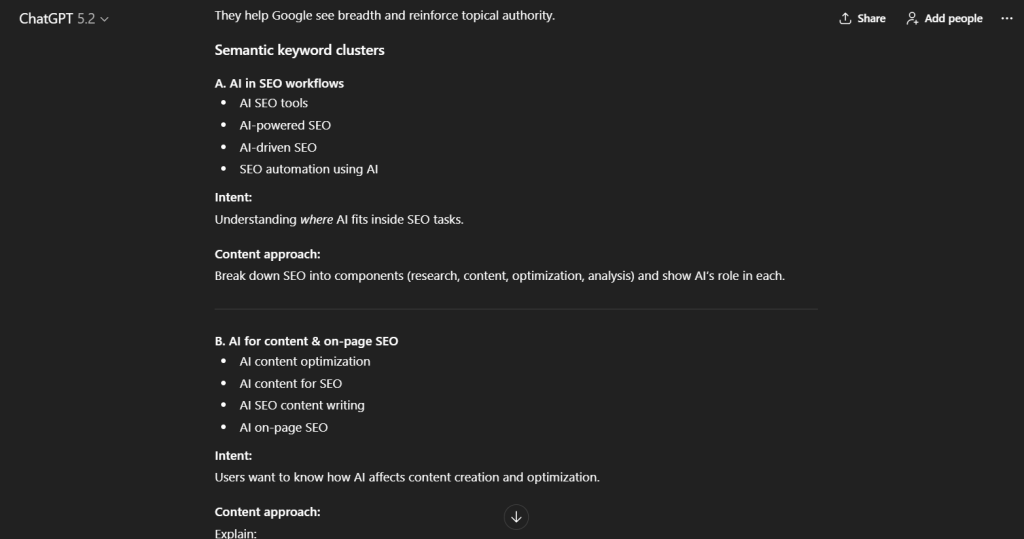
This prompt produces far more useful output than keyword lists. Reason? Well, it explains why each keyword exists. As you can see in the image above, you can see how keyword selection connects directly to content structure.
Content Brief Creation With SEO Context
Now that you are done with keywords, you can use AI to create content briefs. A proper SEO brief explains what the content must accomplish, and that’s why SEO using AI is gaining popularity.
AI helps here when the prompt forces it to think in terms of reader progression and intent resolution. Now, the prompt totally depends on your overall intent and niche.
You can still take an idea from the following prompt that I use:
Act as an SEO content strategist, preparing a brief for a professional writer.

Content context:
- Primary keyword: [keyword]
- Content type: [blog post, guide, landing page]
- Target audience: [describe role, pain points, expectations]
- Competitive intensity: [low, medium, high]

Task:
Create a detailed SEO content brief that outlines how this page should be structured.

Include:
- A logical heading framework that mirrors how users explore the topic
- Key subtopics each section must address
- Supporting keywords to be integrated naturally
- A realistic word count range based on SERP expectations

Focus on clarity, depth, and intent satisfaction rather than keyword density.
Let’s say I put this to the test with the same topic.
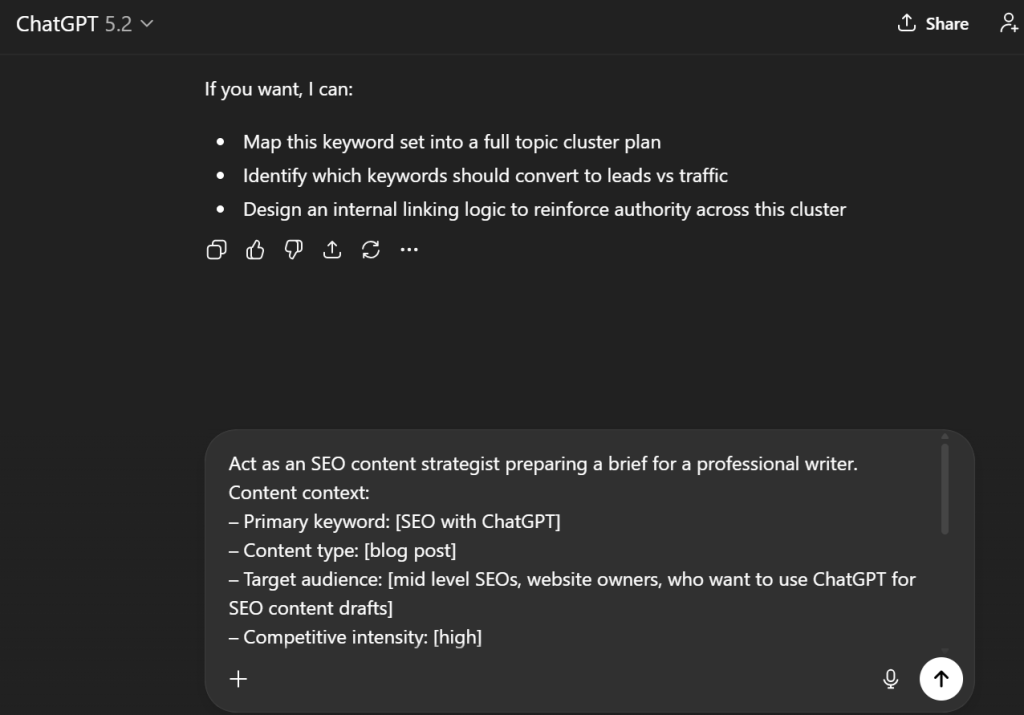
As you can see in the image, I have modified the prompt based on my primary keyword, content type, and target audience. Within seconds, ChatGPT comes up with a very detailed content brief.
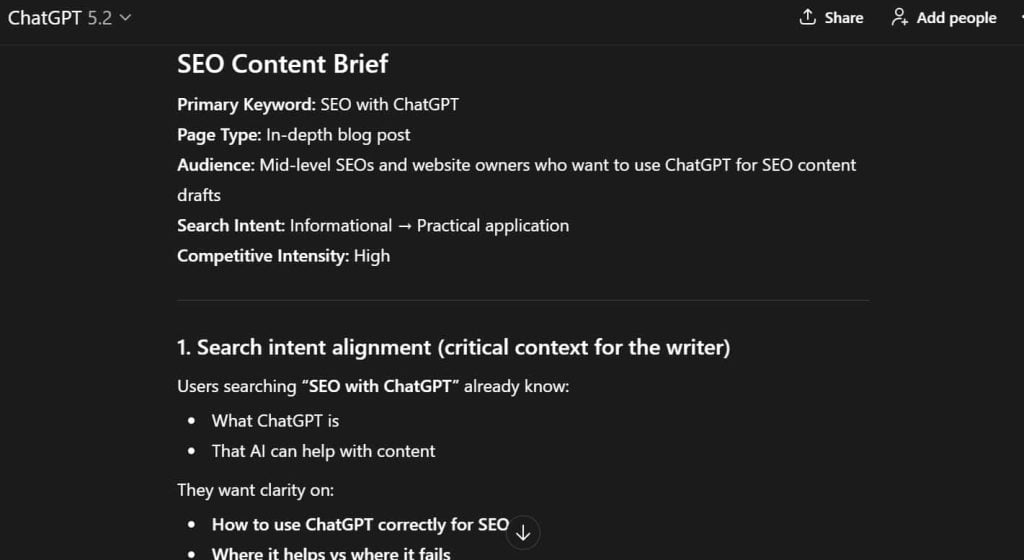
As you can see, any writer can use this brief to create a high-impact content piece that can help with SEO. Remember, the output usually needs light refinement, but the strategic thinking is already there for better SEO using AI.
Content Optimization for Existing Pages
This is where AI tools like ChatGPT, Gemini, and Writesonic can show their capabilities. You can cut your time for content optimization by more than half. But the only problem? Careless AI use and poor prompting.
So generally, I avoid using AI tools to rewrite my piece of content while doing SEO using AI. Instead, I ask AI to evaluate and suggest improvements without altering intent.
While my prompts change based on the niche and the particular content piece, here’s my base prompt:
Act as an SEO editor reviewing an existing page for improvement opportunities.

Page context:
- Target keyword: [keyword]
- Page purpose: [educational, commercial, conversion-focused]
- Known issue: [low engagement, ranking stagnation, weak conversions]

Task:
Review the content with the goal of improving clarity, topical depth, and internal relevance.

Identify:
– Sections where readability drops, or explanations feel incomplete
– Opportunities to expand depth without adding filler
– Logical points where internal links would improve navigation and authority flow

Do not rewrite the content. Focus on diagnostic feedback and targeted improvement suggestions.
I’ve often heard people say writing content is dead. But that’s exactly the attitude that prevents content from ranking higher. So I strongly recommend using AI to evaluate the content instead of rewriting it entirely.
SERP Feature Targeting With AI
Featured snippets and “People also ask” sections reward clarity and structure. And you can make AI think like a search engine and get the job done for better SEO using AI.
Here’s a prompt that can come in handy:
Act as an SEO specialist, analyzing SERP features for a target query using the web.

Query context:
- Primary keyword: [keyword]

Task:
Identify questions commonly associated with this query that are likely to appear in featured snippets or People Also Ask results.

For each question:
– Suggest a concise, direct answer suitable for snippet extraction
– Recommend formatting or structural changes that improve eligibility

Focus on accuracy, clarity, and completeness rather than brevity alone.
Let’s move ahead with the previous topic itself. When I added the keyword and the content type in the prompt, this is what ChatGPT came up with.
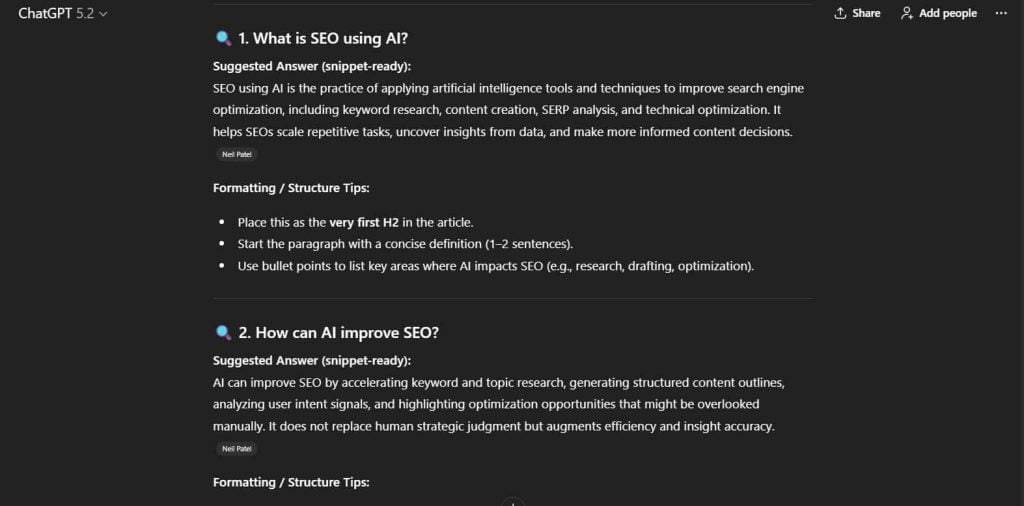
Now I’d say one thing again, don’t just copy and paste these questions. ChatGPT gives you a context and an overview of what might interest your readers. So optimize these questions as per your content for better SEO using AI.
Local SEO Content and GBP Optimization
Templated content has never worked for Local SEO, and it never will. People connect with the content that feels personal. So if you are doing SEO using AI, you can use ChatGPT to get this done by including service, location, and user expectations together in your prompt.
Here’s an example:
Act as a local SEO strategist, optimizing content for geographic relevance.

Business context:
- Business type: [clinic, service provider, retailer]
- Location served: [city, region]
- Primary service: [service]

Task:
- Identify localized keyword opportunities that reflect how users search for this service in this location.
- Suggest content sections or language patterns that strengthen local relevance without sounding forced.
- Additionally, recommend optimization ideas for the Google Business Profile description and service sections that align with organic content.
This prompt can be very useful for GMB experts, SEOs, and even those who are running paid ads.
Prompt Examples to Leverage AI for SEO Strategy
If you can guide AI tools properly, you can get a killer content strategy. But remember, it’s better not to “ask” ChatGPT to create a strategy for you. Instead, use it to organize thinking, simulate scenarios, and stress-test plans. Here are some prompts that you can use for your next SEO using AI project.
Topic Cluster Planning
Cluster planning sets the base for your entire SEO process. So, make sure it’s impeccable. You can use the following prompt to get a very useful cluster plan.
Prompt:
Act as an SEO strategist, designing a topic cluster for long-term organic growth.

Core topic: [topic]
- Business goal: [authority building, lead generation, monetization]

Task:
- Propose a topic cluster structure with a clear pillar page and supporting content.
- Explain how each supporting piece reinforces the pillar and targets specific sub-intents.
- Emphasize internal linking logic and topical authority development.
Let’s take a different example this time. I changed the Core Topic and Business Goal, and here’s what I got:
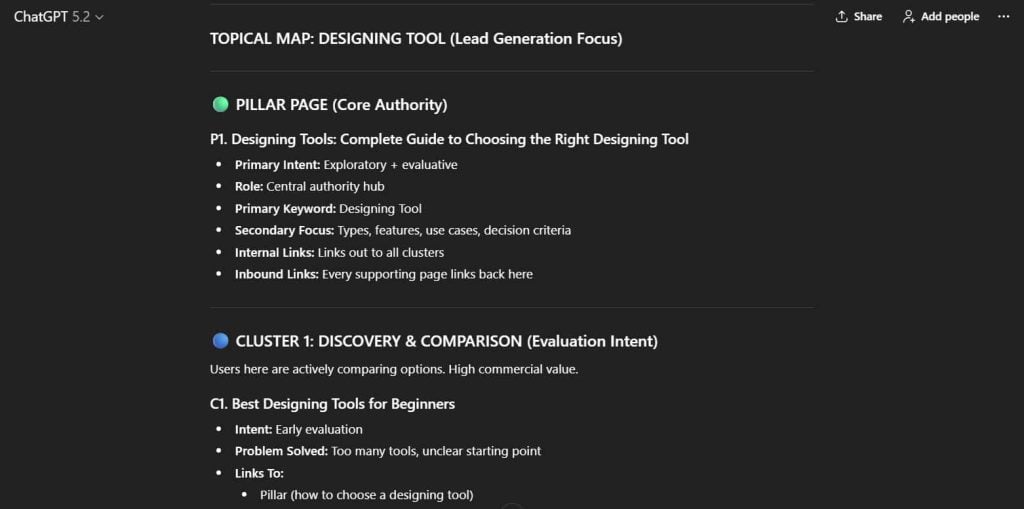
Overall, this can be a great start.
Content Calendar Automation
Struggling with regular content production and planning? I get that!
So I decided to automate the process using this prompt:
Act as an SEO manager planning content production over time.

Constraints:
- Publishing frequency: [number per month]
- Content resources: [solo, small team, agency]

Task:
- Create a content calendar that balances topical depth, keyword coverage, and publishing cadence.
- Explain why each piece appears when it does and how it supports overall SEO momentum.
This prompt has helped me a lot with my content planning and automation. So it might do the same for you.
Backlink Outreach Messaging
While this one is not a “technical SEO” task, it is still very important. How you reach out to others for backlinks makes a great difference.
So you can use this prompt to craft personal messages for SEO using AI that don’t feel like spam:
Act as an SEO outreach specialist, crafting professional backlink outreach messages.

Context:
- Content being promoted: [describe]
- Target site type: [blog, publication, resource page]

Task:
- Write outreach message templates that are personalized, respectful, and value-driven.
- Avoid promotional tone. Focus on relevance and editorial fit.
Here’s an example output of this prompt, optimized for my website.
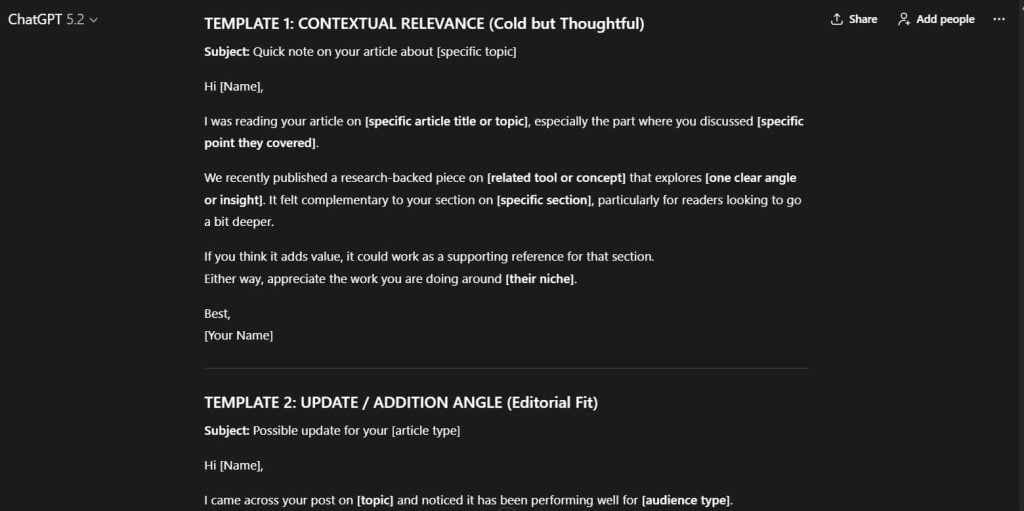
ChatGPT came up with numerous options, based on the type of approach you want to adopt.
Monthly SEO Performance Reporting
If you are doing SEO using AI for your client, reporting is the most crucial part of the entire process. When your client is spending money, they deserve to know where and how their money is being utilized.
And accurate reporting is the best way to do so.
Here’s a prompt you can use to create a very accurate and detailed report that your clients would love:
Act as an SEO consultant, preparing a monthly performance summary.

Data inputs:
- Organic traffic trends
- Keyword movement
- Pages showing improvement or decline

Task:
- Summarize performance in plain language suitable for stakeholders.
- Explain what changed, why it likely happened, and what it indicates for future work.
These prompts can come in very handy for those who want to save time and effort on mundane (but important) tasks like reporting.
Now that you have access to some of the best and extremely useful prompts for SEO using AI, let me give you some prompt optimization tips. Remember, your output will be as good as your input. The better your prompting is, the better results you get.
Prompt Optimization Tips
- Treat prompts as evolving assets: Prompts improve through iteration. So just like SEO strategies, prompts need testing in real scenarios. So every time you use a prompt, review your output critically. If the response feels shallow, misaligned, or too generic, that is a signal to refine the input and get better answers.
- Always specify the role you want the AI to assume: Output quality improves significantly when the prompt clearly defines a role such as “SEO strategist,” “technical SEO consultant,” or “content editor.” This helps the model anchor its reasoning and prevents high-level, generic advice that lacks operational value.
- Define constraints and context upfront: Prompts work best when they include boundaries such as business model, website type, audience sophistication, or competitive intensity. Without constraints, AI defaults to broad SEO theory. With constraints, it starts producing situational analysis that mirrors real-world decision-making.
- Explain why the task exists, not just what to do: Prompts that include the underlying problem perform better. For example, stating that a page suffers from ranking stagnation or low engagement gives the AI a diagnostic lens. This produces more relevant insights than simply asking for “improvements.”
- Use real data whenever possible: Feeding AI with actual page URLs, observed issues, traffic trends, or known constraints leads to sharper output. Abstract prompts generate abstract advice. So make sure you use data-backed prompts to generate analysis that feels grounded and reviewable.
- Refine the scope when outputs feel unfocused: If an AI response tries to cover everything at once, the prompt scope is too wide. Narrowing the task to a single objective, such as intent alignment, topical depth, or internal linking clarity, usually improves usefulness immediately.
- Add context when outputs feel generic: Generic output is almost always a context problem. Adding details about the audience, business goals, or competitive environment helps AI move beyond surface-level SEO guidance.
- Document prompt evolution with screenshots: Capturing before-and-after prompt versions alongside outputs is valuable, especially for teams or client communication. It shows learning, refinement, and reasoning rather than presenting AI as a black box.
Now, let’s take a look at some of the most common prompting mistakes that people make.
AI Prompt Mistakes to Avoid
- Being vague about the task: Vague prompts lead to vague output. AI cannot infer business goals, SEO priorities, or constraints unless they are explicitly stated. Prompts that say “analyze this page” or “improve SEO” almost always underperform.
- Writing long prompts without structure: Length alone does not improve results. Long prompts that lack clear objectives, sequencing, or expectations confuse the model and dilute the output. Descriptive prompts still need clear intent and direction.
- Omitting critical context: Missing information, such as page purpose, target audience, or observed issues, causes AI to fall back on generic SEO advice. Context is what transforms AI from a summarizer into an analytical assistant.
- Assuming AI output is inherently correct: AI responses should never be treated as final answers. They are hypotheses and reasoning aids. Every output must be validated against Search Console data, analytics, crawl reports, or real SERP behavior.
- Using AI as a decision-maker instead of a thinking partner: AI works best when it supports reasoning, highlights blind spots, and accelerates analysis. When used to replace judgment, it introduces risk rather than efficiency.
- Skipping human review before execution: SEO decisions affect rankings, traffic, and revenue. AI output must always be reviewed, refined, and contextualized by someone who understands the website and the business.
Wrapping Up
Using AI for SEO can prove extremely useful. There has been some stigma around AI tools when it comes to SEO. But if you ask me, AI tools can be of great help if utilized properly. In fact, they can put you way ahead of your competitors and even bring down your overall cost.
I hope the prompts that I have shared here can help you get started with your SEO using AI. I’ll be bringing more such useful stuff about AI, SEO, and more. So make sure you stay tuned here. Till then, happy writing!
FAQs
Are AI prompts a replacement for SEO tools?
AI prompts support analysis and decision-making, but they work best alongside tools like Search Console, crawlers, and keyword platforms rather than replacing them.
How detailed should an SEO prompt be to get useful output?
The prompt should include role, context, and objective clearly. More detail usually improves output quality as long as the task remains focused.
Can AI-generated SEO insights be trusted without validation?
AI output should always be reviewed against real data. Treat it as a reasoning aid, not a final verdict.
Is AI useful for advanced SEO work or only basic tasks?
When prompts are written with technical depth and context, AI supports advanced audits, content strategy, and prioritization workflows effectively.
Read more from SEO
- AEO vs SEO: 5 Ways to Master Answer Engine Optimization
- A Complete AEO Guide To Dominate the Answer Engine Citations!
- Content Clustering SEO: How to Build Website Architecture That Google Trusts?
- AI and SEO: How Artificial Intelligence Is Reshaping Search Visibility
- AI Prompts for SEO: How I do SEO Using AI?
- 12 Pinterest SEO Tricks That Actually Bring Traffic
- How to do SEO? (Here is our Secret SEO Checklist!)
- Influencer Marketing Tactics for Real Estate SEO Success
- Why is SEO Important for E-commerce: Effective Strategies to Boost Your Online Store
This post is also available in:
