
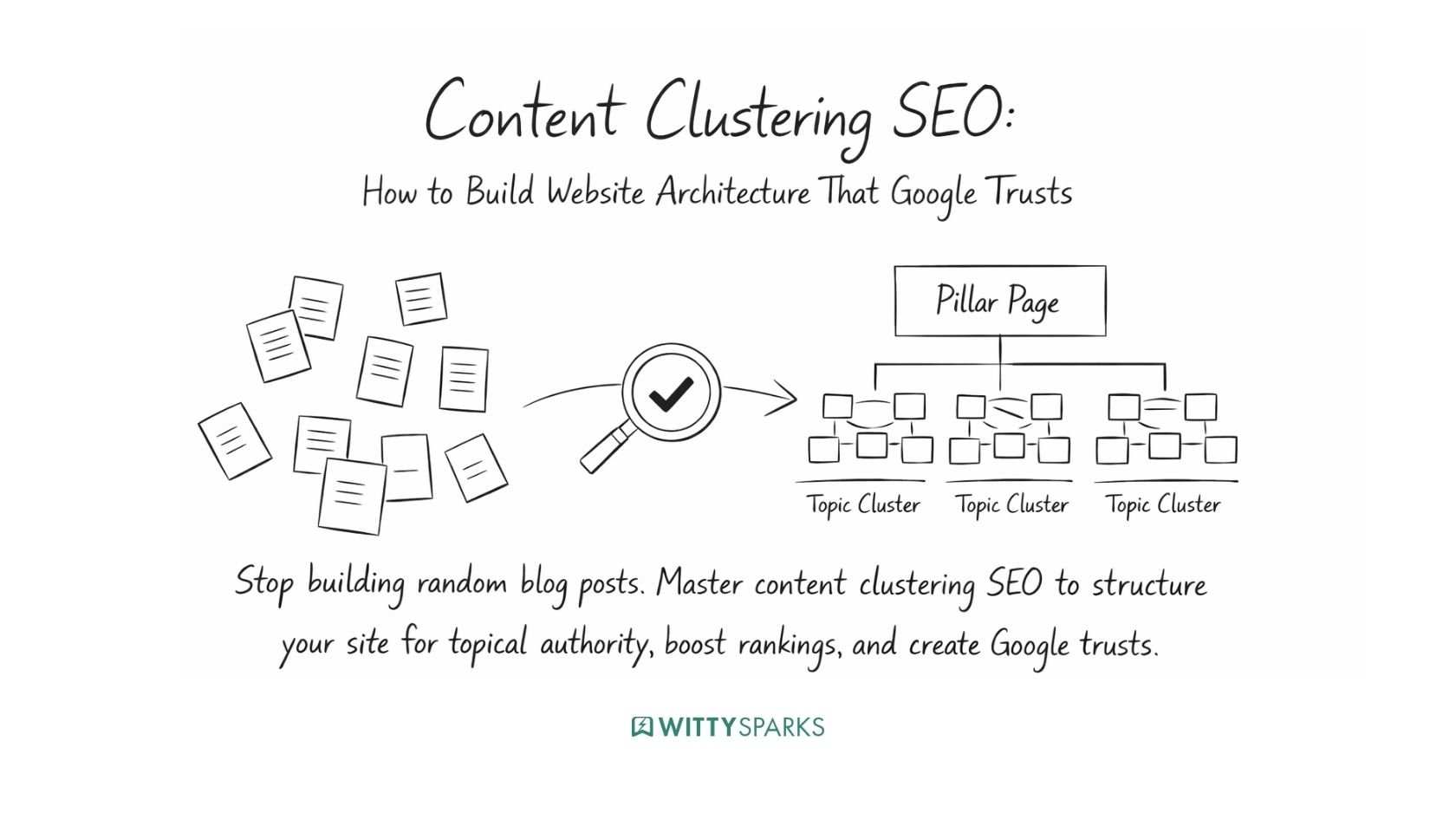

A content clustering strategy can solve a problem with your own website if it merely looks like a bunch of random blog posts and doesn’t resemble the kind of resource you can trust.
“Content clustering enables you to structure your content in a way that makes it clear to Google and intuitive for actual users as a body of related knowledge, and not as separate pages that all want to rank.”
On this page
Content Clustering is more about topics, intent, and relationships than about targeting keywords. Doing content clustering the right way will make your website something Google can trust, users are eager to visit, and search engines can readily quote in search results.
Let’s break it down in a practical, human way.
What Is Content Clustering in SEO?
Content clustering is a search engine optimisation technique in which content on a site is structured around a topic, including a pillar page and a set of supporting subtopic pages, through linking.
Think of it this way:
Rather than publishing random articles, you are building a library. You have a central book that discusses the topic generally, and then other books that explore more specific things your target market is asking as far as the topic is concerned.
This structure helps search engines understand what your site is about, and it helps users move smoothly from one answer to the next.
How Is Content Clustering Different From Traditional Keyword Targeting?
Traditional SEO typically considers each of the keywords a target in itself. This results in the creation of several breakable pages which compete among themselves.
While in the past content clustering was typically:
- You focus on topics, not just keywords
- You cover one subject from multiple angles
- Each page supports the others instead of competing
Google no longer ranks pages in isolation. It assesses the degree to which your site understands and communicates knowledge about a topic as a whole and content clustering is exactly what this looks like.
What Are Pillar Pages and Cluster Pages?
A pillar page is the central hub. It covers a topic broadly and answers the big questions.
Cluster pages go deeper. While each of them emphasizes a different subtopic or question, they are all directly linked to the pillar page.
For instance:
Pillar: Content Clustering SEO
- Cluster pages:
- How to create a content cluster
- Content clustering examples
- Internal linking for clusters
- Content clustering tools
Together, they form a clear, connected topic ecosystem.
Why Does Content Clustering Improve SEO Performance?
Content clustering enhances SEO because it brings about clarity both for search engines and for human visitors.
When Google recognizes that there are a number of well-connected pages on a variety of subjects related to your own topic, this sends a clear message to Google that your site is knowledgeable about what it is talking about.
For example, HubSpot restructured inbound marketing content into clusters (pillar: “Inbound Marketing”; clusters: lead generation, content guides), boosting organic traffic by over 100% and rankings across 300+ keywords through topical signals.
How Does Content Clustering Build Topical Authority?
The power of topical authority comes from depth and consistency, not volume.
By covering one topic thoroughly:
- You answer beginner and advanced questions
- You show expertise across multiple angles
- You reduce the need for users to look elsewhere
Over time, Google starts to connect your website with that topic and rankings start to follow by themselves.
How Does Content Clustering Help Google Understand Context?
All words exist in a context.
Content clustering creates “neighborhoods” of meaning. When related pages link to each other, Google can clearly see:
- What the main topic is
- How subtopics relate
- Which page is the authority hub
This makes it easier for search engines to connect your content with a search query.
How Does Internal Linking Strengthen Cluster SEO?
Internal linking enables the integration of a content group.
When your cluster pages link back to the pillar page and the pillar page links back to them, you:
- Distribute authority more evenly
- Signal which pages matter most
- Help Google crawl and index deeper content faster
It is more about connections. More about relationships.
How Does Content Clustering Align With Google’s E-E-A-T Guidelines?
Content clustering assists Google’s notions of Experience, Expertise, Authoritativeness, and Trustworthiness.
If this is already demonstrated by your structure, there is no need for “optimization for E-E-A-T.”
How Does Clustering Demonstrate Expertise and Experience?
When your site answers related questions in depth and in consistency, it establishes real understanding rather than surface-level understanding.
A blog wouldn’t showcase the same information on different pages. Each one would offer something different. That’s the kind of knowledge Google wants to see when it tries to determine one’s level of expertise.
How Does Clustering Improve Trust and Content Quality Signals?
A good content cluster mirrors how people actually learn:
- Begin with an introduction
- Look into specific questions
- Explore solutions at their own pace
This helps keep visitors on your site for longer, instills confidence, and results in lower bounce rates, which serve as an indicator of your site’s trust and quality.
How Do You Create a Content Clustering Strategy Step by Step?
The construction of a content cluster is not a difficult task, but it does require intention.
How Do You Choose the Right Pillar Topic?
Start with a topic that:
- Matters to your audience
- Has multiple related questions
- Connects to your business or goals
How Do You Identify and Group Cluster Subtopics?
Look for:
- Long-tail search queries
- “How,” “why,” and “best” questions
- Related problems and use cases
Group them based on meaning, not just keywords. A subject matter that cannot sustain at least 8-15 subtopics will not be specific enough for a pillar page.
How Should You Structure Internal Links Within a Cluster?
Where two questions are asking the same thing, they deserve to be on one page.
Make it simple:
- Pillar page links to all cluster pages
- Each cluster page links back to the pillar
- Related cluster pages can link to each other when helpful
Use natural, descriptive, correct anchor text, no forced keyword stuffing.
What Is the Ideal Site Architecture for Content Clustering?
The best site architecture for content clustering is one that feels logical and intuitive.
Should Content Clusters Use URL Folders or Flat Structures?
Both can work.
What matters more is consistency. Whether you use:
- /content-clustering/internal-linking/
or - /internal-linking-for-content-clusters/
Google is less concerned with format but pays attention to clarity and internal linking.
How Does Clustering Improve Crawl Efficiency and Indexation?
Clusters reduce the distance between related pages. That helps search engines:
- Discover new content faster
- Understand relationships more clearly
- Index long-tail pages more reliably
It’s like giving Google a map instead of letting it wander around.
How Can You Use Content Clustering to Find Content Gaps?
One of the biggest hidden benefits of content clustering is gap detection.
How Do You Audit Existing Content Using Clusters?
Start by mapping your current pages to topics. You’ll quickly notice:
- Missing subtopics
- Overlapping content
- Pages with no clear role
Those gaps represent growth opportunities.
What Types of Content Gaps Matter Most for SEO?
The most valuable gaps often include:
- Supporting informational content that answers foundational questions
- Middle-of-funnel education that guides users deeper into your topic
- and pages that bridge the gap between learning and action using effective content types.
Rather than thinking of these gaps as isolated missing pages, recognize that filling them strengthens the entire cluster – each new piece of content amplifies the authority and relevance of your pillar page and related subtopics. This interconnected approach means that strategic gap-filling isn’t just about adding more pages; it’s about creating a more cohesive, trustworthy resource ecosystem.
What Tools Help With Keyword and Content Clustering?
While there is the possibility of manual content clustering, tools expedite the process to make it more scalable.
Which Are the Best Content Clustering Tools in 2026?
Popular options include:
- Keyword Insights
- SurferSEO
- MarketMuse
- Semrush
These tools group keywords based on semantic similarity, not just matching words.
Semrush – SEO and Marketing Tools
Get access to the top 55+ marketing tools.

When Is Manual Clustering Still Useful?
Manual clustering works well when:
- You have a smaller site
- The topic is highly specialized
- You want full control over intent mapping
In many teams, there is a combination of human and AI, where AI is used for speed and human judgment is used.
How Can AI and LLMs Be Used for Content Clustering?
The use of well-considered AI tools has the ability to dramatically increase the processing of content clustering.
How Do LLMs Perform Semantic Keyword Clustering?
LLMs analyze meaning, not just keywords. They recognize:
- Similar questions phrased differently
- Intent patterns
- Conceptual relationships
This makes them especially useful for large keyword sets.
What Is a Practical ChatGPT Prompt for Content Clustering?
A simple approach:
- Provide your keyword list
- Explain your audience and goal
- Ask for pillar topics and subtopic groupings
Always review and improve the results – the AI tool will help you, but ultimately you will be controlling.
How Do Content Clusters Map to the Buyer’s Journey?
Content clusters naturally align with how people make decisions.
How Do You Assign Intent to Cluster Pages?
Some pages educate. Others compare. Some help users decide.
A strong cluster includes:
- Awareness-stage explanations
- Consideration-stage guides
- Decision-stage resources
How Do Clusters Support Conversions, Not Just Traffic?
When content flows logically, users don’t feel pushed, they feel supported. Trust builds first. Conversions follow.
How Is Content Clustering Evolving With Google SGE (Search Generative Experience) and AI Overviews?
With search increasingly being powered by AI, the importance of structure in search is greater than ever.
How to Define an AI-Ready Content Cluster?
AI-ready clusters:
- Answer questions clearly
- Use natural language
- Maintain strong internal connections
This is important for making it easier for AI to interpret and sum up your content.
How is Clustering helpful in the context of Answer Engine Optimization (AEO)?
When your content provides direct answers supported by deeper pages, it becomes ideal training material for answer engines and AI overviews.
What Are the Core Components of a High-Trust Content Cluster?
Every strong content cluster includes:
- A clear pillar page
- Focused subtopic pages
- Consistent internal linking
- Strong thematic alignment
How Do Entities, Attributes, and Values Apply to Content Clusters?
- Your pillar page acts as the central entity.
- Cluster pages describe its attributes.
- Internal links define their relationships.
Together, they form a structure that search engines can trust.
What are some of the common pitfalls to avoid in content clustering?
The biggest mistakes include:
- Creating too many thin pages
- Ignoring search intent
- Weak or inconsistent internal linking
How Can You Measure Content Clustering Success?
Look beyond single keywords. Measure:
- Topic-level rankings
- Organic traffic growth across the cluster
- Engagement and assisted conversions
How Do You Start Building a Content Cluster Today?
Start small. Choose one topic. Audit what you already have. Fill the gaps. Strengthen internal links.
Content clustering is not about doing more; it is about organizing better.
When your content is related, understood clearly, and of practical use to users, there’s no convincing Google needed. Trust follows naturally.
Read more from SEO
- 6-Step LLMO Checklist to Make AI Recommend Your Content
- Links vs Citations in SEO: Why Most People Get This Completely Wrong?
- AEO vs SEO: 5 Ways to Master Answer Engine Optimization
- A Complete AEO Guide To Dominate the Answer Engine Citations!
- Content Clustering SEO: How to Build Website Architecture That Google Trusts?
- AI and SEO: How Artificial Intelligence Is Reshaping Search Visibility
- AI Prompts for SEO: How I do SEO Using AI?
- 12 Pinterest SEO Tricks That Actually Bring Traffic
- How to do SEO? (Here is our Secret SEO Checklist!)
