

Businesses were getting the hang of SEO, and the AI revolution has already introduced a new term, AEO. AEO is where AI answers the query in brief. After helping 20+ businesses last year, I can surely tell you that AEO is here to completely change the way users surf online.
In this blog, we are going to explore the AEO vs SEO strategy, the AEO full form, and how AEO shapes digital marketing in 2026. While SEO was all about ranking web pages on the 1st page of search results, AEO focuses on delivering answers directly.
On this page
For instance, just type this in the Google search bar: “how to measure ROAS in Meta Ads,” and you will get a formula before web pages. This is Google AI Overview, i.e., AEO. Later, if you scroll down, you’ll see multiple blogs explaining the formula, tips to increase the ROAS, etc. These are the well-written and insightful blogs ranked on the 1st page of Google. This is SEO done right.
TL;DR
- AEO (Answer Engine Optimization) focuses on helping content appear as direct answers in AI tools, voice assistants, and Google AI Overviews, while SEO focuses on ranking webpages on search engine results pages.
- Search behavior is changing as users increasingly ask questions to AI platforms like ChatGPT, Gemini, and voice assistants, expecting instant answers instead of browsing multiple links.
- AEO vs SEO is not a competition. Both strategies work together. SEO helps content rank, while AEO helps that content become the answer AI systems show to users.
- Winning in modern search requires clear, structured, and insightful content that AI systems can easily extract, summarize, and reference.
- Businesses that adapt to AEO by optimizing content for AI summaries, conversational queries, and zero-click search can gain stronger brand visibility and attract higher-quality traffic.
AEO Full Form:
Answer Engine Optimization. AEO helps your content become the direct answer that search engines or AI tools show to users. Knowingly or unknowingly, we are all using AI-powered search engines. For every Google query, we no longer scroll, as the answer is at the top. Thanks to Answer Engine Optimization.
What is AEO in Digital Marketing?
Answer engine optimization works differently from SEO. It is more about offering a precise answer than explaining the entire concept. Since this is quick and authentic, 35% of GenZ users prefer AI answers.
Search today isn’t just about typing keywords on Google anymore. People are asking questions directly to tools like ChatGPT, Gemini, and Claude, seeing AI Overviews at the top of Google results, or even asking voice assistants like Siri or Alexa for quick answers.
Did you know that over 20% of global internet users prefer voice search? Which is why content now needs to be clear and easy for machines to pick and present instantly.
What Has Changed With AEO Getting the Hype?
Marketers used to write in-depth blogs and add proper keywords to grab that 1st rank. But since the AI overview and ChatGPT have come, people have literally stopped reading blogs, just like how everybody’s knowledge resource is a reel and not a book. Similarly, AEO offers a quick answer.
Then what about the traffic? HubSpot has experienced an 80% traffic drop due to AI answers. Does this mean that businesses should stop writing blogs? No! Well, AEO is far better than it looks.
It is not reducing the number of visitors; it is bringing the top-quality traffic to your website. How? Before we focus on AEO vs SEO, let’s understand that these 2 are deeply connected and interdependent. SEO just got better with the answer optimization engine. You can say that AEO is the upgraded version of SEO. Let’s see if SEO is still needed.
Also, read AI’s impact on SEO.
Key Takeaways
- AEO focuses on delivering quick and accurate answers instead of only ranking pages.
- AI tools like ChatGPT, Gemini, and Google AI Overviews influence modern search behavior.
- Voice assistants and conversational search are increasing the demand for clear and structured content.
- Businesses must create content that is easy for machines to interpret and present instantly.
AEO vs SEO
With easily accessible answers, many marketers believed that SEO was going to die. But the truth is exactly the opposite of this. SEO is not dead. It demands more focus, better quality content, attention to every technical detail, and most importantly, an understanding of user behaviour.
While businesses were writing for their audience, they must now write for AI as well. Search visibility is no longer only about getting clicks. Today, AI systems analyze content to understand explanations, definitions, and relationships between topics.
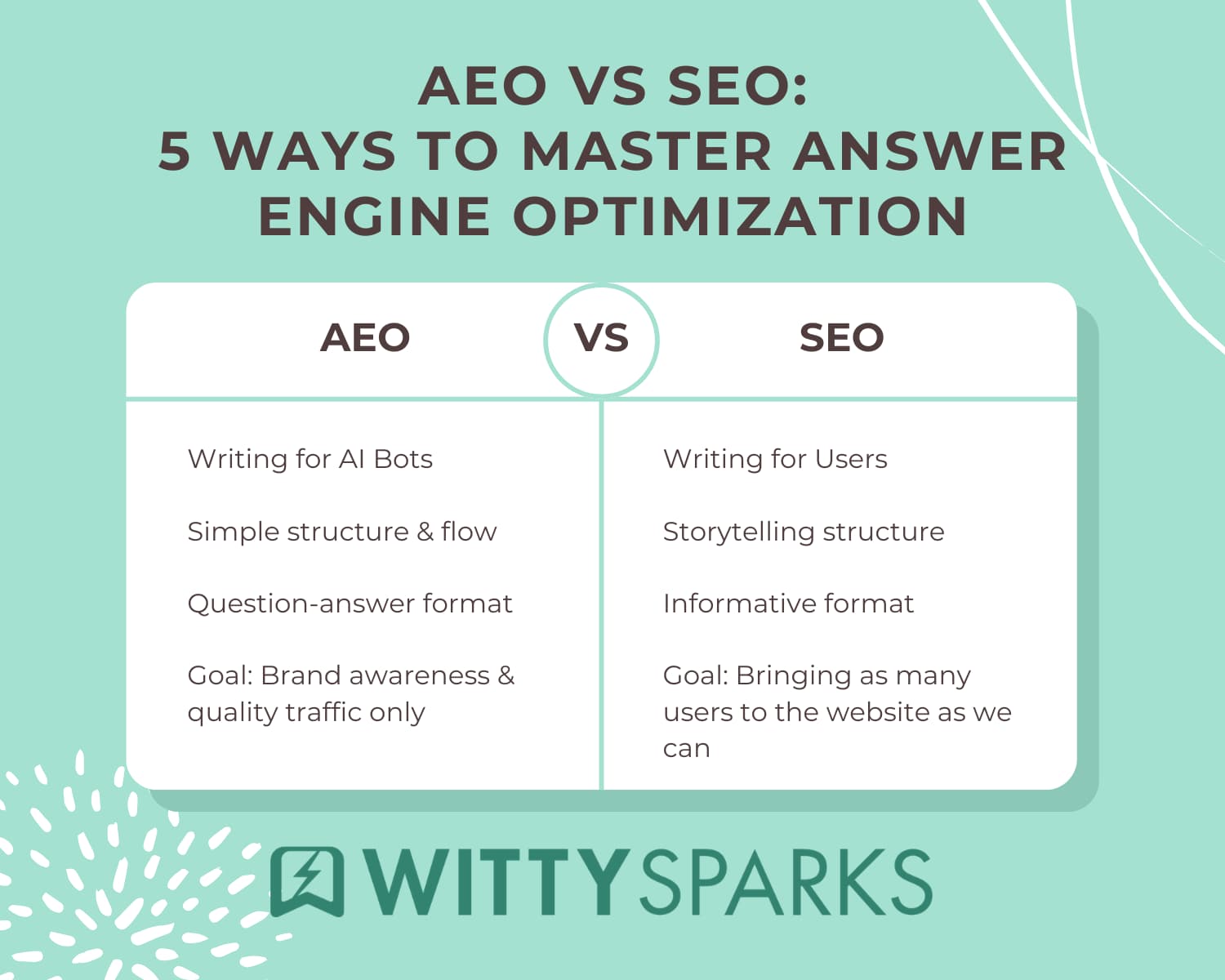
| AEO | SEO |
|---|---|
| Writing for AI Bots. | Writing for Users. |
| Simple structure and flow. | Storytelling structure. |
| Question-answer format. | Informative format. |
| Goal: Brand awareness and quality traffic only. | Goal: Bringing as many users to the website as we can. |
Though these 2 are interlinked, it is important to understand the core of AEO vs SEO. We are not learning this to master any one but to conquer both of these marketing forms.
1. Objective
Why do businesses take great efforts and hire agencies to streamline their SEO activities? The best SEO strategy can rank the webpages higher on search engine results pages. We all explore blogs on the 1st page. We rarely visit the second page of search results.
Hence, SEO’s goal is to shine on the 1st page. To do so, writers focus on keywords, research, technical performance, and backlinks.
AEO focuses on helping content become the direct answer to user questions. Instead of only ranking pages, marketers focus on AEO and prepare content that AI systems, voice assistants, and search engines can extract. These systems then present answers directly in AI summaries, featured snippets, or conversational search results.
2. User Behavior
Before AI, users typically browsed search engine results pages, compared different links, and clicked the one that looked most relevant. They then visited the website to find the information they needed.
With AEO, the behavior is different. Users often ask questions directly and receive an AI-generated response instantly. Instead of clicking multiple links, they may read the answer provided by the AI system. Users sometimes check the cited sources if they want more details.
Example-
If you ask, “What is AEO?”, Google AI overview will explain it to you in a few lines.
When you ask, “What is the best AEO strategy for a startup?”, the Google AI overview will give you a gist of it, but you will have to click on the source blogs to understand the strategy in detail.
What is AEO in digital marketing? It is the process of getting highlighted in the AI-answers and encouraging people to click on the link to explore more.
3. User Intent
SEO generally targets users who want to explore content, compare information, or visit websites to learn more. It is planned for users who are serious about in-depth exploration. I must read multiple blogs if I really want to master a certain topic. This is best for people who want to learn, research, or master something.
AEO focuses on users who want quick and precise answers. Many of these searches come from conversational queries, voice searches, or AI chat interfaces where users expect immediate information without browsing multiple pages.
For example, “What is the gold rate in India today?” or “Who won the T20 World Cup in 2026?”
One of the more important things about AEO vs SEO is to strike a balance between actual readers and AI bots. You are supposed to write for both. Their intentions are different, but your intention is to get more traffic and boost brand awareness.
4. Discovery Surface
SEO content mainly appears through traditional discovery channels such as organic search results, featured snippets, ‘People Also Ask’ boxes, local packs, and other search engine result features.
AEO content appears across AI-driven surfaces like AI-generated summaries, chat interfaces, voice assistants, and search experiences where answers are generated directly rather than displayed as a list of links.
5. Content Style
SEO content often focuses on detailed explanations optimized around specific keywords. Articles are usually long-form and structured to cover a topic thoroughly so they can rank well for multiple related search terms.
AEO content prioritizes clear, concise, and structured answers. It often includes definition-style explanations, question-based headings, and structured information that AI systems can easily extract and summarize.
Very Important- It doesn’t mean that AEO supports short content. Rather, it demands a much more detailed content full of insights, stats, and examples.
When discussing AEO vs SEO, the real difference lies in how the content is organized and presented. SEO helps pages rank, while AEO ensures that the same content is structured well enough for AI systems to understand, summarize, and deliver as direct answers to users.
You can also use AI to write quality content. Here is a list of efficient prompts: AI Prompts for SEO.
6. Success Measures
The success of SEO is usually measured through metrics such as keyword rankings, organic traffic, click-through rate, and time spent on the page.
For AEO, success is measured differently. Key indicators include citations in AI-generated answers, brand mentions within AI responses, featured snippet visibility, and placement in AI-driven search results.
Key Takeaways
- SEO helps webpages rank on search engines, while AEO helps content become the answer shown to users.
- Both strategies are interconnected and work best when implemented together.
- Businesses must optimize content for both human readers and AI systems.
- Understanding AEO vs SEO helps marketers adapt to the changing search landscape.
How to Win the AEO Game?
1. Optimizing Content for Direct Answers
The core idea of AEO is to structure content so that search engines and AI platforms can extract a clear answer to a question. Instead of only ranking pages, modern search systems try to present the answer immediately through features like AI summaries, featured snippets, or voice responses.
To achieve this, content must include definition-style explanations, short answer paragraphs, and question-based headings. These formats make it easier for algorithms to identify the exact sentence or paragraph that solves a user’s query.
2. Structuring Content for Machine Readability
AEO heavily depends on how easily machines can scan and interpret the structure of a page. This means using elements like clear heading hierarchy, structured paragraphs, lists, and FAQ sections.
Search engines and AI systems rely on semantic patterns and page organization to determine which section contains the most relevant answer. Well-structured content improves the chances that AI tools can extract, summarize, and display your information accurately.
3. Understanding Conversational Search Queries
AEO is strongly connected to the way people ask questions today. With voice search and AI assistants becoming common, users often search in natural language queries rather than short keywords.
For example, instead of searching “AEO meaning,” users may ask:
“What is answer engine optimization in digital marketing?”
This is the best comparison of AEO vs SEO.
Because of this shift, AEO strategies focus on question-based content formats, conversational explanations, and intent-driven answers that align with how real users phrase their questions.
4. Building Authority and Trust Signals
Answer engines prioritize information from credible and authoritative sources. This means that content optimized for AEO should demonstrate expertise, accuracy, and reliability.
Factors that influence this include clear author information, consistent brand mentions across the web, references to credible sources, and high-quality content. When AI systems can verify the reliability of the source, they are more likely to use it as a reference in their generated answers.
5. Aligning with the Shift Toward Zero-Click Search
AEO also reflects a broader change in search behavior. Many modern searches end without a click because the answer appears directly in search results or AI responses.
Instead of focusing only on traffic, marketers increasingly optimize for visibility within answer boxes, AI summaries, and voice responses. This ensures the brand remains visible even when users receive information instantly without visiting the website.
One very important aspect that many marketers may miss out on is the impact of your brand identity. Let’s say you write insightful blogs about the latest AI technologies, and your primary service is AI-based app development.
If you have a mediocre name like TechABC or XYZSolutions, and have a ‘logo next door’. It is going to be difficult for your users to remember you and recognize you. Hence, having a strong brand visibility through visuals as well as knowledge sharing is equally important.
You can also explore our exclusively curated AEO guide for potential business.
Key Takeaways
- AEO requires content that clearly answers user questions.
- Structured formatting improves how AI systems interpret content.
- Conversational queries and voice searches are shaping modern search strategies.
- Building authority and trust increases the chances of being cited by answer engines.
- Strong branding combined with insightful content improves long-term visibility.
Final Words
The debate around AEO vs SEO is not about choosing one over the other. It is about understanding how search behavior is evolving and adapting your strategy accordingly. SEO still plays a crucial role in helping your webpages rank and attract organic traffic. At the same time, AEO ensures that your content is structured well enough for AI systems to recognize, summarize, and present it as a direct answer.
If you are still wondering what is AEO in digital marketing, think of it as the natural evolution of SEO. Search engines are becoming smarter, users are expecting faster answers, and AI tools are changing the way information is delivered.
Businesses that focus only on traditional SEO may still rank, but those that combine SEO with answer-focused content will stay ahead in the new search ecosystem.
At WittySparks, we help businesses adapt to this shift by creating strategies that balance both AEO and SEO. From structured content to AI-ready optimization, our goal is simple: help your brand get discovered, trusted, and remembered in the age of AI-driven search.
Frequently Asked Questions
Is AEO good for startups?
Yes. Even small businesses can benefit from Answer Engine Optimization by creating clear, structured content that answers common questions in their industry. If AI systems recognize your page as a reliable source, your brand can appear in AI summaries and voice search results.
Does AEO work only for Google?
No. AEO applies across multiple platforms, including Google AI Overviews, ChatGPT-style interfaces, voice assistants, and other AI-driven search experiences where answers are generated instead of just showing links.
How long does it take to see results from AEO strategies?
AEO results depend on factors like content quality, topical authority, and technical optimization. In many cases, improvements in structured content and clarity can increase visibility in answer boxes and snippets within a few months.
What type of content performs best for AEO?
Content that explains concepts clearly, answers questions directly, and includes examples, definitions, and structured sections tends to perform well. AI systems prefer information that is easy to interpret and summarize.
Read more from SEO
- 6-Step LLMO Checklist to Make AI Recommend Your Content
- Links vs Citations in SEO: Why Most People Get This Completely Wrong?
- AEO vs SEO: 5 Ways to Master Answer Engine Optimization
- A Complete AEO Guide To Dominate the Answer Engine Citations!
- Content Clustering SEO: How to Build Website Architecture That Google Trusts?
- AI and SEO: How Artificial Intelligence Is Reshaping Search Visibility
- AI Prompts for SEO: How I do SEO Using AI?
- 12 Pinterest SEO Tricks That Actually Bring Traffic
- How to do SEO? (Here is our Secret SEO Checklist!)
