

ChatGPT ranking means getting your brand mentioned in AI-generated answers when users ask relevant questions.
PR, backlinks, and media features are expensive deals. You can still get featured in ChatGPT answers with simple steps like adding a strong hook, offering a quick solution in the introduction, building topical authority, and much more.
TL;DR
- ChatGPT ranking means getting your brand mentioned in AI answers, not ranking on a page
- Write simple, human-like content that gives direct answers quickly
- Use question-based headings and define concepts early
- Build topical authority by covering one topic from multiple angles
- Be present in real conversations like Reddit and Quora without sounding promotional
- Stay consistent across platforms and support your content with real examples
On this page
Last year, I got a call. The person was enquiring about our marketing services. At the end of the call, I asked where he got our company details from. He said ChatGPT.
I was stunned. I thought, how can ChatGPT generate leads for me? Then I decided to figure this out.
That’s when I started digging deeper into how to rank in ChatGPT. Over the past year, I have understood the entire process, which I am going to share here today.
How to Rank in ChatGPT Search? 10 Proven Ways
1. Why Answer Like a Human, Not Like SEO?
Do you know what the problem with traditional writing is? Most traditional SEO content is written for search engines, not for people. That’s why you’ll see sentences stuffed with keywords, awkward phrasing, and unnecessary fluff. Such content is good for Google crawling, but not for AI models like ChatGPT. ChatGPT tries to understand and reuse content in a natural way.
ChatGPT prefers content that sounds like a real human, clearly explaining something. It looks for direct answers, simple wording, and conversational tone. If your content feels like something a person would say in a meeting or on a call, it becomes easier for AI to pick and reuse.
| Example | SEO Style | Human Style |
|---|---|---|
| Example 1 | “Businesses wondering how to rank in ChatGPT must implement advanced AI-driven content optimization strategies to enhance visibility across large language model platforms.” | “If you want to show up in ChatGPT, focus on writing clear and helpful content that directly answers people’s questions.” |
| Example 2 | “Leveraging high-quality, keyword-rich content can significantly improve your chances of being recognized by AI-powered search systems.” | “If your content is simple, useful, and easy to understand, ChatGPT is more likely to pick it.” |
2. Put the Answer in the First 3 to 4 Lines
Most people make this mistake. They start with long introductions, storytelling, or background before actually answering the question. You must understand that you are writing a blog, not a book. AI looks for direct answers first, not a buildup.
When your answer is buried in the middle of the content, it becomes harder for AI to pick it. But if your answer is right at the top, clear and complete, it becomes easy to extract and reuse. This is what makes your content more “AI-friendly.”
I always tell this, consider that all users are busy. So avoid fluff and get to the point. But ChatGPT is in more of a hurry. It scans content to find the fastest, cleanest answer. If your first few lines solve the query, you win.
| Examples | SEO Style | Better (Human + AI-Friendly) – Direct answer first. |
|---|---|---|
| Example 1 | “Wonder how to rank in ChatGPT? ChatGPT is transforming the way users search for information online. With the rise of AI-driven platforms, businesses are now exploring new ways to optimize their content…” | “To rank in ChatGPT, you need to create clear, simple content that directly answers user questions and builds trust across multiple platforms.” |
| Example 2 | “In today’s digital landscape, understanding how to rank in ChatGPT and retrieve information is essential for improving visibility…” | “ChatGPT picks content that is easy to understand, well-structured, and widely mentioned online.” |
3. Use Question-Based Headings Everywhere
People don’t search for keywords anymore. They ask full questions. And tools like ChatGPT are built exactly around that behavior. So if your content already matches those questions, your chances of getting picked increase a lot.
When you use question-based headings, you are basically aligning your content with how users actually think. Instead of forcing keywords, you are mirroring real queries like “How to rank in ChatGPT?” or “Why is my brand not showing in ChatGPT?” This makes your content easier for AI to understand and reuse.
Also, question headings act like ready-made answers. ChatGPT can directly lift your section under that question and use it as a response. That’s why this format works much better than generic headings.
| Examples | Typical SEO Heading | Question-based Heading |
|---|---|---|
| Example 1 | “Ways to Improve ChatGPT Visibility?” | “How to rank in ChatGPT?” |
| Example 2 | “ChatGPT Ranking Factors Explained” | “What factors help you rank in ChatGPT?” |
4. Build Topical Authority (This is HUGE)
Most people write one blog and expect results. That’s not how AI works. Tools like ChatGPT look for depth, not just presence. If you have only one article on a topic, you look like a beginner. If you are an expert, you must have multiple pieces around the same topic.
It’s like a doctor saying I treat cold and cough. I don’t know how to treat fever, jaundice, hyper-acidity, etc. Topical authority means covering a subject from different angles.
Instead of writing just one blog on “how to rank in ChatGPT,” you also write about “what is AEO?”, “AEO vs SEO“, “AI search trends”, “content structure for AI”, and “real AI-optimization case studies.” This creates a strong signal that you understand the topic deeply.
The more content you build around a single theme, the easier it becomes for AI to trust and pick your content. It’s not about volume, it’s about connected depth.
Example: Let’s say you are a fashion content writer. If you write just 1 blog on “Upcycling”, ChatGPT won’t consider it as an expert’s insight. But if you write 5-6 blogs on the same topic, you are established as an expert.
You must cover multiple sub-topics like:
- Heritage Upcycling: Saree and Heirloom Transformations
- The “Visible Mending” Trend
- Eco-Impact: Why Upcycling Beats Recycling
- Upcycling for Home Decor
- Beginner-Friendly “No-Sew” Upcycling Ideas
5. Be Mentioned in Real Conversations (Not PR)
This is where things get real. A lot of people think visibility comes from PR articles and paid features. But in reality, tools like ChatGPT learn heavily from natural discussions happening across the internet.
Platforms like Reddit and Quora are full of real questions and real answers. When your brand starts appearing in these conversations in a genuine way, it creates a strong signal. Not because you “promoted” it, but because people are talking about it in context.
But here’s the truth. These platforms have become extremely strict. The moment your answer sounds promotional, your content gets downvoted, reported, or your account gets banned. You cannot treat them like marketing channels. You have to treat them like communities.
5 Vital Tips for Reddit answers:
1. Build credibility on Reddit and Quora first.
Do not jump to adding links to your content. First, try to solve some queries strictly without promotional text and links. Pure helpful content. Reddit has a Karma score. It depends on your answers, comments, questions, media, etc. Earn good Karma first, and then start posting links.
2. Answer first. Brand later.
Focus 90% on solving the question. If your answer genuinely helps, you can add a soft mention at the end.
Bad:
“Check out WittySparks, the best company for…”
Good:
“We tried a similar approach for a marketing project, and it worked well. One thing that helped was…”
3. Use storytelling instead of promotion
People trust experiences, not ads. Reddit and Quora do not work like Facebook and Instagram. Here, users are used to long, insightful answers. You can build a story around the case study and subtly mention your brand name & link somewhere.
Example:
“We got a lead through ChatGPT recently. The person said they found us while asking for marketing agencies. That made us realize how important structured content is.”
4. Be consistent, not aggressive
One answer won’t change anything. But consistent, helpful participation will. Answer 3-4 questions per week. Stay in your niche. Build identity over time.
5. Blend in with the platform tone
For Reddit, use a casual, honest, sometimes blunt tone.
For Quora, use a slightly more structured, informative tone.
6. Keep Language Extremely Simple
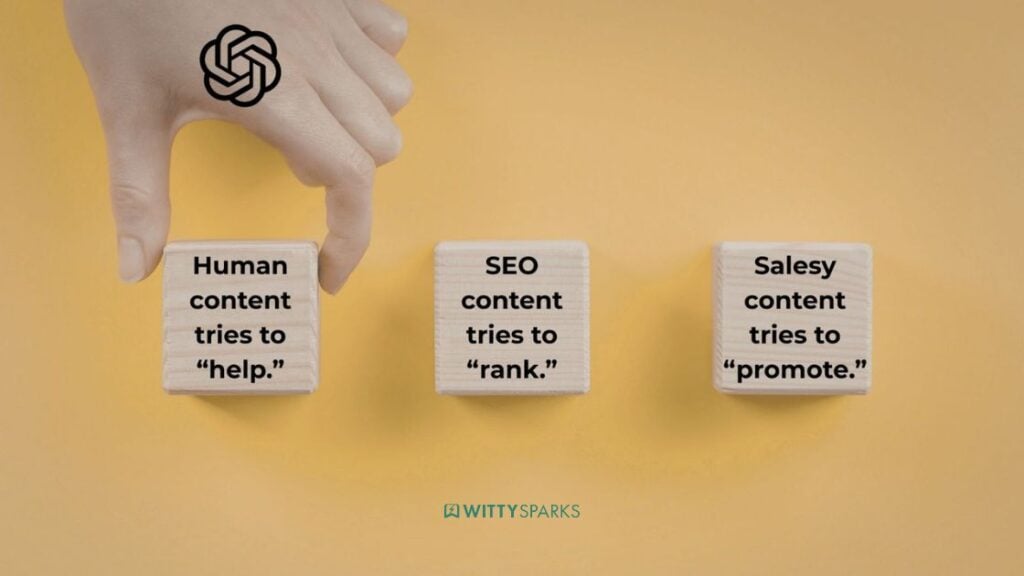
One thing I always tell my clients is that making simple things complex is the most inefficient way of showing your expertise. Your audience won’t have the skillset and expertise that you hold. That’s the core reason they are hiring you. Do not expect them to understand your technical terms.
Most people think sounding “smart” will make their content rank better. In reality, it does the opposite. Tools like ChatGPT prefer content that is easy to understand, not difficult to decode.
When your sentences are simple, AI can quickly process, extract, and reuse them. But when you use heavy words, jargon, or complicated phrasing, it becomes harder to interpret. And if AI struggles to understand it, it won’t use it.
Simple language also matches how people actually talk. Remember, ChatGPT is designed to respond like a human conversation. So the closer your content is to real speech, the better your chances.
Simply put, if a 15-year-old teenager understands your content, you are doing a great job!
| Examples | Overly Formal / Jargon-Heavy | Simple and Clear |
|---|---|---|
| Example 1 | “Implementing a multi-channel content dissemination strategy can significantly enhance your brand’s visibility across AI-driven platforms.” | “If you share your content on different platforms, more people and AI tools will notice your brand.” |
| Example 2 | “Optimizing content readability is crucial for improved extraction by large language models.” | “If your content is easy to read, ChatGPT can pick and use it easily.” |
7. Add Real Examples and Proof
Anyone can write “tips.” Very few people can show proof. And that’s exactly what tools like ChatGPT look for. If your content is backed by real experience, it feels more reliable, and it gets picked more often.
Almost everybody understands the concept immediately with much better clarity when you associate an example with it. Examples and proofs are NOT supporting elements. They are the most important elements. Sometimes, more important than the explanation itself.
When you add real examples, you’re not just explaining, you’re showing that it works. This builds trust. AI models are trained to prefer content that sounds credible, practical, and experience-based, not just theoretical.
Even a simple story can make a big difference. Like your own example of getting a lead from ChatGPT. That one line is more powerful than 10 generic tips because it proves the concept.
8. Be Consistent Across Platforms
One of the biggest signals AI looks for is consistency. Tools like ChatGPT don’t depend on just one source. They check multiple places to understand if your brand is real and trustworthy.
If your website says one thing, your LinkedIn says something else, and your Google profile is different, it creates confusion. But when everything says the same thing, it becomes easy for AI to understand who you are and what you do.
The more places your brand appears with the same message, the stronger your presence becomes. It’s not about being everywhere. It’s about being clear everywhere. But being clear everywhere is not enough. Every platform has different post styles. Let’s say Jack is active on LinkedIn.
When is scrolling through LinkedIn, he expects a little professional tone and insightful posts. Same Jack when scrolling through Instagram reels, expects a casual tone and some fun hook elements to stop and watch the complete reel.
Tone & Hook Ideas for Different Platforms:
Keep it slightly professional but conversational. Start with a real insight or mini story. Hooks like “Last week, something unexpected happened…” or “Most people are doing this wrong…” work well. Focus on value and experience, not selling.
Google Business (GMB)
Keep it simple and direct. Highlight what you do and where you are. Hooks like “Looking for a branding agency in Pune?” or “Here’s how we helped a client…” work well. Add clarity and relevance over creativity.
Keep it short, engaging, and scroll-stopping. Start with a bold or relatable line like “Nobody tells you this about ChatGPT…” or “This is why you’re not getting leads…” Use simple language and quick takeaways. Add some fun elements or a meme reference. It grabs attention.
9. Write “Citable” Sentences
ChatGPT doesn’t always use full paragraphs. It often picks one clean line that directly answers the question. That’s why writing “citable” sentences is powerful. These are short, clear lines that can stand on their own.
If your content is full of long, mixed ideas, it becomes hard to extract. But when you write sharp, independent sentences, it becomes easy for tools like ChatGPT to pick and reuse them.
Think of every few lines as a potential answer. If someone copies just that one sentence, it should still make sense.
Also, check our guide on Links vs Citations.
Example 1:
“Ranking in ChatGPT involves multiple factors such as content quality, backlinks, authority signals, and various other elements that together contribute to visibility.”
Vs
“ChatGPT prefers content that is clear, simple, and easy to extract.”
Example 2:
“In order to improve your chances of being recommended, it is essential to focus on structuring your content in a way that aligns with AI processing.”
Vs
“If your content is structured well, ChatGPT can easily pick and use it.”
10. Use Definition Blocks Early
AI tools like ChatGPT love clear definitions. When you explain something in one simple, direct line, it becomes very easy to pick and reuse.
Instead of slowly building up to the meaning, just define it upfront. This helps both the reader and AI understand the topic immediately. It also increases your chances of being used as a source.
Think of it like giving the answer before the explanation. Once the definition is clear, you can expand on it.
Example: Normal vs Definition First
Normal Style:
“Many people are now trying to understand how visibility works in AI tools like ChatGPT. It depends on multiple factors…”
With Definition Block:
“ChatGPT ranking means your brand gets mentioned in AI-generated answers when users ask related questions.”
Final Words
Nowadays, almost every person is using ChatGPT. Some use it for work, many use it as an assistant, and some use it as a friend! People trust what ChatGPT tells them. Since it gathers information from reliable sources and prepares one solid answer, the trust rate is higher.
Hence, every business must understand how to rank in ChatGPT search. Once you get highlighted by ChatGPT, your brand value automatically boosts. The process is indeed very detailed, but you must start implementing the changes as the shift from SEO to AEO and GEO is clearly visible. Follow WittySparks for more such tips.
Key Takeaways:
- Write like a human, not for search engines
- Give the answer in the first few lines
- Use question-based headings
- Build strong topical authority
- Be part of real conversations (not promotional)
- Keep your language simple and clear
- Add real examples and proof
- Stay consistent across platforms
- Write short, citable sentences
- Define concepts early for better clarity
Frequently Asked Questions
Can you rank #1 in ChatGPT like Google?
No. ChatGPT does not show rankings like Google. It’s more like a chatbot. It picks and combines answers from multiple sources. Your goal is to become the most relevant and trustworthy mention.
How long does it take to rank in ChatGPT?
There is no fixed timeline. If you want ChatGPT to mention your brand name, be consistent, create clear and helpful content, and build presence across platforms. Once you publish enough quality content around one topic of your expertise, you can start seeing results in a few weeks to months.
Does SEO help in ranking in ChatGPT?
Yes, but not alone. Traditional SEO helps with visibility, but you also need AEO and content that is easy for AI to understand and reuse.
How do I know if my brand is showing in ChatGPT?
Search for your service or niche in ChatGPT and see if your brand gets mentioned. You can also track AI traffic in GA4.
Featured image is created using ChatGPT.
Read more from ChatGPT
- How to Rank in ChatGPT? 10 Proven Ways!
- 18 Powerful ChatGPT Prompts for Marketing
- How Custom GPTs Can Accelerate Software Development Learning?
- ChatGPT for Bloggers or Writers?
- Why ChatGPT is Revolutionizing Conversational AI
- How Students Should Use ChatGPT?
- ChatGPT: A Game-Changer in AI-Language Models?
- Here Are The Top 11 ChatGPT Plugins To Make The Best Out of ChatGPT!
- The Dark Side of ChatGPT That No Affiliate Marketer is Talking About
