
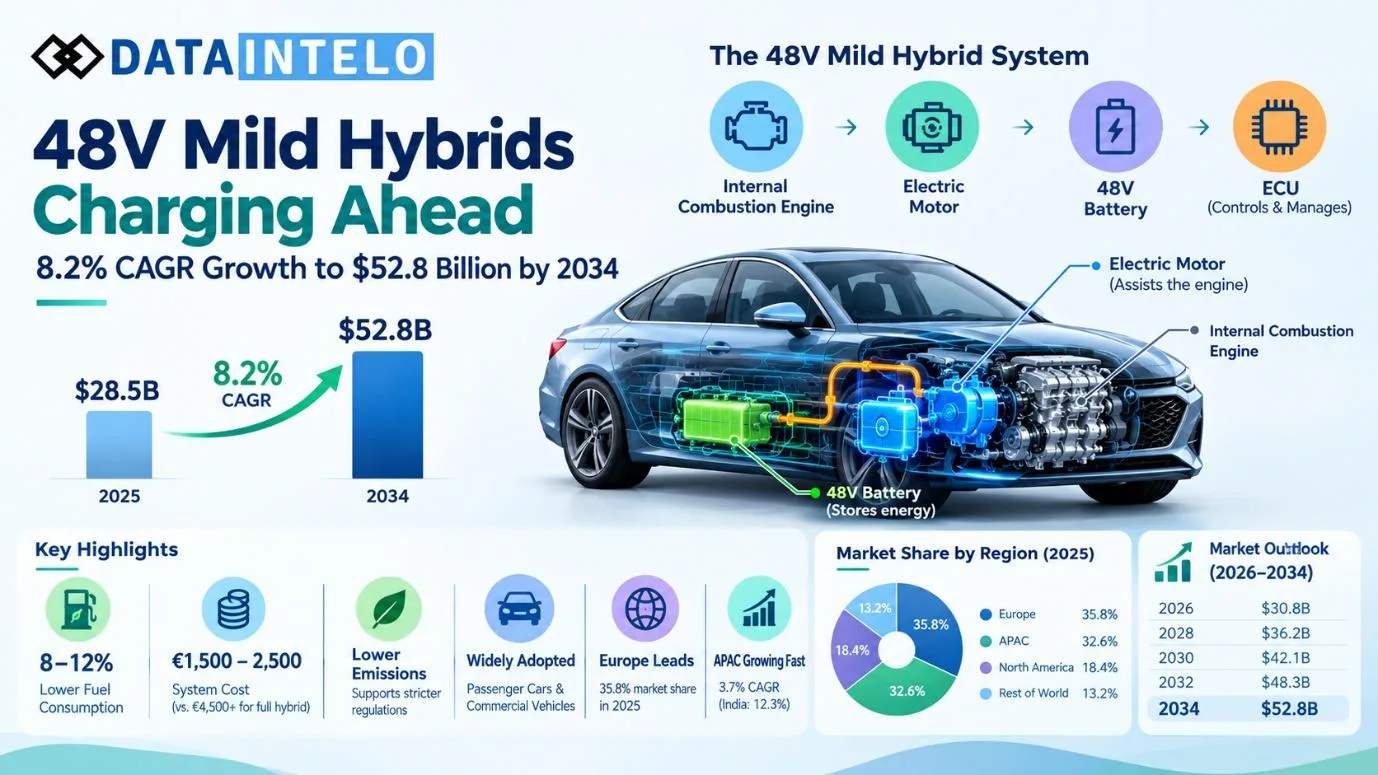

With manufacturers racing to meet more stringent emission norms without paying a heavy price for a complete hybrid and electric vehicle drive-train, there is no doubt that 48V Mild Hybrid technology has become increasingly popular choice.
This is because the system is cost-effective to add to the existing engines, does not need a change in the platform design, and also reduces the fuel economy. These features have led to the rise in the value of the 48V MHEV Industry, according to Dataintelo’s recent report, which is expected to grow from $28.5 billion in 2025 to $52.8 billion by 2034 with a Compound Annual Growth Rate of 8.2%.
On this page
This is no tale for the techies when it comes to senior executives making decisions in the world of auto manufacturing, parts supplies, and fleets. It is a transitional phase that falls somewhere between internal combustion and complete electrification.
What is the 48V Mild Hybrid System?
The 48V mild hybrid system is a combination of a conventional internal combustion engine and an additional electric motor, small lithium-ion battery, and electronic control unit responsible for energy exchange between the engine and the battery. It is crucial to highlight that the 48V system is not capable of driving the vehicle in an electric-only mode.
On the contrary, the electric system is used to support the operation of the engine in the process of accelerating the car, recovering energy during deceleration, and more efficient power supply of the vehicle’s onboard systems compared to the classic 12V one.
It goes without saying that such a system is very attractive in terms of performance. Fuel consumption reduces by 8-12% in real conditions (10-15% in laboratory tests) at a relatively low increase in the price of manufacturing the vehicle (€1,500-2,500 for a 48V system vs. €4,500-6,200 for a full hybrid system and €8,000-12,000 for BEV conversion).
Outlook: Steady, Widespread Growth Until 2034
The trajectory of growth of this industry is steady as compared to any kind of sudden or explosive one due to the nature of technology being applied in a gradual manner on the existing production line. The industry is worth around $16.8 billion in 2019 but has already reached $28.5 billion in 2025 with predictions of $30.8 billion in 2026, $36.2 billion in 2028, $42.1 billion in 2030, $48.3 billion in 2032, and finally crossing $52.8 billion in 2034.
Passenger cars constitute the dominant market with 64.2% share in 2025, however, the commercial vehicles segment will continue to hold the attention. Light commercial vehicles (vans, pickup trucks, and last mile delivery fleet) have seen the share of 48V systems increase from 8.2% in 2022 to 22.4% in 2025 and this segment is expected to show a CAGR of 8.5%, which is higher than the one of passenger cars (8.1%). Operators of fleet vehicles are turning out to be equally eager as individual customers if not more due to the rapid
accumulation of savings.
Regulatory Force Behind 48V Adoption
There is one force that does more to propel 48V adoption than any other. This is regulation. Europe’s aim to reduce its CO2 footprint to 49.5 grams per kilometer by 2030, China’s fuel consumption regulations calling for 5 liters per 100 kilometers, and Corporate Average Fuel Economy standards set for the U.S. market requiring 40.9 miles per gallon average by 2026 are all contributing factors to choosing the most affordable compliance route. Failure to comply in Europe may cost automakers up to €95 per gram of extra CO2 per sold vehicle, making a system integration cost of €1,800-2,500 seem rather insignificant.
All these regulations make Europe the leader on the regional level by claiming 35.8% of the global revenue (totaling $10.2 billion in 2025). It is Germany that drives adoption in Europe, with the Volkswagen Group facilities in Wolfsburg and Ingolstadt responsible for assembling more than 2.4 million vehicles with 48V systems each year. 28.3% of European installations can be attributed to France, Italy, and the UK, where Stellantis and the former PSA Group add 1.8 million units until 2028.
APAC comes next, accounting for 32.6% of the market value, but is growing even faster than Europe – 8.7% CAGR compared to Europe’s 8.1% – due to China’s vast production capacity of vehicles (27 million+ per year) and manufacturers such as Geely, BYD, and Great Wall Motors adding 48V systems in mid-range, cost-sensitive applications. Another standout area in APAC is India, where adoption is expected to grow by 12.3% CAGR until 2034 amid rising fuel prices and electrification policies.
North America, which accounts for 18.4% of the market, represents a somewhat different story, with adoption being driven mainly by consumer considerations and manufacturing strategies of companies such as Ford, General Motors, and Stellantis since there is no significant regulation in the area.
What’s Driving Growth: Four Forces Converging?
There is a rapid drop in battery costs. Costs of 48V Li-ion batteries dropped from about €400/kWh in 2020 to €285 in 2025 with a reduction of 28%, while the costs will further reduce to €220 in 2032. Lithium iron phosphate will be the fastest growing cell chemistry of 48V batteries between 2022 and 2025.
ADAS will run on 48V electric architectures. Current features of driver assistance, like adaptive cruise control, automated emergency braking, sensors, require 3-5 kilowatt peak electrical power, which cannot be generated by conventional 12V electric architecture. This means that 48V electric architecture will become a mandatory feature of ADAS because it is required to support high levels of vehicle autonomy and safety features, not an optional one for reducing emissions only.
The consumers are speaking through their pockets. The average consumer driving in Europe could save €400-$650 per year on fuel, while the North American consumer could save $350-$520. Figures based on insurance costs and sales figures from Germany, France, and the UK indicate that consumers are prepared to pay an extra cost of €1,200-$1,800 to have the technology in their car. This is because the total savings over a period of five years can be up to €2,800-4,200.
The supply chain has been developed. Leading-tier suppliers such as ZF Friedrichshafen have invested billions in manufacturing 48V components specifically, reducing lead time of procurement from 18 months to only 8-10 months. Such a reliable supply chain is precisely what OEMs require to base their multi-year production plans on.
The Money Matters: Composition
Batteries continue to be the largest category, comprising 28.4% of total cost, with the next-largest categories being electric motors (22.1%), power electronics (19.7%), transmission components (17.2%), and other ancillary parts (12.6%). Power electronics continues to grow at the fastest rate at 8.8% CAGR due to the change to silicon carbide semiconductors which help achieve efficiencies above 96%, whereas traditional silicon semiconductors have conversion efficiencies of 91-93%.
With regard to propulsion type, gasoline continues to dominate with a 62.3% market share largely due to North American and developing Asia needs; however, diesel 48V systems which dominate in Europe and Asia commercial fleets are growing faster at 8.7% CAGR due to fleet preferences for diesel energy density and range for long-distance transportation.
Landscape: Competitor Landscape – A Supplier Driven Ecosystem
Bosch is leading the competitors in the marketplace with 24.3% market share and €2.8 billion revenue from its diverse range of components including batteries, motors, power electronics, and starter generators. The second player is Continental AG with market share of 18.7% and revenue of €2.1 billion thanks to their power electronics expertise and integration with autonomous driving systems.
Valeo holds the third position with market share of around 12.6% based on its expertise in regenerative braking and motor efficiency technology. The BorgWarner corporation, which is recently acquired by the Delphi Technologies (2020), occupies the 11.3% market share.
Nevertheless, it is important to note that the original equipment manufacturers such as Volkswagen Group, Mercedes-Benz, BMW, and Volvo develop the 48V system independently instead of purchasing all from their suppliers and managed to reduce their manufacturing costs by 18-22%.
Case Study: Retrofit of Commercial Fleets
A particularly interesting pattern of adoption is emerging in the commercial vehicle aftermarket sector, especially with the fleet managers of Europe who operate large vehicle fleets. Retrofitting with 48V kits costs around €2,800 to 3,600 per vehicle, with some fleets traveling over 50,000 kilometers per year enjoying a payback period of 3 to 4 years simply because of fuel savings.
There are approximately 4,200 48V enabled trucks currently operating in regional delivery fleets in Germany, Belgium, and Scandinavia by mid-2026, another indication of the progress of the 48V technology from the passenger vehicles into commercial transport applications.
Headwinds Worth Watching
The single greatest long-term risk to the market space is that of the technology that this market was meant to be a stepping stone towards: BEVs. As the cost of BEVs continues to inch closer to that of combustion engine vehicles, and as subsidies and charging infrastructure increase, certain brands are foregoing the investment in mild hybrids and investing directly in BEVs.
The regulatory uncertainty surrounding the timing of the combustion engine phase-out timeline in the EU, UK, and California adds to the hesitation, and some companies are wary of putting any more money into a 48V system with an unclear time period going forward.
Increased costs in the supply chain for both semiconductor and rare earth metal manufacturing are adding 8-12% additional cost to components from 2024-2025.
Implications for Decision-Makers
From an OEM perspective, the decision seems fairly obvious: 48V technology is the cheapest way to meet regulations at present and its increasing use for the power of ADAS and autonomous functionalities gives the technology relevance outside of fuel economy considerations.
Suppliers will need to move beyond component manufacturing towards offering complete platforms and software-based energy management systems as a means of differentiating themselves. For commercial fleet managers, the numbers have now become too good for 48V technology to be ignored as part of total cost of ownership considerations.
While its ultimate limit is going to come from the speed of electrification, 48V mild hybrids are forecast to stick around until at least 2034 and with annual growth rates north of 8%, it looks likely that the discussion on them will be ongoing for at least another decade.

Read more from Autos & Vehicles