

Search behavior now revolves around answers rather than links. AI systems scan pages and reuse the clearest explanations they find. Pages that open with direct answers, question-based headings, clear examples, and well-organized sections get cited far more often.
AEO strengthens existing pages by improving answer clarity, covering related questions, and structuring content so extraction becomes easy. When done properly, a page shifts from simply ranking in search results to shaping the answers people see across AI platforms.
TL;DR
- This guide explains how Answer Engine Optimization (AEO) works and why it matters in the age of AI search.
- It covers how answer engines extract information, why certain pages get cited while others get ignored, how to run an AEO audit, how to find the questions AI tools answer, and how to format pages with answer blocks, question headings, and schema so Google AI, ChatGPT, and Perplexity can easily use your content.
The Shift From Search Engines to Answer Engines
If you open Search Console today, you will notice something strange. Impressions keep climbing, and rankings hold steady. But clicks through rate (CTR) is shit. If you don’t already know the reason, let me tell you.
This happens because Google and AI tools now answer the question themselves.
Google AI Overviews appear in 25%+ of searches today, driving the impressions-up-clicks-flat trend you’re seeing in Search Console
Search for something simple like “what is schema markup.” The answer appears immediately at the top. Google shows an AI Overview. Below that is a featured snippet. Then, a stack of People Also Ask questions. By the time the user scrolls, the question is already answered.
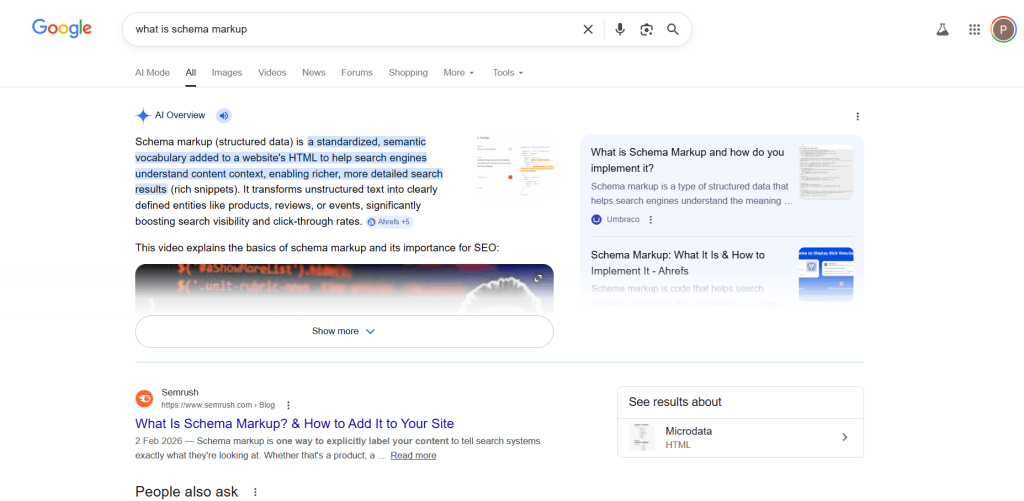
Your page may still rank #3. Google may even pull your definition. But the user reads the answer right there and leaves.
This happens constantly.
For example, one blog page may rank for “what is dental SEO.” Google extracts the definition from that page and shows it in the AI Overview. Thousands of people see it. Only a fraction click. The page influences the answer, but traffic stays flat.
The same thing happens inside ChatGPT and Perplexity.
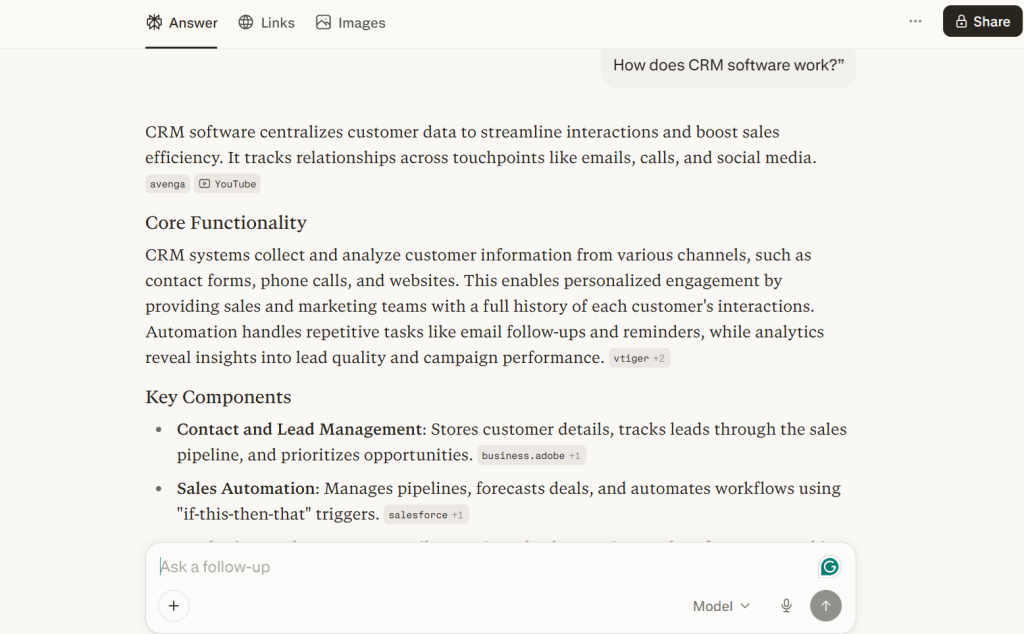
Ask Perplexity:
“How does CRM software work?”
It responds with a clear explanation. That explanation comes from somewhere. It pulls pieces from pages that explain the concept clearly. The user gets the explanation immediately. They never need to visit ten different websites.
This directly affects every type of page.
A service page explaining how your service works can shape buying decisions before someone ever lands on your website.
A blog explaining how something works can become the explanation AI tools repeat across thousands of conversations.
A product page explaining setup or comparisons can become the reference source voice assistants read aloud.
This is the new reality. Ranking still matters. But extraction matters more.
The page that explains the answer clearly becomes the source. The rest exist, but they rarely influence the answer.
Answer Engine Optimization decides which pages AI systems actually use.
What is AEO and How It Actually Works?
Answer engines do not read your page like a human. They scan it and isolate answer-ready sections. They reuse the clearest parts.
They are looking for clean answers they can lift and reuse safely.
How answer engines extract information?
Start with a real query:
“How does Invisalign work?”
Now imagine two pages.
Page A opens a section like this:
Invisalign works by using clear aligners that gradually move teeth into position. Each aligner applies controlled pressure. Patients switch aligners every one to two weeks until alignment completes.
This is perfect extraction material. It answers the question immediately. AI can use it instantly.
Page B starts like this:
“In modern dentistry, technological advancements have improved orthodontic treatment options significantly…”
The answer exists somewhere further down, but AI does not want to hunt for it. It moves on and finds a clearer source.
AI now powers 65% of all search experiences globally. So it’s the structure that decides whether your content gets used
Answer engines also evaluate whether your site consistently covers the topic. If your site publishes multiple detailed pages on orthodontics, treatments, costs, timelines, and comparisons, the system trusts it more. It recognizes your site as a reliable entity on that subject.
Clarity plus topical consistency increases extraction probability.
Citation vs link vs mention
This is where most people misunderstand how visibility works.
There are three levels.
Level 1: Citation
This is the best outcome.
Example:
Search in Perplexity: “What is Answer Engine Optimization.”
The answer may say:
“Answer Engine Optimization involves structuring content so AI systems can extract and present direct answers, according to [your website name].”
Your site becomes part of the answer itself. Your explanation shaped the response.
Google AI Overviews do this too. Your page appears inside the source cards attached to the answer.
Your content influenced the explanation directly. That’s the reason why cited pages drive 40% higher brand searches within 90 days.
Level 2: Link
Your page appears as supporting material.
Example:
ChatGPT answers:
“Best SEO strategies for dentists.”
At the bottom, it lists several links. Your article appears there.
This still brings visibility. But your page supported the answer rather than defining it.
Another page provided the core explanation.
Level 3: Ignored
This happens more often than people realize.
Your page ranks. It gets crawled. But AI never uses it.
Usually because:
- The answer appears too deep in the page
- The explanation feels vague
- Another page explains it more clearly
Answer engines prefer clarity over domain authority alone.
A smaller site with a clean explanation can outrank larger sites in AI answers.
Platforms that pull answers
Google already does this through featured snippets and AI Overviews.
Search:
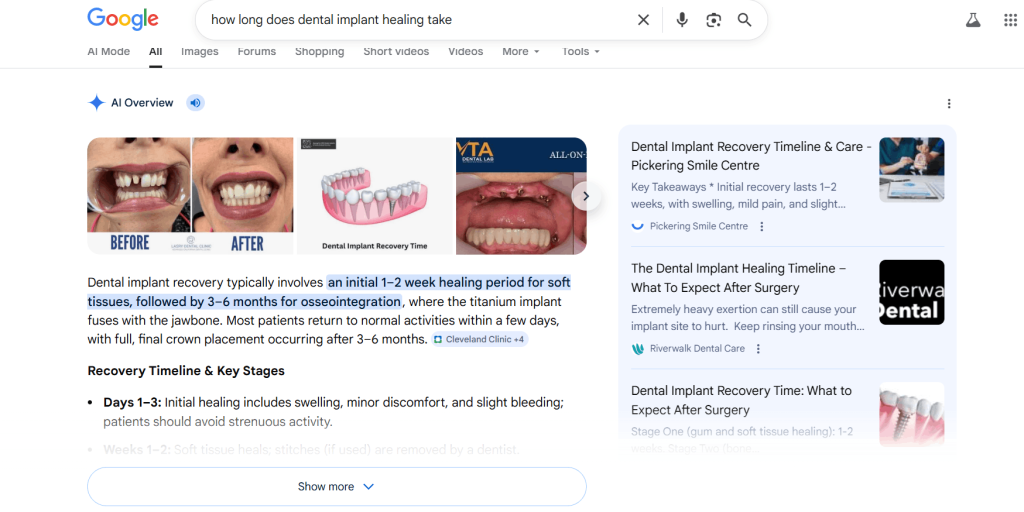
“How long does dental implant healing take?”
Google shows a direct answer at the top. That answer comes from a specific page.
ChatGPT behaves the same way.
Ask:
“How does technical SEO work?”
It builds an explanation using web sources. Pages that explain steps clearly influence the answer.
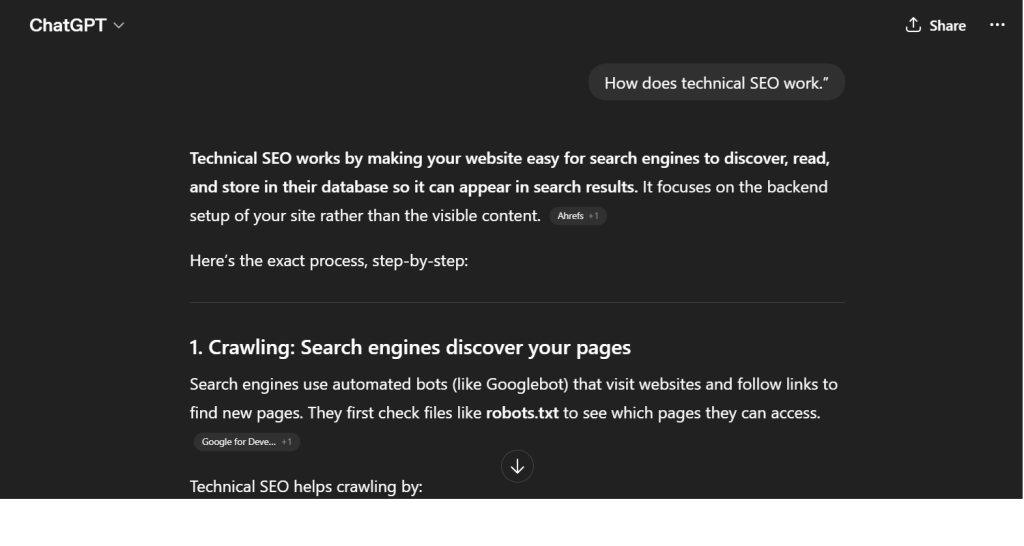
Perplexity makes this even more visible. It shows citations next to each section. You can see exactly which pages shaped the response.
Voice assistants go even further.
Ask Google Assistant:
“What is schema markup.”
It reads one answer. That answer comes from a single page.
Not ten pages. One.
That page structured its explanation clearly enough to become the chosen source.
This is exactly what AEO prepares your content to do.
Why Some Pages Get Picked as Answers and Others Never Do?
At this stage, most people assume rankings decide everything. Well, they are wrong!
Two pages can rank side by side and still, only one gets extracted. The other gets ignored.
The difference usually comes down to answer readiness and how well the answer is structured.
AI systems prefer pages that make their job easy.
For example, search:
“What is schema markup.”
You will notice a pattern. The pages that appear in AI answers almost always open with a direct definition. Within seconds, the system understands the topic, the scope, and the explanation.
Now open a competing page ranking nearby. Many open with long introductions, storytelling, or general commentary. The answer appears later, buried inside paragraphs.
AI systems skip friction. They choose clarity. Direct-answer pages get cited 3x more in Perplexity responses.
This explains why smaller sites often get cited over larger ones. Authority helps, but extractability decides selection.
Several signals influence this selection process.
Clear answer blocks
Pages that answer the question immediately get used more often.
Example:
What is technical SEO?
Technical SEO improves how search engines crawl, interpret, and index a website so its pages appear correctly in search results.
This single block gives AI everything it needs.
Pages that delay this explanation reduce extraction probability.
Structural clarity
Answer engines prefer predictable structure. Clear headings framed as questions help systems locate answers faster.
Example:
- How technical SEO works?
- Technical SEO vs on-page SEO
- How long technical SEO takes?
Each heading creates an extraction point.
Dense narrative pages without structure rarely get selected.
Topical consistency across the site
AI evaluates the entire site while answering on any topic.
If a site publishes multiple detailed pages on SEO, crawling, indexing, schema, and page speed, it builds strong topical confidence.
Now compare that to a general blog that mentions SEO once. Even with a good explanation, the system may prefer the specialist site.
Consistency builds trust.
Answer coverage across related questions
Answer engines answer clusters. For example, someone asking:
What is CRM software
often asks next:
- How CRM software works?
- Why businesses use CRM software?
- How much CRM software costs?
Pages covering multiple related questions become stronger answer sources.
They give AI everything it needs in one place.
Once you understand these signals, the next step becomes straightforward.
You identify pages already close to meeting these conditions, and upgrade them so that answer engines select them consistently.
That is exactly what the audit does.
The AEO Audit: Identify Pages That Can Win Citations First
Not every page starts from the same position. Some pages already sit very close to becoming answer sources. Google shows them. AI tools read them. They simply do not get selected consistently.
These pages often appear in search results, receive steady impressions, and cover the right topic. What holds them back is usually presentation, not relevance.
For example, a page explaining technical SEO may rank on page one. Google recognizes it as relevant. But the AI Overview pulls a definition from another site because that site presents the answer more clearly and immediately.
The difference rarely comes down to authority alone. It comes down to answer readiness.
Step 1: Pages that already attract attention
Pages with strong impression volume already sit inside the answer engine’s evaluation pool. Google shows them to users frequently. That means the topic alignment already exists.
These pages often rank between positions two and ten. They appear visible, yet they rarely become the extracted answer. 40% of PAA answers pull from #2-10 ranked pages
Another strong signal appears inside the People Also Ask section. When a page occasionally appears under those expandable questions, it shows that Google already considers it useful for answering related queries. With clearer structure and direct explanations, these pages often move into more prominent answer positions.
In other words, the foundation already exists. The opportunity lies in improving clarity.
Step 2: Where most pages fall short
Many pages explain topics well, but they do not present answers clearly enough for extraction.
A common example appears on educational blog pages. They introduce the topic, explain context, and gradually build toward the explanation. Humans appreciate that flow. Answer engines prefer immediacy.
- A definition placed near the top helps establish clarity instantly.
- Process explanations benefit from visible step sequences rather than long paragraphs.
- Comparison sections help answer the evaluation questions users often ask next.
- FAQ sections help cover related queries in a format that answer engines recognize easily.
These additions do not change the meaning of the page. They make the answers easier to identify and reuse.
Step 3: Pages that influence decisions carry the highest value
Some pages play a direct role in user decisions. These pages often cover topics such as pricing, timelines, comparisons, or service explanations.
When answer engines extract explanations from these pages, they influence users before those users explore multiple sites.
Commercial blog articles often fall into this category. So do service explanation pages and educational pages that consistently attract engaged readers.
Improving these pages strengthens both visibility and authority. Over time, answer engines begin to rely on them more frequently when generating responses.
AEO begins by strengthening pages that already matter, so they can transition from being visible results to becoming trusted answer sources.
AEO Keyword Research: Find Questions AI Actually Answers
Traditional keyword research focuses on phrases people search for. Answer engine research focuses on the questions people ask.
This shift matters because answer engines respond directly to questions. They look for pages that resolve those questions clearly and confidently.
For example, the phrase SEO tactics represents a broad topic. But answer engines respond more directly to questions such as:
How to do technical SEO?
How long does SEO take to see results
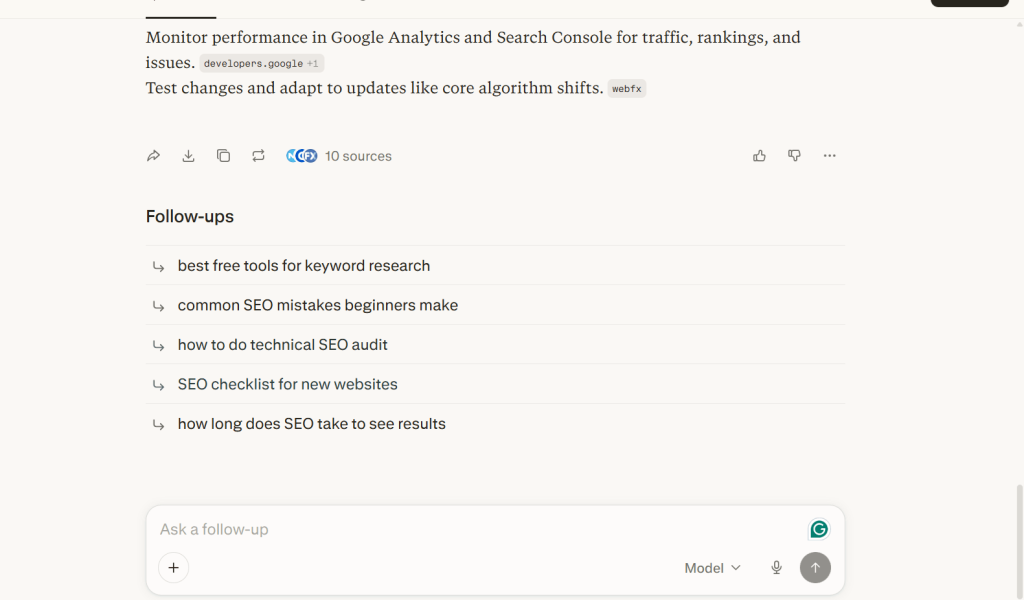
Where these questions naturally appear?
Search engines themselves reveal much of this information.
The People Also Ask section reflects related questions users commonly explore. PAA expands to 4.2 related questions per query on average. These questions often expand into clusters, showing how curiosity develops around a topic.
Search suggestions also reveal intent patterns. As users type queries, search engines anticipate common question formats.
Outside search engines, platforms like Reddit provide insight into real-world concerns. Users ask practical questions based on experience. These questions often reflect early-stage curiosity and decision-stage evaluation.
Internal site search and customer support conversations reveal similar patterns. When visitors repeatedly seek clarification on specific topics, those questions hold strong relevance.
These sources help reveal how users frame their curiosity.
Understanding how questions group naturally
Most questions follow predictable intent patterns. Some questions seek understanding. They define the topic. Others focus on process. They explore how something works. Some compare options. These help users evaluate choices.
Decision-focused questions relate to cost, timeline, or expected results. Troubleshooting questions emerge when users encounter uncertainty or problems. Answer engines frequently respond to clusters of related questions rather than isolated ones.
How this changes content focus?
Instead of targeting a broad topic alone, pages benefit from addressing the questions surrounding that topic.
For example, a page about CRM software becomes more useful when it explains what it is, how it functions, and why organizations use it.
This broader coverage allows answer engines to understand the page more completely. Over time, the page becomes more likely to appear as a source when related questions arise.
AEO keyword research expands understanding. It reveals how users and answer engines approach the topic, and how pages can align more closely with that behavior.
How to Format Content So AI Can Extract It Easily?
AEO wins live inside your page layout. The content that gets pulled into AI Overviews, Perplexity answers, or ChatGPT browsing usually shares one trait: it reads like a clean answer on first contact.
Think of it like this. AI systems scan for “answer-ready” sections. When your page gives a complete answer fast, it becomes reusable. When your page makes the reader work to find the answer, it becomes easy to skip.
So the goal here is simple: make the key answers obvious, self-contained, and easy to reuse.
The direct answer block formula
This is the most dependable pattern for getting picked up. Use it for every core question your page targets.
1) Question heading
Use the exact question a user asks.
Example heading:
What is technical SEO?
2) 40 to 60 word answer
Put a complete answer immediately below the heading. Keep it tight. Keep it factual. Make it stand alone.
Example answer block:
Technical SEO improves how search engines crawl, interpret, and index a website. It focuses on page speed, crawl access, internal linking, canonical signals, XML sitemaps, and structured data. When these pieces work cleanly, search engines understand pages faster and show them more reliably in search features and AI answers.
3) Expanded explanation
Now deepen the idea in 2–3 short paragraphs. This part adds context and detail for humans.
Example expansion topics:
- What crawl access means in practice?
- Why internal linking helps discovery?
- Where indexing issues show up in Search Console?
4) Example
End with a quick example that feels real, like a scenario you would see on an actual site.
Example:
A site publishes a service page on “Dental Implants.” The page opens with a clear answer block for “How long does implant healing take?” Then it adds a simple timeline list and an FAQ. Google starts showing the healing timeline in PAA. Perplexity starts citing the timeline section during “implant recovery” queries.
That four-part pattern keeps answers easy to lift and easy to trust.
Question-based heading system
Headings act like signboards. They tell AI exactly what question each section answers.
So you want headings that match how people search and how they prompt AI tools.
Bad heading: Features of ERP software
Better heading: What features should ERP software include?
Now the intent becomes crystal clear. Your page aligns with real prompts.
Here are a few quick conversions that work well:
ERP implementation steps → How does ERP implementation work step by step?
CRM benefits → Why do businesses use CRM software?
Schema markup guide → What is schema markup and how does it work?
When your headings look like real questions, your page creates more extraction entry points.
Content blocks that increase citation probability
Certain page elements get cited more often because they package information cleanly.
Definition blocks
A short definition near the top removes ambiguity fast.
Example:
Schema markup is structured data added to a webpage that helps search engines interpret content and display enhanced results such as FAQs, product details, ratings, and event info.
Why it works: it gives a complete explanation in one grab.
Step-by-step lists
Processes show up constantly in AI answers because they convert complexity into sequence.
Example:
How to add FAQ content to a service page?
- Pick 6–10 buyer questions from PAA and support tickets
- Answer each in 2–3 sentences
- Place the FAQ near the decision section
- Add FAQ schema and validate
Why it work?
Steps extract cleanly and read well inside AI summaries.
Comparison tables
Comparisons are citation magnets because users ask comparison questions all day.
Example table idea:
- ERP vs CRM
- Self-hosted vs cloud ERP
- Service A vs Service B
Why it works?
Tables turn evaluation into clear differences, which AI tools reuse easily.
FAQ blocks
FAQs multiply your “answer inventory” on a single page.
Why it works?
Every Q&A pair becomes a separate answer candidate, so one page can win many prompts.
Internal linking setup for answer authority
Answer engines care about topic depth across your site. A single page can perform well. A connected topic cluster tends to perform better over time because the site signals consistent coverage.
The clean pattern here is hub and spoke.
Hub page covers the main theme.
Example: Technical SEO
Spoke pages cover the major questions around it. Example spokes
- What is schema markup?
- How does crawl budget work?
- How do canonical tags work?
- How does internal linking help indexing?
Link spokes back to the hub and link spokes to each other where it makes sense. This builds a clear topic network that answer engines can understand quickly. Over time, the site becomes a familiar source for that subject area.
Schema Markup and Technical Setup for AEO
Schema helps search platforms interpret your page elements with higher confidence. When your page already uses clean answer blocks, schema adds explicit labeling that improves how those blocks get understood across search features.
Keep schema focused. A few types create most of the lift.
Essential schema types
| Schema Type | Best Use Case | Where It Helps |
|---|---|---|
| FAQ Schema | Any page that includes a real FAQ section. | PAA visibility, rich results eligibility, and clearer Q&A extraction. |
| HowTo schema | Guides that explain a process, setup, checklist, or workflow. | Step-based answers and process extraction. |
| Article schema | Editorial content, guides, research pages, thought leadership. | Clearer page classification, stronger content metadata, improved context signals. |
| Organization schema | Site-wide brand identity and entity clarity. | Brand association, consistency across knowledge systems, and cleaner entity matching. |
Implementation workflow
A simple workflow keeps this clean and repeatable:
- Identify the page that already answers important questions.
- Add clear Q&A blocks and step lists where they fit naturally.
- Apply schema to the exact sections that match the schema type.
- Validate using a schema validator and rich results testing tools.
- Deploy and submit for indexing where relevant.
- Monitor impressions, PAA appearances, and AI citation patterns over time.
Schema works best when the page already presents crisp answers. Pair the two, and the page becomes far easier to reuse across AI answer surfaces.
Off-Page Signals That Influence AI Citations
Answer engines rarely rely on a single page in isolation. They cross-check information across multiple sources. When your brand appears repeatedly in relevant places, confidence increases, and your pages get selected more often.
Brand mentions play a quiet but powerful role. If industry blogs, directories, podcasts, or newsletters reference your brand while discussing a topic, answer engines start associating your name with that subject.
For example: When several marketing blogs mention a specific agency while discussing “dental SEO,” AI tools begin recognizing that agency as part of that topic ecosystem.
Expert citations strengthen this further. If your insights appear in interviews, guest posts, or research roundups, those references reinforce credibility. When answer engines scan the web and see your explanations repeated or referenced elsewhere, they treat your content as corroborated information rather than an isolated claim.
Digital PR accelerates this effect. Publishing research reports, contributing expert commentary, or getting quoted in industry publications creates external validation. Even a well-referenced LinkedIn article or niche industry feature can help establish an association between your brand and specific topics.
Consistency also matters. Your business name, website, author profiles, and organization details should appear consistently across platforms. This helps answer engines connect all mentions back to the same entity.
When multiple trusted sources reference the same brand and topic combination, answer engines gain higher confidence using that brand’s explanations when generating answers.
How to Measure and Track AEO Performance?
AEO performance shows up differently compared to traditional SEO. Traffic alone rarely reflects the full picture. The reason is that visibility inside answers acts as the primary signal.
Featured snippets offer the clearest indicator. Snippets grab 8.6% of clicks from <1% of SERP space. When your page appears inside definition boxes or People Also Ask answers, it confirms that search engines recognize your content as answer-ready.
AI citation tracking requires direct testing. So search your core questions inside ChatGPT, Perplexity, and Google AI Overviews. Watch which pages appear as sources. And over time, you will notice certain pages getting referenced repeatedly.
Search Console provides another valuable signal. Pages that receive strong impressions for question-based queries often influence answers even when click volume remains steady. Rising impressions paired with stable rankings usually indicate these pages have higher answer visibility.
Brand search volume also reflects growing influence. When users begin searching your brand name alongside topics you cover, it often means your content shaped earlier AI-generated explanations.
Together, these signals reveal how frequently your content participates in answer generation.
The New Reality: Pages That Explain Clearly Become the Sources AI Repeats
Every answer you see inside Google AI Overviews, ChatGPT, or Perplexity comes from somewhere. Those systems select the expertise that already exists on Google (or let’s say web!).
- They select the pages that explain topics cleanly.
- They select the pages that answer questions directly.
- They select the pages they encounter repeatedly across the web.
That selection process decides which brands shape understanding inside millions of searches and AI conversations every day.
This shift is already visible in Search Console. Impressions are rising, rankings are holding and yet CTR is falling. The page still influences the answer, even when the user never visits the site.
That influence compounds over time.
- A clear service explanation can shape how buyers understand your offering before they contact anyone.
- A well-written guide can become the explanation repeated across AI tools.
- A comparison page can frame how users evaluate options across an entire category.
This is where AEO creates long-term leverage.
- It turns your content into reference material.
- It turns your pages into answer sources.
- It turns your site into part of the infrastructure AI systems rely on.
Sites that adapt early begin appearing again and again across answers. Sites that ignore it remain visible, but rarely shape the explanation itself.
The opportunity remains wide open. But the problem is, most sites still publish pages built only for rankings, not extraction.
Remember, when your pages answer questions clearly, reinforce topic depth, and present information cleanly, answer engines begin returning to them repeatedly.
And once that happens, your content stops competing for attention. It becomes part of the answers themselves.
Wrapping Up
AEO is one of the most important and yet, the most neglected marketing and branding strategies today. AI is here to stay, and it’s changing the search behavior across devices.
People don’t want to search for a topic and find the relevant answer on Google. They want direct answers, and that’s exactly what Answer Engines are doing right now.
So if you too want your website to appear in citations and mentions, you have to optimize its using AEO strategies. It might sound complex, but we have already discussed and derived that it’s not!
You won’t have to reinvent the wheel. All you have to do is make some minor tweaks here and there, and you are good to go. And if you liked this image, you can explore our website for more details on the same.
FAQs
What is Answer Engine Optimization in simple terms?
Answer Engine Optimization prepares your content so AI tools and search engines can use it directly when answering user questions. It focuses on clear explanations, question-based headings, and answer-ready sections.
Does AEO replace traditional SEO?
AEO builds on traditional SEO. Rankings still matter, but answer inclusion adds another layer of visibility. Pages that rank and explain clearly influence both search results and AI responses.
Which pages benefit most from AEO?
Educational blog posts, service explanation pages, comparison pages, and product guides often perform well because they answer specific questions users frequently ask.
How long does it take to see AEO results?
Google AI Overviews, ChatGPT browsing, Perplexity, Gemini, and voice assistants all pull answers from web pages that present clear explanations and reliable topic coverage.

Read more from SEO