
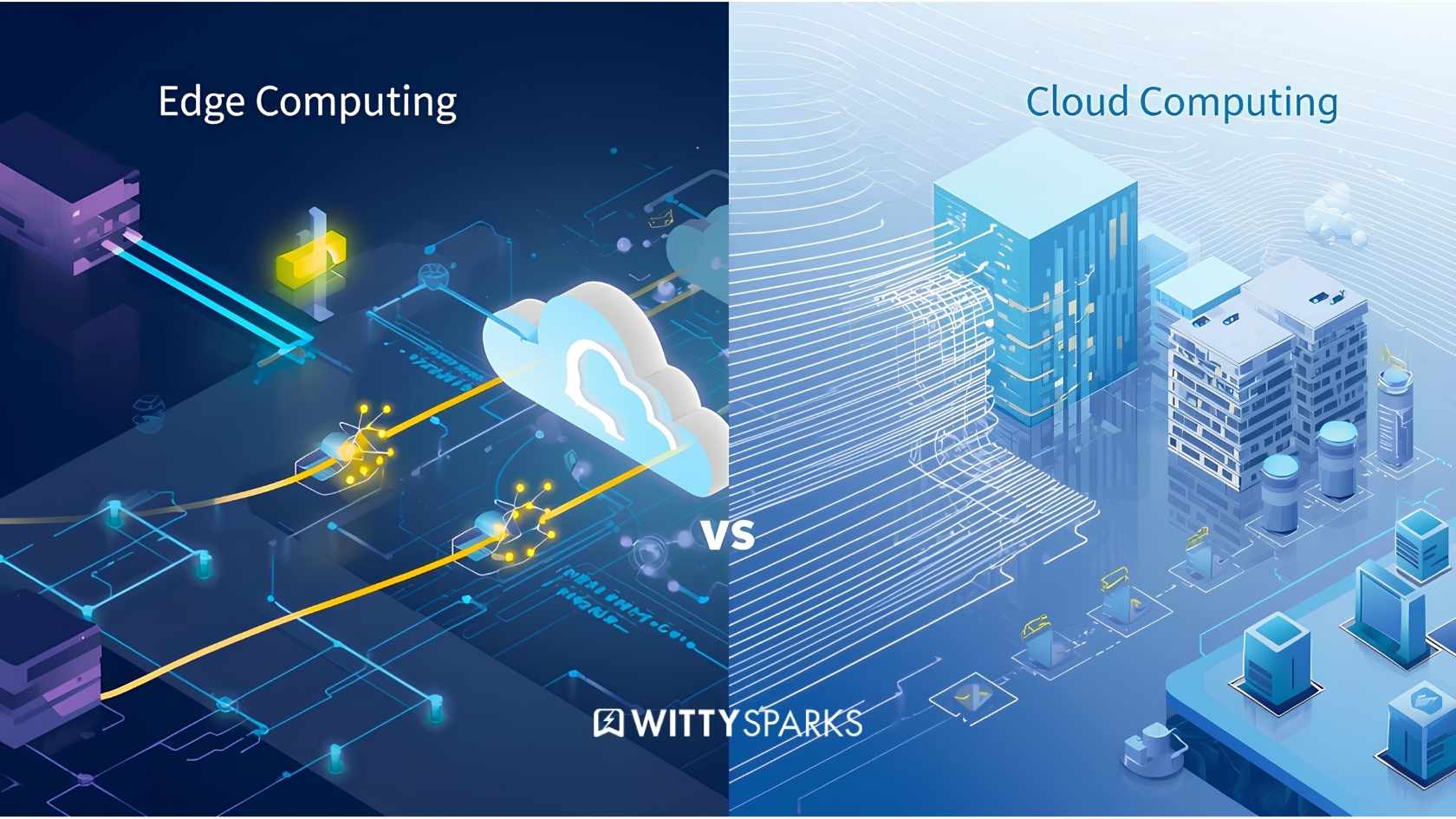

Choosing between edge and cloud isn’t a philosophical debate, it’s a systems design decision that affects cost, latency, reliability, security, and how quickly you can ship new capabilities.
Most businesses don’t need to pick one forever. The best architecture is often a blend of cloud for scale and centralized intelligence, and edge for real-time responsiveness and local autonomy.
Still, when leaders ask “edge or cloud?”, what they usually mean is: Where should computation happen to best serve our product and operations? This article provides a practical way to think through Edge Computing vs Cloud Computing and choose the right approach for your business.
On this page
Edge Computing vs. Cloud Computing: Key Differences for Businesses
Cloud Computing
Cloud means compute and storage run in centralized data centers, accessed over the internet or private networks. It’s ideal for elastic scaling, centralized data processing, shared services across teams and regions, and rapid experimentation and deployment.
This is the foundation of most cloud Computing for businesses today, especially when paired with managed services.
Edge Computing
Edge means compute happens closer to where data is generated, which is on devices, gateways, local servers, factory floors, retail stores, vehicles, or telecom nodes. It’s ideal for low-latency decisions, offline or unreliable network conditions, privacy constraints (data stays local), and localized processing at high volume.
Edge isn’t a replacement for cloud. It’s a placement strategy for specific workloads.
When Cloud is the Better Default?
For most organizations, the cloud remains the best starting point. Here’s why.
1. Speed to build and scale
Cloud platforms make it easier to provision infrastructure, ship updates, and scale globally without hardware procurement. Modern cloud infrastructure services provide:
- Managed databases and caches
- Autoscaling compute
- Observability tooling
- Security controls and identity services
This is a big reason enterprise cloud solutions are attractive as they reduce time spent on undifferentiated infrastructure work.
2. Centralized data and analytics
If your value comes from aggregating data across users, devices, or regions, cloud is the natural home:
- Analytics warehouses/lakehouses
- Machine learning training pipelines
- Enterprise reporting
- Cross-system integrations
Centralization simplifies governance, monitoring, and auditing.
3. Easier integration with SaaS and enterprise systems
CRMs, ERPs, payment systems, marketing stacks, and identity providers are usually cloud-connected. Cloud computing reduces friction for API integrations, event-driven workflows, and business process automation.
This is a core advantage of cloud computing services when you need to orchestrate multiple systems.
4. Operational simplicity (relative to edge)
Running distributed edge infrastructure at scale is hard because it covers patching, monitoring, device management, and physical constraints. Cloud shifts much of that operational burden to providers and managed services.
When edge makes more sense?
Edge is worth prioritizing when the physical world and real-time constraints dominate.
1. Ultra-low latency requirements
If response time must be milliseconds, which is too fast for a round trip to cloud, edge wins:
- Industrial safety systems
- Robotics control loops
- AR/VR and computer vision feedback
- Real-time trading adjacent systems (in certain contexts)
- In-vehicle decisions and driver assistance patterns
The closer compute is to the signal, the faster the decision.
2. Unreliable or expensive connectivity
Edge is critical when connectivity is intermittent or costly:
- Mining sites, offshore facilities, remote logistics routes
- Aircraft, ships, trains
- Rural deployments
- Retail systems that must run even during internet outages
Cloud-only architectures can fail in these conditions.
3. Data privacy, sovereignty, or sensitivity constraints
Some data should not leave a location, such as regulated video feeds, patient or industrial proprietary data, security camera analytics, and highly sensitive operational telemetry.
Edge processing can keep raw data local while sending only aggregated insights to the cloud.
4. High-volume sensor data
Video, industrial telemetry, and IoT streams can be massive. Shipping everything to cloud increases bandwidth costs and latency. Edge can filter, compress, and pre-process data:
- Detect anomalies locally
- Send only relevant events
- Reduce noise and cost
The Reality: Most Businesses Should Use Both
The most practical answer to Edge Computing vs Cloud Computing is usually: “both, with clear boundaries.”
A common and effective pattern:
Edge does real-time detection and decisions, data filtering and aggregation, local fallback operations during outages, and privacy-preserving pre-processing.
Cloud does centralized storage and analytics, model training and fleet-wide learning, orchestration and policy enforcement, cross-region dashboards and reporting, and enterprise integrations and automation.
Think of edge as the “local reflex,” cloud as the “global brain.”
Closing Thought
The best way to decide Edge Computing vs Cloud Computing is to stop thinking in absolutes and start thinking in workloads. Cloud remains the best default for most cloud computing for businesses, especially when speed, scale, and integrations matter.
Edge becomes essential when latency, offline resilience, privacy, and high-volume local processing are the true constraints. In 2026, the “right” answer for many businesses is hybrid: edge for real-time action, cloud for global intelligence, connected by secure, well-governed cloud infrastructure services and an operational model that can manage both.
About the contributor
Harris Anderson is a strategic content writer at Seasia Infotech, specializing in crafting insightful and engaging blogs on cutting-edge topics such as software development, AI, and web development.

Read more from Technology