

Online furniture shopping has come a long way since the days of grainy catalog photos. Shoppers can now compare hundreds of products in minutes, read peer reviews, and check delivery timelines before making a shortlist.
Key Takeaways:
- 3D visualization helps shoppers evaluate furniture beyond flat product photos.
- Buyers can inspect angles, materials, finishes, and variations more clearly.
- Better product understanding reduces uncertainty around size, fit, and appearance.
- Retailers can improve engagement, conversion potential, and buyer confidence.
- Accurate 3D assets can help reduce expectation gaps and encourage repeat purchases.
Despite that, there often remains a gap between what shoppers see online and what arrives at the door. According to the NRF, U.S. retail returns totaled $849.9 billion last year, with online channels recording a 19.3% return rate.
Within the eRetail segment, furniture remains one of the trickiest categories to buy online because what buyers see and what’s delivered have to match in terms of aesthetics, look & feel, and, most importantly, fit the actual space.
3D furniture visualization has emerged as a trusted practice to close that gap. By replacing static furniture photos with interactive 3D models, retailers can give shoppers the visual confidence they would normally only get from a showroom visit.
Below is a closer look at where online furniture shopping falls short, how 3D furniture rendering services address each pain point, and what this shift changes for retailers.
On this page
The Challenges in Online Furniture Shopping
Furniture purchases involve more uncertainty than most online products because buyers must judge scale, finish, comfort cues, and room compatibility from a screen. These gaps do not always prevent shoppers from browsing, but they often slow decision-making and create hesitation before checkout.
1. Size and Proportion are Hard to Assess
Photos rarely communicate scale accurately. A loveseat shot in a styled showroom can look generously proportioned online and arrive looking noticeably smaller than expected.
Dimensions in inches appear on the page, but most buyers do not translate those numbers into a mental picture of how the piece will fit between their existing armchair and the window.
2. Material and Finish Clarity is Limited
A flat image cannot reliably convey the difference between brushed and polished brass, top-grain and bonded leather, or matte and satin lacquer.
Shoppers want to assess texture, sheen, and grain before they commit, especially at higher price points where the finish itself is much of what they are paying for. Standard product photography flattens these differences into a single carefully lit angle.
3. Variety Makes Decision-Making Complex
Most furniture lines ship in multiple fabrics, finishes, leg styles, and modular configurations. Static photography forces shoppers to mentally compose combinations the gallery does not show, often leading to indecision or a delayed purchase.
A buyer who likes the sofa silhouette but is unsure about the leg finish has no real way to test the question short of ordering it.
4. Room Fit Remains a Key Concern
Even when a buyer likes the product, they want to know whether the dimensions and silhouette will work in their actual living room or the intended space. Moreover, as furniture returns are expensive both in reverse logistics and in buyer friction, this uncertainty often stops the purchase before it starts.
How 3D Furniture Visualization Makes Product Evaluation Easier?
Well-executed 3D furniture visualization directly addresses each of the four pain points above, and that is where the practical case for 3D furniture modeling services begins.
1. Allows for 360-Degree Product Inspection
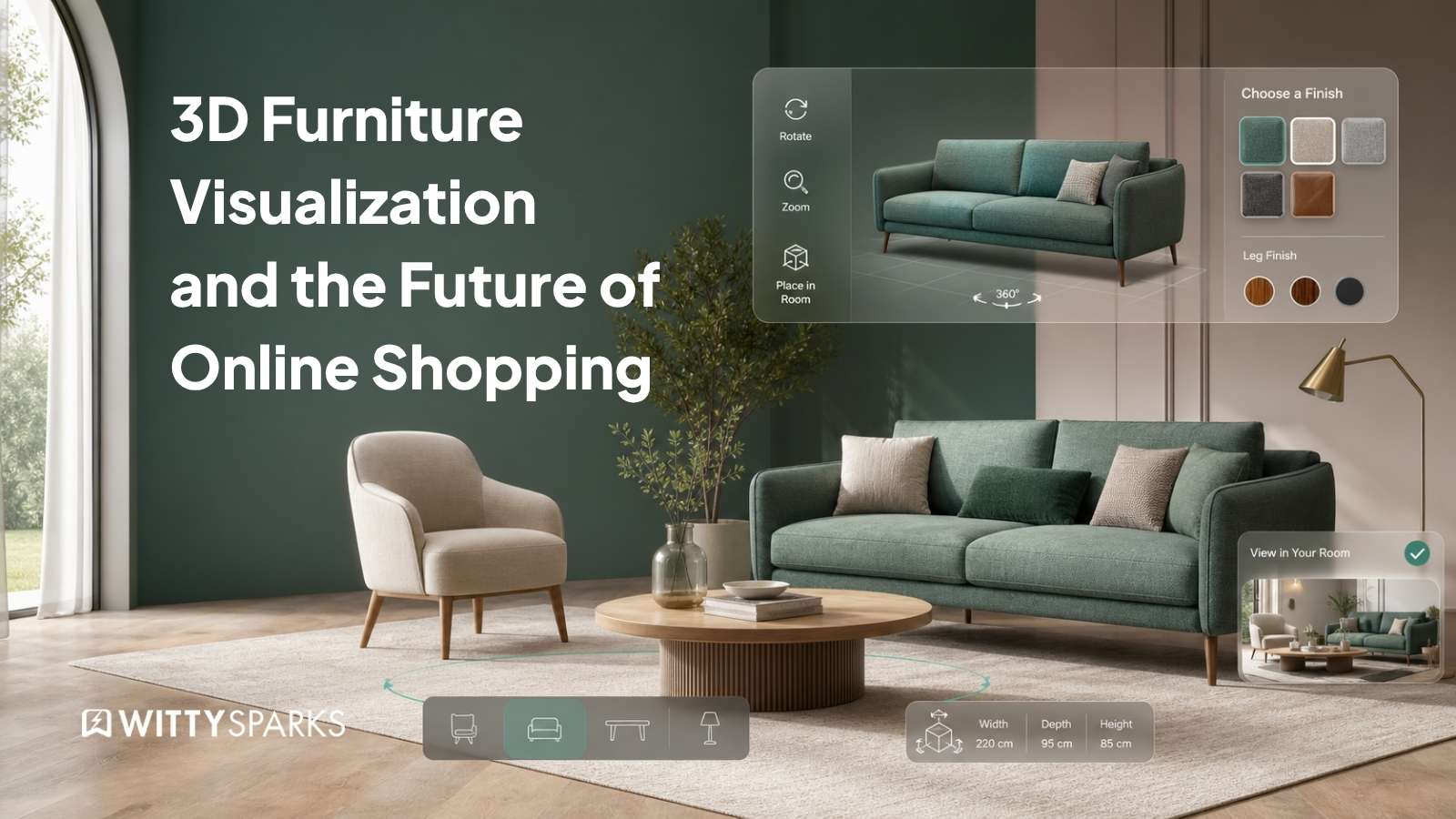
Shoppers can rotate a 3D model, zoom into a corner stitch, and study the back of a piece they will eventually push against a wall. This level of control feels closer to an in-store inspection. It helps answer practical questions that flat photography often misses, such as whether the legs flare outward or how the cushion seams are placed.
2. Enables Clearer Detail and Finish Evaluation
3D models built from real material references can render fabric weave, wood grain, metal sheen, and stitching with photographic fidelity. Buyers can see how light moves across a velvet cushion or how a herringbone tweed actually reads at a one-foot distance rather than from a styled overhead shot.
This is where 3D vs. traditional furniture photography produces the most visible difference for shoppers: when they zoom in, they see the same thing they would if they walked up to the piece in person.
3. Facilitates Real-Time Comparison
With 3D furniture rendering, organizations can display a single product page display every fabric, leg style, and configuration on demand. Consequently, instead of scanning a grid of 12 near-similar thumbnails, a shopper can customize the 3D model to explore the exact version they want and watch it update in real-time.
For modular pieces and made-to-order lines, this is often the difference between a decision and an abandoned cart.
4. Better Scale and Placement Understanding
Accurate 3D visualization helps buyers understand scale, proportion, and placement more clearly before purchase. The buyer sees the piece at true scale against the actual wall, beside the actual rug, or in the actual light.
Few features close the “will it work in my space” question more directly, and the same underlying 3D asset can be used in different ways across the product page, the AR view, the room planner, and the marketing imagery in parallel.
What This Means for Furniture Retailers?
The benefits of 3D furniture rendering are not abstract. They show up in the metrics retailers already track week to week.
Better Product Pages, Higher Engagement
Static gallery pages reward a glance. 3D pages reward exploration. Shoppers who can rotate, customize, and examine a product in detail spend more time with it. That interaction can influence purchase behavior.
Shopify’s 2026 retail conversion guidance notes that shoppers who interacted with 3D models were 44% more likely to add an item to their cart and 27% more likely to place an order.
But this only works when the 3D asset is built with retail accuracy in mind. Furniture models need correct dimensions, realistic material mapping, consistent lighting, and optimized file sizes.
For large catalogs, the challenge becomes even sharper because every sofa, chair, bed, table, and finish variant must stay visually consistent across product pages, configurators, and marketing assets.
This is where 3D product modeling and rendering services can help. Many furniture retailers lack in-house 3D artists, rendering infrastructure, material-mapping expertise, and quality control workflows needed to produce accurate models at catalog scale.
Professional 3D furniture modeling can help them fill these resource gaps, manage large SKU volumes, maintain visual consistency, and create retail-ready 3D assets without slowing internal teams.
Higher Buyer Confidence, Better Conversions
When buyers can inspect details, compare options, and visualize a product before checkout, they are less likely to postpone the decision. This matters most in furniture, where second-guessing kills more sales than pricing does. A buyer who has already “seen” a sofa in their living room has done most of the emotional work of owning it, and checkout becomes a much shorter conversation.
Fewer Expectation Gaps, Lower Abandonment
Cart abandonment in furniture retail is tightly linked to uncertainty about size, color, and fit. Baymard Institute’s 2026 aggregation of 50 studies puts the average global cart abandonment rate at 70.22%, and home and furniture sit among the higher-abandonment verticals because the category requires more confidence than a photo can convey. Clearer visuals up front mean fewer shoppers step away to “think about it” and never return.
Better Post-Purchase Experience, More Repeat Buyers
The most expensive return is the one that erodes trust. When a sofa arrives looking like what the buyer saw on screen, they are far more likely to leave a positive review and come back for the matching armchair.
The same NRF and Happy Returns report found that 71% of consumers are less likely to shop with a retailer again after a poor experience, which makes accurate visualization a loyalty lever, not just a conversion tool.
Ending Note
In a category where the gap between online expectations and in-home reality has always been wide, 3D furniture visualization is doing useful work. It helps shoppers understand size, finish, and fit before they reach the checkout button, and it helps retailers move past the limits of traditional furniture photography.
The real value, though, is not in the visuals themselves. It is in facilitating the better purchase decisions that shoppers can make when they can finally see a product the way they would in a showroom: from every angle, in every configuration, and in their own space.

Read more from eCommerce