
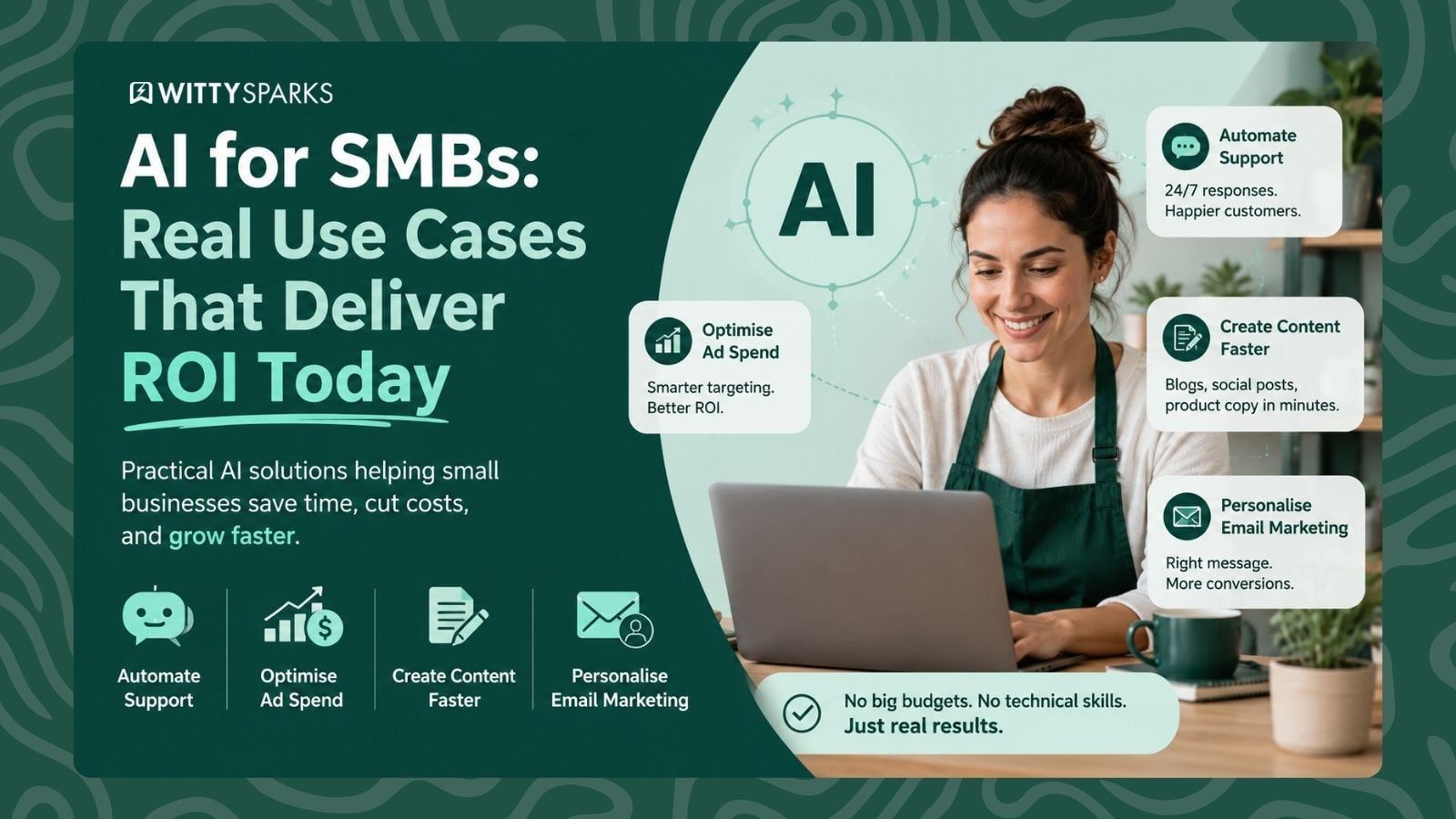

Key Takeaways:
- Most AI tools for small businesses cost under fifty dollars a month and require zero coding knowledge.
- AI-powered customer support pays for itself fastest by handling repetitive enquiries around the clock.
- Combining AI ad optimisation with human expertise beats either approach used alone.
- Email personalisation driven by AI lifts open rates, click-throughs, and revenue per subscriber.
- Predictive analytics helps SMBs forecast cash flow, flag at-risk customers, and prioritise leads.
- Starting with one pain point and expanding gradually beats overhauling everything at once.
If you run a small business, nobody would blame you for tuning out every time someone mentions AI. The hype has been relentless. And for the longest time, the actual tools behind that hype were expensive, complicated, and clearly built for companies with dedicated tech teams. Not for a plumbing business with eight employees or a local café trying to fill seats on a Tuesday night.
What caught a lot of people off guard is how quickly the pricing collapsed. Tools that charged enterprise rates two years ago now offer monthly plans cheaper than a decent lunch. Dashboards that used to need a developer to configure? Drag-and-drop. Your office manager could set one up between meetings.
On this page
None of what follows is theoretical. These are use cases where small businesses are already getting measurable returns, without needing big budgets or technical backgrounds.
Your support inbox is eating your team alive
This is where most small businesses should start, because the payoff shows up embarrassingly fast.
Think about how many hours your team burns every week answering the exact same questions. Where is my order? What are your hours? Do you ship to this postcode? Nobody on your team went through a job interview hoping to type “your order is on its way” forty times a day. Yet here they are, doing exactly that.
Platforms like Tidio, Intercom, and Drift now handle this entire layer surprisingly well. And no, these are not the embarrassing chatbots from 2019 that answered “how do I return this?” with “thanks for reaching out!”
These newer tools actually digest your past support conversations, learn your tone, and figure out which questions they can resolve solo versus which ones need a human being who can think on their feet.
Here is what most business owners do not expect, though. The real payoff is not faster replies. It is what your team does with the hours they get back. Suddenly people who were drowning in “where is my tracking number” requests are solving the genuinely tricky problems that build customer loyalty.
Morale shifts. Turnover drops. The numbers on a support dashboard improve, sure, but the mood in the office changes too.
Stop lighting your ad budget on fire
Running paid ads manually is a spectacular way to waste money, and most small business owners learn this lesson with their wallets. The usual story goes something like: you target an audience that “feels right,” you write a headline at 11pm because that is when you finally had five minutes, and then life happens.
Three days pass. You check the dashboard. Half the budget went to clicks from people who had zero intention of buying anything. Sound familiar?
AI changes that equation entirely. The software does not get distracted by a supplier crisis or a sick kid at home. It checks performance constantly, reallocates spend toward whatever is converting, and tests creative variations at a pace no human team could match.
Twenty different headlines running against twelve audience segments, all before breakfast. Try doing that manually with a to-do list and a prayer.
Where things get particularly interesting is the overlap between AI tools and experienced human strategists. Service businesses in competitive local markets have found that working with a team who understands paid advertising for niche industries produces meaningfully better returns than automation alone.
The algorithm handles speed. The humans handle judgement. That pairing keeps winning.
The content treadmill does not have to be this painful
Blog posts. Social updates. Emails. Video scripts. The queue never empties, does it? Every small business owner knows this feeling. You publish one thing and three more are already overdue.
AI does not make that queue vanish, but it shrinks the time each piece takes to produce by a shocking amount. Rough drafts that used to consume a whole morning appear in minutes. Topic research that meant crawling through Reddit threads and competitor sites for half a day now takes a few clicks.
Got a decent 2,000-word blog post? One tool can chop it into five LinkedIn posts, three email snippets, and a Twitter thread before you finish your second coffee.
Already doing design work? The Canva ecosystem now bundles AI-powered background removal, headline suggestions, and layout generation directly into the editor. No extra subscriptions. No bouncing between six browser tabs.
One genuine warning, though. Never publish raw AI output and call it done. Let it handle the structure and grunt work, then go back and inject the specific, slightly messy, distinctly human voice that makes your brand sound like actual people. Readers spot templated content from three paragraphs away.
Your email list deserves better than batch-and-blast
Here is a question worth sitting with: if email marketing consistently delivers the highest ROI of any digital channel, why do so many businesses still blast the same generic message to their entire list on a random Tuesday and wonder why nobody opens it?
The gap between emails people delete and emails people act on almost always boils down to two things: did it arrive at the right moment, and did it say something relevant? AI handles both of those without you needing to hire a dedicated email strategist.
Send times adjust per subscriber based on when they actually check their inbox. Subject lines get stress-tested against historical open data. Segmentation splits your list so that a loyal repeat buyer and a first-time browser get entirely different messages, without you manually sorting anyone.
For anyone still finding their feet with this channel, building a strong foundation in email marketing first makes the AI layer dramatically more powerful. Think of it this way: great strategy plus AI equals outstanding results. No strategy plus AI equals automated mediocrity.
Mailchimp handles the basics well enough for most businesses starting out. ActiveCampaign is worth graduating to once you want branching workflows and conditional triggers that go beyond simple drip sequences.
Klaviyo stays the obvious choice for e-commerce, particularly Shopify stores where personalisation needs to touch every step from browse to checkout.
The crystal ball most SMBs never bother picking up
Predictive analytics draws the most blank stares on this list, yet it might deliver the most long-term value. When people hear predictive modelling, they picture PhD statisticians hunched over whiteboards. The reality is far less dramatic. You feed historical business data into a tool, and it spots patterns that help you anticipate what comes next.
Real example: a retail business notices their bestseller sells out every March. Except last year it sold out in February because a local event drove unexpected traffic. A predictive tool would have flagged that demand spike two weeks early. Or take customer churn. Someone who used to order monthly just skipped two cycles. The system notices and alerts you before they switch to a competitor.
Fathom connects to Xero and QuickBooks for financial forecasting. Float maps cash flow visually on a timeline. HubSpot tackles lead scoring and pipeline predictions. Years of business intuition built these instincts in you already. These tools just hand that intuition a magnifying glass and some hard numbers.
Where to actually begin?
Not everywhere at once. Seriously. That is the single fastest way to burn out on AI before it even has a chance to prove itself.
Here is a better approach. Think about your week. What task makes you groan every Monday morning? Customer replies? Ad management? Content? Whatever it is, that becomes your first experiment.
Grab a free trial, spend a week getting comfortable, and measure one thing for thirty days. Did it save time? Did leads go up? If yes, keep it. If no, cancel and try something else.
Then pick the next annoyance and repeat.
Businesses that get real mileage from AI are the ones that stay boring about it. They pick a problem, test a solution, measure the outcome, and move on. No grand overhaul. No twelve-tool implementation plan. Just steady, practical experimentation.
AI will not rescue a business with broken fundamentals. But for SMBs that have their house mostly in order and want a genuine edge? The tools are there, the price tag is negligible, and the barriers that kept small businesses locked out three years ago are gone. The only real question is timing.
Article by: Ned Mehic, founder of Orkkid.

Read more from Business