

Key Takeaways:
- Define your audience clearly before creating anything
- Validate demand before building your product
- Always start with a simple MVP before enhancing the product
- Use a reliable platform like Payhip to manage selling
- Focus on user experience
- Also, focus on the after-sales experience
- Build trust through content before selling
Thousands of businesses, freelancers, and creators are selling smart solutions in the form of ebooks, templates, and software. This is considered a great passive income source.
If you have a product idea that can simplify complex tasks for your audience, do not look at this as passive income. This can be your automated business. All you need to know is how to sell digital products online in 2026.
On this page
The digital landscape has completely changed over the last few years. Thanks to AI, people are exploring more and more digital products. Hence, the process has to match the pace of 2026. I have curated a detailed guide to selling digital products online in a smart way. Simple steps, no clutter, even a non-tech-savvy person can do it. Let’s explore.
Before we learn how to sell digital products online, let’s first understand what needs to be checked before your final product launch.
Checklist Before You Start to Sell Digital Products Online
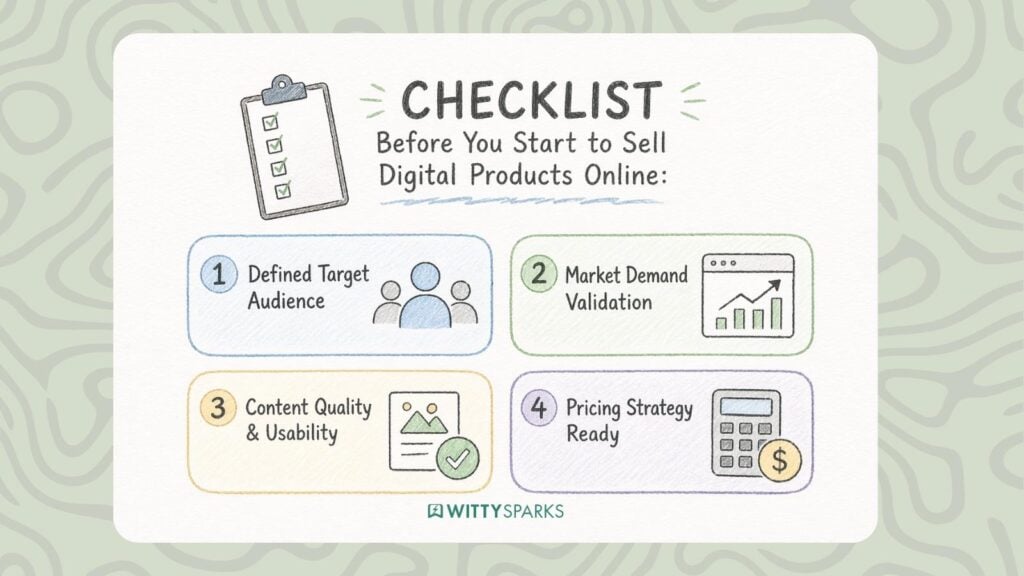
Before you jump into selling, take a step back. A little clarity at this stage can save you weeks of confusion later. Here’s a quick checklist to make sure you’re actually ready:
1. Defined Target Audience
One of the biggest mistakes people make is trying to sell to everyone. Be specific. Is your product for students, working professionals, business owners, or creators?
The clearer your audience, the easier it becomes to sell. Because your messaging, content, and positioning will directly speak to them.
2. Market Demand Validation
Always check if people are looking for a solution to their problem. Even if your product has great features, it doesn’t mean people will buy it. Check if demand already exists:
- Search your topic on Google or YouTube
- Read comments and questions
- Explore platforms like Reddit or marketplaces
If people are already searching for solutions, you’re on the right track.
3. Content Quality & Usability
Your product doesn’t need to be lengthy. It needs to be useful. Check if it’s user-friendly. Let’s say your target audience is boomers; your UI and copy must be so easy that even a school child can easily access it.
Ask yourself:
- Is it easy to understand?
- Can someone actually implement it?
- Does it save time or effort?
A simple, actionable product will always perform better than a complex one that confuses users.
4. Pricing Strategy Ready
Pricing is not just a number. It’s an important element in defining your product’s positioning. If you price too low, people may not take it seriously. If you price too high without justification, conversions will drop.
Study similar products, understand the value you’re offering, and price it in a way that feels justified to your audience.
How to Sell Digital Products Online in 2026 (Step-by-Step Guide)?
Now that your basics are clear, let’s get into the actual execution. Here’s a practical, no-fluff process to sell digital products online in 2026:
Step 1: Create a fully-functioning MVP
You don’t need a perfect product to start selling. Your digital product should do its main job perfectly. Rest can be added gradually.
Launch a simple version to get started with:
- E-book instead of a full course
- Webinars instead of a complete educational series
- Basic template instead of a full system
- Short guide instead of a long program
MVP helps in entering the market faster. You can also treat it like a prototype to test the functioning and get real feedback. Such feedback helps in improving the real product.
Another important benefit of launching an MVP is increased brand awareness. Once people trust your product to solve their biggest challenge, you can offer other related solutions.
Step 2: Set Up Your Digital Store
Payhip – Sell courses and digital downloads
Payhip, a digital storefront helps to sell digital downloads and courses.

This is where your idea turns into an actual business. To sell digital products efficiently, you need a platform that doesn’t just host your product but helps you convert visitors into buyers without adding complexity.
I have tried multiple platforms and found Payhip to be the best. Since I have tried and tested it, I would recommend Payhip.
It gives you a complete system to launch and scale, without needing a developer or technical setup. You can upload your digital products, set pricing, and start selling almost instantly. Whether it’s ebooks, templates, courses, memberships, or even software with license keys, everything can be managed in one place.
What makes it powerful in 2026 is its focus on conversions and global accessibility. With a customizable checkout experience, support for Apple Pay and 100+ payment methods, and integrations across multiple international gateways, you’re not limited by geography or payment barriers.
Beyond just selling, Payhip also helps you grow. You can run time-based offers with countdown timers, create advanced coupon strategies, cross-sell related products, and even allow customers to gift your products. These features directly impact how much you earn from each visitor.
It also supports collaborations, where you can partner with other creators and automatically split revenue. This opens up a completely new way to scale without increasing your workload.
On the operational side, everything is streamlined. From automated delivery and tax handling to customer management, review responses, and even customizing post-purchase experiences, the platform takes care of the backend so you can focus on building and marketing your product.
Simply put, instead of managing multiple tools, you get a single system that is built to help you launch faster, sell smarter, and grow consistently.
Step 3: Create a High-Converting Product Experience
Uploading your product is easy. Making people buy it is the real game. Your product is not just the file you sell. It is the entire experience around it. Start with clarity so that the user instantly understands what the product does, who it is for, and what result the user will get.
Next, make it easy to trust you. Add previews, samples, or a small free version if possible. When people can see what they’re getting, they don’t hesitate.
Also, think beyond the product. The post-purchase experience matters just as much. A clean download page, clear instructions, and a smooth onboarding flow can turn a one-time buyer into a loyal customer.
You can use Payhip, where you can customize your product pages and even control what users see after purchase. This gives you the flexibility to guide your customers properly instead of just delivering a file.
Step 4: Drive Targeted Traffic to Your Product
Even the best digital product will not sell if no one sees it. At this stage, your focus should shift from creation to visibility. But instead of trying everything, be strategic about where you show up.
Start by identifying where your audience already spends time. If you are targeting professionals, LinkedIn works well. For creators or younger audiences, Instagram and YouTube are more effective.
The goal is not to push your product directly. It is to build trust first. It’s important to show subject matter expertise. Develop regular content that solves small problems, shares insights, and shows real case studies. When people start seeing value in your content, they naturally become curious about your product.
As traffic starts coming in, your system should be ready to convert. This is where having a structured platform like Payhip helps, because once someone clicks, the buying experience is already optimized.
Conclusion
When you learn how to sell digital products the right way, you are not just building a side income. You are building a scalable, automated business that can grow over time. Start with a good strategy. Right from launching your MVP to designing a perfect landing page.
Start simple, stay consistent, and improve as you go. And most importantly, don’t wait for perfection. Launch, learn, and refine.
Featured image is created using ChatGPT.

Read more from Business