

The digital economy doesn’t wait. Markets shift overnight, customer expectations evolve faster than most annual plans can anticipate, and the technologies that gave your competitors an edge six months ago may already be table stakes today.
For business leaders navigating this environment, the instinct is often to focus on speed, move fast, launch quickly, and iterate constantly. But speed without financial clarity is just expensive chaos.
On this page
What actually separates businesses that grow sustainably from those that burn bright and collapse is something far less glamorous than product innovation or marketing genius.
It’s disciplined, adaptive financial planning, the kind that connects where you’re spending money to where you want the business to go, and then adjusts in real time when reality doesn’t match the forecast.
This article is about building that kind of financial foundation. Not the theoretical kind that lives in a spreadsheet no one looks at after Q1, but the practical kind that helps you make smarter decisions under uncertainty, allocate resources to what actually moves the needle, and grow in a way that doesn’t hollow out the organization in the process.
1. Align Financial Planning with Business Objectives
Define Clear Digital-era Strategic Goals
There’s a meaningful difference between a business with goals and one with a plan to fund those goals. Many organizations spend considerable energy crafting vision statements and digital transformation roadmaps, then manage finances in a completely separate track, almost as if the two functions operate independently.
They don’t, or at least they shouldn’t. To bridge this gap, embed digital initiatives into your financial planning process to ensure each project aligns with strategic objectives and budget allocations.
The starting point is to get specific about what success looks like in quantifiable terms. The SMART framework, Specific, Measurable, Achievable, Relevant, and Time-bound, has been around long enough that it risks sounding like a management cliché. But it’s worth revisiting because most digital goals still fail this basic test.
For example, Instead of vague aims like ‘improve digital presence,’ set measurable targets such as ‘increase online revenue by 20% in 12 months while maintaining customer acquisition costs.’ This clarity helps you build precise KPIs and track progress effectively.
These targets need to be anchored in real market data, not aspiration. If your industry is seeing 8–12% annual growth in digital revenue among mid-size players, a 20% target is ambitious but defensible.
A 50% target with no corresponding investment plan is a fantasy. Being honest about this distinction early saves an enormous amount of organizational pain later.
Map Financial Resources to Key Initiatives
Once you have clear goals, the next step is connecting money to actions. This sounds obvious, but many organizations still allocate budgets based on historical spending patterns rather than strategic priorities. The result is that high-impact digital initiatives end up underfunded, while legacy systems and processes continue to consume resources out of habit.
A more effective approach uses a phased funding model tied to performance checkpoints, encouraging your audience to feel confident in flexible, accountable investments.
The financial artifacts supporting this approach, cash flow models, budget templates, and rolling forecasts should be living documents, not annual deliverables. Build forecasts, budget templates, and cash flow models to allocate capital to high-impact projects such as e-commerce outreach platforms and automation tools.
When revenue trends shift or a major platform investment underperforms, these documents should be updated immediately, and KPIs should be monitored continuously to enable rapid decision-making and maintain financial agility.
One area that leaders sometimes overlook in this planning process is personal financial health. Running a growing business is consuming, and it’s easy to defer decisions about retirement savings or personal financial planning indefinitely.
But building those considerations into your broader financial picture matters both for individual security and for founders and executives with stable personal finances, who tend to make less desperate decisions when the business faces pressure.
2. Build a Flexible Budget for Digital-era Growth
Rigid annual budgets were designed for a world that changed slowly. In the digital economy, they’re a liability. A business that locked in its marketing budget for the year in January is not well-positioned to respond when a new customer acquisition channel opens up in June, or when a competitor makes a move that changes the competitive calculus entirely.
Flexible budgeting isn’t about abandoning financial discipline; it’s about building discipline that accounts for the fact that conditions will change. The organizations that do this well tend to share a common characteristic: they treat their budget as a hypothesis rather than a commitment.
Rolling Forecasts and Scenario-based Budgeting
Rolling forecasts update on a regular cycle, monthly or quarterly, rather than being fixed for the year. This means the business always has a current view of its financial position, not a view that was accurate nine months ago. The practical benefit is that decisions about reallocation happen continuously, based on current data, rather than in a single high-stakes annual planning cycle.
Scenario-based budgeting builds on this by asking “what if” across a range of plausible futures. The key variables worth modelling typically include revenue growth rates, customer acquisition costs, platform performance metrics, and operational costs tied to growth assumptions. Confidently building best-case, worst-case, and base-case.
Allocating Resources to Technology and Talent
Digital transformation is expensive in two ways that are easy to underestimate. The first is the technology costs of cloud services, data infrastructure, and security, as well as the ongoing maintenance burden of building on third-party platforms. The second is talent cost, which includes both the difficulty and expense of hiring people with in-demand digital skills and the ongoing investment in keeping existing teams current.
A sound flexible budget explicitly reserves capacity for both. On the technology side, this means categorizing software investments by their expected return horizon. Some tools pay back quickly through efficiency gains, others are long-cycle investments in capability.
See this guide on key tech strategies to grow your business for a practical breakdown of how digital tools map to different growth outcomes. On the talent side, it means treating upskilling and development as capital investment, not discretionary spending. Organizations that cut training budgets in difficult quarters consistently find themselves with capability gaps at exactly the moments when capability matters most.
Zero-based Budgeting for Efficiency
Zero-based budgeting requires every expenditure to be justified from scratch, rather than inheriting its allocation from the prior year’s budget. It’s a demanding process, but it surfaces something important: in most organisations, a meaningful portion of spending has simply never been seriously questioned.
It existed in last year’s budget, got carried forward, and continues to consume resources that could be deployed more productively.
Combining zero-based reviews with rolling forecasts is particularly effective. The zero-based process ensures capital is being allocated based on current value, not historical inertia. The rolling forecast ensures that decisions made in that process stay relevant as conditions evolve.
3. Leverage Data-driven Forecasting and Scenario Planning
Analyzing Historical Performance and Market Signals
Good forecasting starts with good data, which sounds straightforward but is harder in practice than most organizations admit. Historical financial statements, sales data, customer acquisition metrics, and web analytics are rarely clean or consistent.
They live in different systems, use different definitions, and reflect different time periods. Before any meaningful analysis can happen, there’s usually a substantial data cleaning and normalization exercise required.
The effort is worth it. Clean, well-organized historical data reveals patterns that are invisible in raw, inconsistent form, such as seasonal demand peaks, the relationship between marketing spend and revenue lag, and the leading indicators that precede customer churn.
These patterns form the foundation for forecasting models grounded in how the business actually behaves, not in how someone hopes it will behave, which is essential for improving customer experience through more informed and timely decision-making.
Market signals add an external dimension to this analysis. Consumer sentiment indexes, transaction volume data, competitor pricing changes, and macroeconomic indicators all carry information relevant to how demand is likely to evolve.
Integrating these external signals with internal historical data produces forecasts that are both more accurate and more resilient. They account for the broader environment, not just internal momentum.
Developing Best, Worst, and Base-case Scenarios
Scenario planning forces an organization to think seriously about futures it would prefer to ignore. The base case reflects moderate growth and typical market conditions. It’s a useful anchor but rarely what actually happens.
The best case models favorable conditions: strong digital adoption, low churn, positive macro trends. The worst case confronts supply disruptions, cost inflation, or demand contraction.
The value of this exercise is not that any one scenario will prove accurate. The value is that it prepares decision-makers for a range of outcomes and helps the organization identify the thresholds at which its financial position becomes strained. When the worst case is mapped out in advance, the response to adverse conditions can be thoughtful rather than reactive.
Applying Predictive Analytics Tools
Traditional forecasting methods, such as regression models, moving averages, and trend extrapolation, remain useful, but they have limitations in highly dynamic environments. Machine learning approaches, including support vector machines and neural networks, can identify nonlinear patterns across high-dimensional datasets in ways that conventional models cannot.
More importantly, these tools can be updated continuously as new data arrives, especially when supported by an agent engine that continuously ingests, processes, and reacts to real-time financial and market signals, rather than being recalibrated quarterly or annually.
Integrating real-time inputs such as social media sentiment, transaction feeds, and market data enables forecasts to adapt dynamically to emerging signals. The practical constraint is that these approaches require investment in both data infrastructure and analytical capability, neither of which materializes without deliberate planning.
The ethical dimension of predictive analytics is also worth taking seriously. Models that inform financial decisions have real consequences for real people, employees, customers, and suppliers.
Maintaining transparency about how forecasts are generated and what their limitations are isn’t just good governance; it’s a prerequisite for the kind of organizational trust that allows data-driven approaches to actually influence decisions.
4. Integrate Technology and Automation in Financial Planning
Adopting Cloud-based FP&A Tools
Cloud-based financial planning and analysis platforms have become the standard infrastructure for finance teams in the digital economy, and for good reason. They centralize data that was previously scattered across spreadsheets and disconnected systems, enable real-time collaboration across geographies, and reduce the IT overhead associated with maintaining on-premises financial infrastructure.
When evaluating these platforms, a few factors deserve particular attention. Security controls and compliance certifications matter enormously, financial data is sensitive, and cloud platforms vary significantly in how seriously they treat it.
API connectivity to existing ERP and CRM systems determines the amount of integration work required. And scalability with user access management ensures the platform can grow with the organization without creating governance problems.
The real productivity gains from cloud-based FP&A come from the shift they enable: from finance teams spending most of their time compiling and reconciling data, to spending most of their time actually analyzing it. That shift requires not just the technology but the organizational commitment to use it properly.
Automating Data Collection and Reporting
Automation in financial processes serves two overlapping purposes: it reduces the time humans spend on low-value repetitive tasks, and it reduces the errors that inevitably creep into manual processes.
The combination of API integrations with sales, banking, and HR systems, robotic process automation bots, and ETL pipelines feeding a unified data warehouse can dramatically compress the time required to produce accurate financial reports.
Beyond internal systems, organizations are increasingly using solutions like a letter API to streamline document workflows, automating the sending of transactional documents, customer communications, and compliance notices at scale.
This matters for financial planning specifically because it creates visibility into physical communication costs that are otherwise difficult to track and optimize, helping finance teams identify and reduce unnecessary overnight mail costs and operational spending
The broader principle here is that every manual handoff in a financial process is both a time cost and an error risk.
Systematically identifying and automating those handoffs in data collection, reporting, document distribution, and reconciliation creates a more reliable foundation for the analytical work that actually drives decisions from payroll and reporting to customer communications, there are far more business functions you can automate with software than most finance teams initially realise.
Many organizations are also adopting AI tools for small businesses and midsize enterprises to further automate financial processes, improve forecasting accuracy, and reduce the burden on lean finance teams.
These tools have matured substantially, and the barrier to entry has dropped enough that organizations without dedicated data science capabilities can now meaningfully benefit from them.
Alongside AI and automation, investing in secure payment application development strengthens how your business receives, reconciles, and reports revenue in real time, closing the gap between customer transactions and financial planning, thereby improving both accuracy and speed.
Utilizing AI and Machine Learning Models
Finance teams are adopting AI tools at an accelerating pace. Roughly 28% of finance teams now use machine learning for quarterly forecasting, and 35% are exploring generative AI for real-time what-if analysis. These numbers are moving quickly.
Platforms like FinRobot embed AI agents directly into ERP systems, enabling budgets to adjust automatically in response to new data rather than waiting for the next human review cycle. This reflects a broader shift in how AI operates within business infrastructure, understanding how agentic AI integrates APIs, tools, and data helps finance teams evaluate which automation investments will deliver the deepest operational impact.
Leading organizations are using agentic AI to automate data ingestion, variance analysis, and narrative reporting, generating the kind of plain-language summaries of financial performance that used to require significant analyst time.
The caveat, and it’s an important one, is that as AI-generated insights become more common, the risk of stakeholders treating them uncritically increases. It’s worth putting in the effort to humanize AI-generated content, ensuring that AI outputs are reviewed, contextualized, and presented in ways that reflect genuine human judgment rather than being passed through unchanged.
An AI model can identify a variance; it typically can’t explain why it matters in the specific context of your organization, or what the right response is, given factors the model doesn’t know about.
5. Continuous Monitoring, Review, and KPI Management
Setting Digital Economy KPIs
The financial metrics that matter most in the digital economy are different from those that dominated traditional finance. Customer Acquisition Cost (CAC), total digital spend divided by the number of new customers acquired, is a fundamental efficiency metric for any business that relies on digital channels to grow.
Customer Lifetime Value (CLV or LTV), the product of average purchase value, purchase frequency, and expected customer lifespan, measures the long-term return on investment from that acquisition. Digital marketing ROI ties specific channel spend to revenue generated, enabling ongoing optimization of where the marketing budget goes.
These aren’t metrics to review quarterly. Effective digital businesses monitor CAC and CLV weekly, sometimes daily, for specific campaigns, because the signals they carry are time-sensitive. A CAC trend that’s been rising for three weeks remains manageable. One that’s been rising for three months is a structural issue.
Scheduling Financial Reviews and Variance Analysis
Consistent review cadences create accountability in ways ad hoc reviews cannot. When everyone in the organization knows that financial performance will be reviewed on a specific schedule, with specific metrics, the signal that those metrics matter becomes embedded in how teams operate.
Amazon’s approach to weekly business reviews has been widely studied. For this reason, the discipline of tracking key metrics consistently, across the organization, at a regular cadence, creates a culture where performance data is taken seriously rather than being treated as a compliance exercise.
Variance analysis templates that compare actual results against forecasts flag deviations before they compound, giving leadership the opportunity to respond while options are still available.
Updating Plans Based on Performance Data
The final step in the monitoring cycle is using what you learn to update the plan. Dashboards and automated alerts that surface KPI changes are useful, but they’re only useful if the organization has built the habit of acting on what they surface.
When CAC rises, the question is whether to reduce spend, improve conversion, or shift budget to better-performing channels. When CLV dips, the question is whether the issue is in retention, purchase frequency, or average order value.
These aren’t questions with universal answers. They’re questions that require judgment, informed by data. The financial planning process supports that judgment by ensuring the data is available, current, and presented in a form that decision-makers can actually use.
6. Innovate with ESG Metrics and Sustainable Finance
An ESG framework equips finance teams to track carbon emissions, diversity targets, and other sustainability measures alongside traditional financial metrics. Sustainable finance has moved from a niche concern to a mainstream strategic consideration faster than most business leaders anticipated.
ESG assets under management are projected to grow from $18.4 trillion in 2021 to $33.9 trillion by 2026, a trajectory that reflects both investor pressure and a genuine shift in how large institutional capital allocates. Businesses that treat ESG as a compliance checkbox are increasingly out of step with where capital is flowing.
The more substantive argument for integrating ESG into financial planning isn’t about optics. It’s about risk management. Environmental exposure regulatory risk, physical climate risk, and supply chain vulnerability have measurable financial implications that belong in scenario models.
Social metrics, including workforce retention and labor practices, correlate with operational stability. Governance quality is one of the most reliable predictors of whether an organization will manage crises effectively. These aren’t soft factors.
Incorporating ESG into Financial Goals
Embedding ESG KPIs into the budgeting process means treating carbon intensity metrics, diversity ratios, and supplier sustainability standards as budget line items rather than aspirational targets that exist outside the financial plan.
This requires finance teams to develop fluency in metrics they may not have encountered in traditional financial training, but the infrastructure for tracking and reporting on these metrics has matured significantly, and the tools to do it are accessible.
Scenario planning should explicitly incorporate sustainability investments, modelling their impact on cash flows and risk profiles over time. The argument for renewable energy investments, for example, often looks better over a ten-year horizon than over three years, which means a financial planning process focused only on short-term returns will systematically undervalue these investments.
Evaluating Green Loans, Bonds, and Subsidies
The financing landscape for sustainability initiatives has expanded considerably. Green loans, sustainability-linked bonds, and government grants are now realistic options for organizations of various sizes, not just large enterprises. Comparing interest rates, reporting requirements, and covenants across these instruments requires the same rigor as any other financing decision.
One practical factor worth monitoring: lenders reviewing sustainability-linked financing often assess overall credit health as part of their evaluation. Keeping a clear view of your organization’s credit profile using resources that let you check your credit score for free can help ensure you’re positioned to access favorable terms when the right financing opportunity arises.
Conclusion: The Discipline That Drives Durable Growth
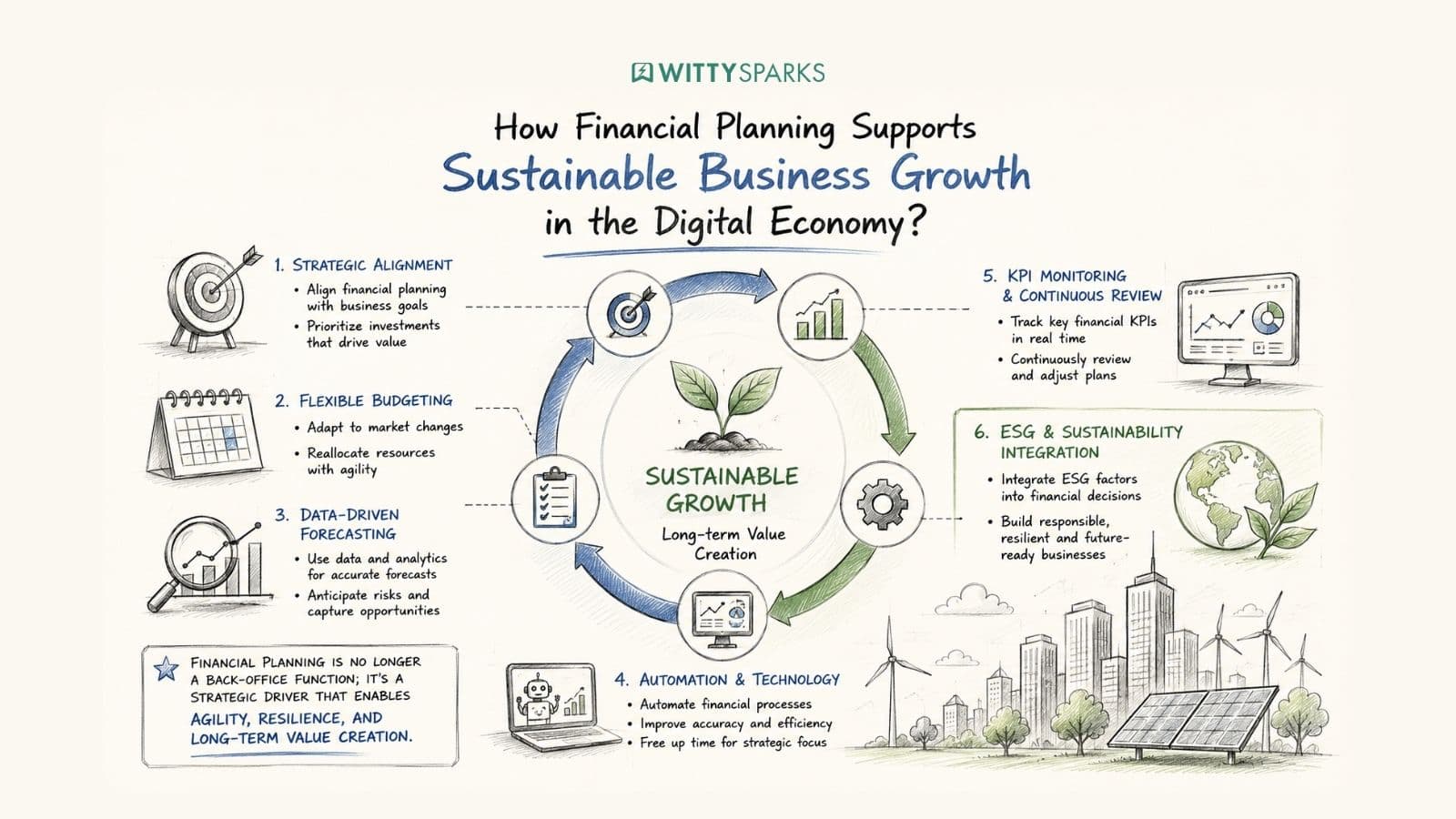
Financial planning in the digital economy is not a back-office function. It’s a strategic capability, one that determines whether an organization can actually execute on its vision or whether it will constantly find itself outpaced by faster-moving, better-capitalized competitors.
The frameworks outlined in this guide are not revolutionary in isolation. SMART goal-setting, rolling forecasts, scenario planning, and KPI monitoring are established practices. What distinguishes organizations that use them effectively is the consistency and intentionality with which they apply them, and the degree to which financial planning is integrated into strategic decision-making rather than running parallel to it.
A few things worth carrying forward:
Align your financial planning objectives with real digital-era goals using the SMART framework, and build explicit maps that link funding to high-impact initiatives. Don’t let historical spending patterns substitute for strategic allocation.
Build flexible budgets with rolling forecasts, scenario planning, and zero-based reviews so your financial plan can adapt to conditions as they develop, not as they were predicted to six months ago.
Invest in data infrastructure and analytics capability. Clean data and sound forecasting models aren’t glamorous, but they’re the foundation on which every other analytical capability rests.
Integrate cloud-based FP&A tools, process automation, and AI-driven models, thoughtfully capturing the efficiency and accuracy gains while maintaining the human judgment that gives financial insights their organizational relevance.
Monitor core KPIs continuously, review performance against forecasts consistently, and build the organizational habit of acting on what the data tells you. The monitoring cycle is only as valuable as the decisions it informs.
Finally, take ESG seriously as a financial consideration, not just a communications one. The capital flows, regulatory trends, and risk dynamics all point in the same direction. Organizations that integrate sustainability into their financial planning now will be better positioned as those pressures intensify.
The digital economy rewards organizations that move quickly, but more precisely, it rewards organizations that move quickly and intelligently. Strong financial planning is what makes intelligence possible.
Key Takeaways
- Strategy + Finance must align: Clearly defined, measurable goals should directly guide capital allocation across digital initiatives.
- Flexibility beats rigidity: Rolling forecasts and scenario-based budgeting allow businesses to adapt quickly to market shifts.
- Zero-based thinking improves efficiency: Regularly reassessing every expense prevents waste and redirects funds to high-impact areas.
- Data is the foundation: Clean, integrated data combined with predictive analytics leads to more accurate and actionable forecasts.
- Technology is a force multiplier: Cloud FP&A tools, automation, and AI reduce manual work and enhance financial insights.
- KPIs must be tracked continuously: metrics such as CAC, CLV, and ROI should be monitored frequently to inform real-time decisions.
- Action matters more than reporting: Financial insights are only valuable if they drive timely adjustments and strategic actions.
- Talent and tech need sustained investment: Cutting back on skills or infrastructure creates long-term capability gaps.
- ESG is now financial, not optional: Sustainability metrics and green financing are playing a growing role in risk management and access to capital.
- Consistency drives results: The real advantage comes from continuously applying financial discipline, not just planning once a year.
Featured image is created using ChatGPT.

Read more from Finance