
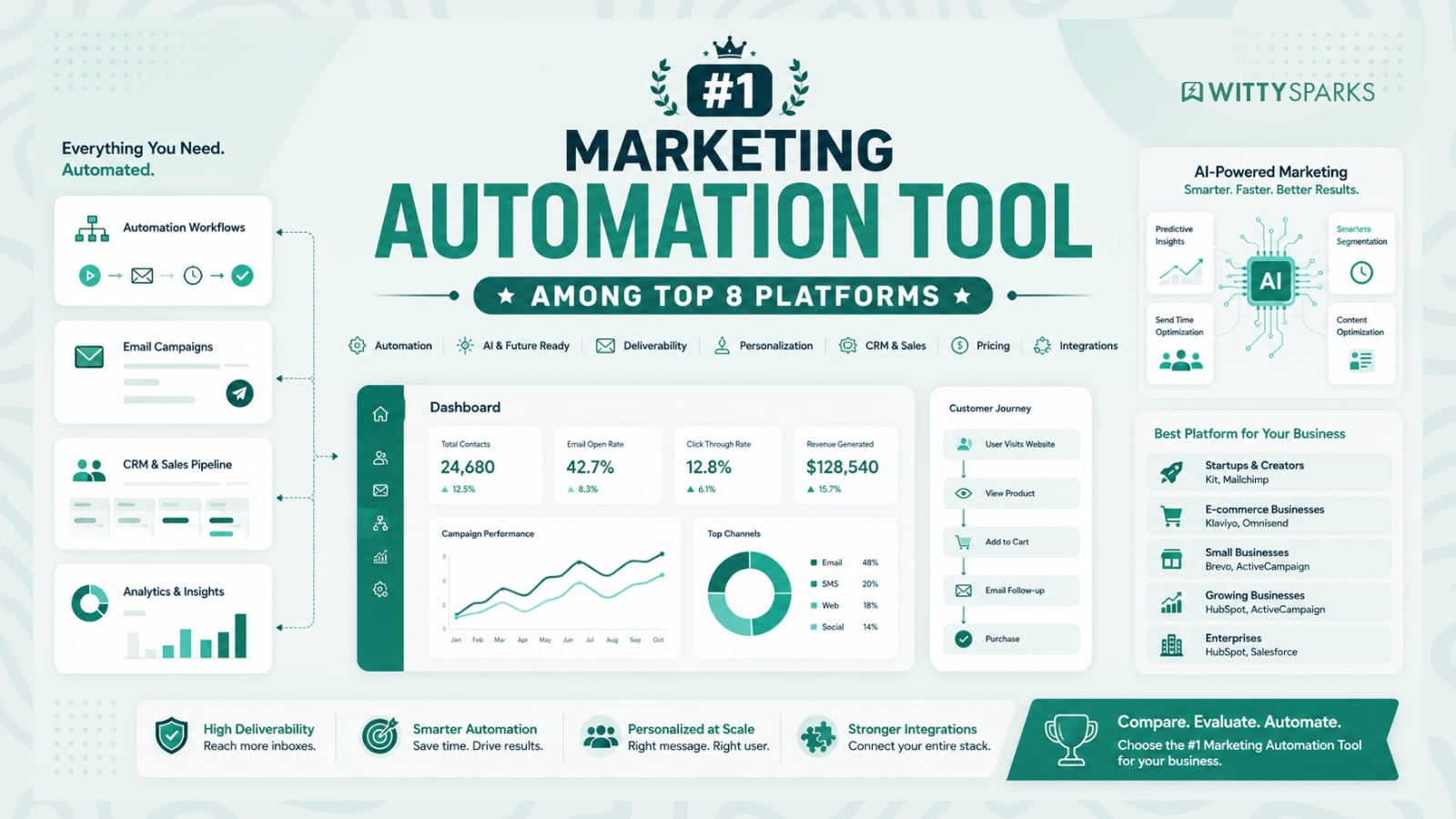

Over the last 20 years, I’ve realized that successful marketing is a combination of creativity and the right technology working together. You can run brilliant ad campaigns, but if your team is still manually following up with leads, updating spreadsheets, and sending emails one by one, you’re probably using a 2010 marketing playbook in a 2026 world.
That is why many of my entrepreneur friends often ask me the same question: Which platform should I choose for email marketing and automation?
Key Takeaways
- Different businesses need different marketing automation tools. There is no one-size-fits-all solution.
- Mailchimp is a strong choice for beginners and small teams.
- Klaviyo is particularly effective for eCommerce and Shopify-based businesses.
- HubSpot offers one of the most comprehensive CRM and business ecosystems.
- Brevo provides good value for budget-conscious businesses.
- Kit is designed specifically for creators, coaches, and newsletter businesses.
- ActiveCampaign stands out for its balance of automation, AI features, CRM capabilities, personalization, and integrations.
- AI is becoming a major factor in choosing marketing automation tools in 2026 and beyond.
- Email deliverability, integrations, and scalability are often more important than feature count alone.
- Choose a platform based on where your business will be in the next few years, not just where it is today.
On this page
Mailchimp, ActiveCampaign, HubSpot, Klaviyo, Brevo, or Kit? The honest answer is that there is no universal winner. A Shopify store has very different requirements from a SaaS company. A creator looks for different features than an agency. And a startup often evaluates tools very differently from a mature business.
So instead of crowning a single champion, I thought it would be more useful to create a practical comparison of some of the most popular marketing platforms available today. Let’s look at where Mailchimp, ActiveCampaign, HubSpot, Klaviyo, Brevo, and Kit perform well, where they have limitations, and which businesses they are best suited for.
Top 8 Marketing Automation Tools Compared for Features, AI & Pricing
1. Automation Capabilities
Marketing automation is usually the first thing business owners check when comparing platforms. Every popular tool today offers some form of automation. The real difference is not whether a tool can automate emails. The real difference is how deep, flexible, and practical that automation becomes once your business starts growing.
Mailchimp is a good option for businesses that want simple customer journeys without too much complexity. It supports automation flows with multiple triggers, branches, and actions, so it works well for welcome emails, abandoned cart journeys, re-engagement campaigns, and basic lead nurturing. For beginners and small teams, that simplicity is actually a strength.
HubSpot is also strong in automation, especially for companies that want marketing, sales, CRM, and service data all in one place. Its workflows can support serious sales and marketing operations, but the platform can feel heavy if your main need is email marketing and lifecycle automation without a full enterprise-style setup.
Klaviyo performs very well for eCommerce brands. Its flows are built around customer behavior, product data, order history, email, SMS, push notifications, and even webhooks. So if your business is strongly eCommerce-first, especially Shopify-heavy, Klaviyo is definitely a good platform to consider.
ActiveCampaign stands out when you want automation depth without making the whole system feel too enterprise-heavy. Its automation builder works with triggers, actions, goals, logic, split actions, and conditional paths, which gives marketers a lot of control over how journeys start, stop, branch, and adapt based on customer behavior.
ActiveCampaign is beyond traditional automation. Through initiatives like Active Intelligence and Autonomous Marketing, the platform is gradually moving beyond rule-based workflows. Instead of simply executing instructions, it can help marketers identify opportunities, optimize communication timing, personalize experiences, and improve campaign performance with AI-driven recommendations.
ActiveCampaign – Email Marketing and CRM
A software for customer experience automation (CXA) that combines email marketing, marketing automation, sales automation, and CRM categories.

So, if your automation needs are basic, Mailchimp can do the job well. If you want a larger CRM-led ecosystem, HubSpot is strong. If your brand is deeply eCommerce-focused, Klaviyo makes sense. But if you want flexible, behavior-based smart automation that can support marketing and sales journeys without feeling too bulky, ActiveCampaign becomes one of the strongest options in this comparison.
2. AI Features & Future Readiness
I won’t be surprised if every new or old tool launches AI features. AI is everywhere, and it is helping businesses if used properly.
- Write an email with AI.
- Generate a subject line with AI.
- Create a campaign with AI.
The problem is that many of these features feel more like add-ons than a genuine part of the platform. So when comparing marketing tools in 2026, the real question is not “Does it have AI?” The real question is “How useful is that AI in everyday marketing?”
Mailchimp offers AI-powered content generation, subject line suggestions, and creative assistance. These features can help small businesses and beginners save time while creating campaigns. If your primary goal is to speed up content creation, Mailchimp’s AI tools are fairly useful.
One of the Mailchimp alternatives for AI-based features is HubSpot. It has invested heavily in AI through its AI-powered content assistant, Breeze AI, predictive lead scoring, and customer insights. For businesses already using the HubSpot ecosystem, these AI capabilities can become valuable because they work across marketing, sales, and service operations rather than just email campaigns.
If you are an eCommerce brand and looking for HubSpot alternatives, Klaviyo is an option. Klaviyo’s AI strength comes from its eCommerce focus. It helps brands with product recommendations, predictive analytics, audience segmentation, and customer lifetime value predictions. For online stores with large product catalogs, this can significantly improve personalization and targeting.
Klaviyo – Data-Driven Email & SMS Marketing
Unlock hyper-personalized, multi-channel messaging with Klaviyo’s AI-powered email and SMS platform, designed for ecommerce and consumer brands.
ActiveCampaign is taking a slightly different approach. Instead of positioning AI mainly as a writing assistant, it is increasingly focusing on AI-powered marketing execution. Through features like Active Intelligence, predictive sending, intelligent segmentation, and autonomous marketing capabilities, the platform is trying to help marketers make better decisions, not just create content faster.
The timing of this shift is interesting. According to Salesforce’s State of Marketing report, 75% of marketers are already using or experimenting with AI in some form. The conversation has moved beyond “Should we use AI?” to “How can AI help us achieve better results?” That is exactly where platforms are now competing. [https://www.salesforce.com/news/stories/state-of-marketing-2026/]
If your primary need is AI-assisted content creation, most major platforms can help. But if you’re looking at where marketing technology is heading over the next few years, platforms that combine automation, customer data, and AI-driven decision-making are likely to have a significant advantage. After analyzing the features and comparing ActiveCampaign vs Mailchimp and ActiveCampaign vs HubSpot, ActiveCampaign offers comprehensive AI support.
3. Email Deliverability
You can build the world’s best email campaign. You can write the perfect subject line. You can spend hours designing the workflow.
But none of that matters if your emails never reach the inbox.
Deliverability is one of the most overlooked factors while choosing a marketing platform. Most businesses compare features, pricing, and automation. Very few ask the most important question: “Will my emails actually get delivered?”
ActiveCampaign vs Mailchimp: According to EmailTooltester’s deliverability tests, ActiveCampaign achieved a deliverability rate of 93.4%, while Mailchimp recorded 92.6%. Both platforms performed extremely well and consistently ranked among the strongest email marketing providers in inbox placement. [https://www.emailtooltester.com/en/blog/activecampaign-vs-mailchimp/]
For most businesses, the difference between 93% and 92% may not sound huge at first. But when you’re sending 100,000 emails every month, that gap can mean thousands of additional emails reaching actual inboxes instead of getting filtered, delayed, or lost.
Mailchimp has built a strong reputation over the years for email sending reliability, making it a trusted choice for small businesses and creators. ActiveCampaign performs equally well here and has become a preferred option for businesses that combine email marketing with advanced automation.
HubSpot, Brevo, Klaviyo, and Kit also maintain solid deliverability standards, although they are often evaluated more for their overall ecosystem rather than inbox placement alone. The reality is that most major platforms have invested heavily in deliverability because even the best automation system becomes useless if customers never see the message.
So if inbox placement is your top priority and you are looking for more than just deliverability, then one of the best Mailchimp alternatives is ActiveCampaign.
4. Personalization & Segmentation
A few years ago, personalization meant adding a customer’s first name to an email. Today, customers expect much more. They expect brands to understand what they browse, what they buy, what they ignore, and even when they are most likely to engage.
In fact, according to McKinsey, companies that excel at personalization generate 40% more revenue from those activities than average players. That explains why personalization has moved from being a “nice-to-have” feature to a business necessity. [https://www.mckinsey.com/capabilities/growth-marketing-and-sales/our-insights/the-value-of-getting-personalization-right-or-wrong-is-multiplying]
Mailchimp offers audience segmentation based on demographics, purchase history, engagement, and customer behavior. For many small and mid-sized businesses, these capabilities are more than enough to create targeted campaigns and improve relevance.
Klaviyo is particularly strong in this category because of its deep eCommerce roots. Online stores can segment customers based on browsing activity, purchase frequency, average order value, product interests, and dozens of other behavioral signals. This is one of the reasons many Shopify brands prefer Klaviyo.
HubSpot also performs well when it comes to segmentation, especially for B2B businesses. Since it combines CRM, sales, and marketing data, companies can build highly detailed audience segments using customer lifecycle stages, deal activity, engagement scores, and contact history.
HubSpot – A perfect marketing solution
One of the best software for inbound marketing and sales.

ActiveCampaign’s strength lies in combining advanced segmentation with automation. Marketers can build segments using customer actions, website behavior, campaign engagement, tags, purchase history, and custom fields, then immediately trigger automated journeys based on those segments. This makes personalization feel less like a separate activity and more like an integrated part of the marketing process.
For example, imagine two visitors downloading the same ebook from your website. One spends the next week visiting pricing pages repeatedly, while the other keeps reading educational blog content. Most businesses would send both users the same nurture sequence. Advanced segmentation allows you to treat them differently. One may be ready for a sales conversation, while the other still needs education and trust-building.
And that is really the goal of modern personalization. It is not about adding someone’s name to an email. It is about understanding where they are in their journey and communicating accordingly. So if you are looking for good Mailchimp alternatives and HubSpot alternatives that go beyond basic AI integrations, try ActiveCampaign.
5. CRM & Sales Pipeline Management
You send emails. Now what? Sending emails is one thing. Managing leads, tracking opportunities, assigning follow-ups, monitoring sales pipelines, and aligning marketing with sales is a completely different challenge.
Mailchimp does offer CRM functionality, but it is primarily designed to support email marketing and audience management. For businesses that simply want to track contacts and run campaigns, it works reasonably well. However, as sales processes become more complex, you can look for Mailchimp alternatives with deeper CRM capabilities.
HubSpot is arguably one of the strongest platforms in this category. Its CRM is at the heart of the entire ecosystem. Marketing, sales, customer service, reporting, and automation all connect to a single customer record. For companies with dedicated sales teams, this creates a very powerful setup.
ActiveCampaign bridges the gap between marketing and sales by offering a unified CRM and automation platform. This eliminates the need for expensive third-party integrations. It has features such as lead scoring, deal pipelines, automated task creation, contact tracking, and sales automation.
Brevo also includes CRM functionality, making it attractive for smaller businesses looking for an affordable all-in-one solution. Brevo vs HubSpot & Brevo vs ActiveCampaign: Brevo may not have the depth of HubSpot or ActiveCampaign, but it provides enough functionality for many growing businesses.
Brevo – Marketing for growing businesses
A marketing software that allows you to engage with your contacts, and enhance your customer relationships.

Let’s take a simple example. Imagine a prospect downloads your pricing guide, visits your pricing page three times, opens multiple emails, and requests a demo. A strong CRM system should not just store that information. It should help your team act on it. The right salesperson should be notified, the lead score should increase automatically, and follow-up tasks should be generated without anyone manually updating spreadsheets.
6. Pricing & Value for Money
Most businesses don’t look at tools as an expense, but they look at it like an investment. And such businesses scale more in less time. If a tool genuinely helps them generate more leads, improve conversions, or save time, it is worth the money. The frustration starts when pricing becomes difficult to justify as the business grows.
This is where the marketing automation market gets interesting. Some platforms are packed with powerful features but become expensive very quickly. Others are affordable but may lack the depth needed as your business scales.
Brevo is often one of the first platforms recommended to budget-conscious businesses. Its pricing is relatively accessible for small-scale businesses. If you are looking for Mailchimp alternatives, Brevo is easy to start with. But many businesses discover that costs can increase substantially as contact lists grow and advanced features become necessary. This isn’t unique to Mailchimp, but it is something many growing businesses eventually encounter.
ActiveCampaign vs HubSpot: HubSpot offers a powerful ecosystem, but it is also widely known for becoming expensive as companies adopt more hubs, users, and advanced functionality. For larger organizations, the investment may be justified. For smaller businesses, however, the total cost can become a serious consideration.
ActiveCampaign sits somewhere in the middle. It isn’t the cheapest platform in the market, but many businesses find that it offers a strong balance between automation depth, CRM capabilities, AI features, and overall flexibility without moving into enterprise-level pricing territory.
The bigger question is not “Which tool is cheapest?” The better question is “How much value am I getting for every dollar spent?”
A ₹20,000-per-month platform that saves your team 30 hours and improves conversions can be cheaper than a ₹5,000-per-month platform that forces your team to manually handle everything. That’s why experienced business owners rarely compare software only by price. They compare it by the value it creates.
7. Integrations & Ecosystem
A marketing platform is only as good as the tools it can work with. Most businesses today don’t operate from a single software. They use Shopify, WooCommerce, Salesforce, Stripe, Calendly, Zoom, Slack, Google Analytics, Meta Ads, and dozens of other applications. The real challenge is getting all these systems to talk to each other.
Mailchimp offers hundreds of integrations and covers most common business needs. For many small and medium-sized businesses, connecting an online store, website, payment gateway, or CRM is fairly straightforward. You can also explore more Mailchimp alternatives.
HubSpot has built one of the strongest ecosystems in the industry. Since many businesses already use HubSpot’s CRM, marketing, sales, and service products together, integrations often feel seamless. This is one of HubSpot’s biggest strengths.
Klaviyo focuses heavily on eCommerce integrations. Shopify, WooCommerce, Magento, BigCommerce, and other commerce platforms are deeply integrated into the platform, making it especially attractive for online retailers.
ActiveCampaign vs HubSpot: ActiveCampaign has quietly built one of the largest integration ecosystems in the marketing automation space, with 1,018 integrations available. Whether you’re connecting CRM systems, eCommerce stores, webinar tools, payment gateways, support platforms, or analytics software, chances are there is already a direct integration available.
Imagine a customer purchases a product, attends a webinar, opens three emails, and submits a support ticket within the same week. The more connected your ecosystem is, the easier it becomes to create a complete customer journey instead of managing isolated pieces of data across multiple platforms.
That’s why integrations are often overlooked during software evaluations but become one of the most important factors later. A platform may have fantastic features, but if it cannot connect with the rest of your business stack, those features become far less valuable.
8. Best Platform by Business Type
After comparing all these features, many business owners still ask the same question:
“Okay, but which one should I actually choose?”
You need to tweak the question a little. Because every business has unique requirements, and if you are a decision-maker, don’t go for the tool that’s cheap, easy, or with the most features. First, learn about your business needs and then select the right tool.
Because a Shopify store, a SaaS company, a creator, and a digital agency are all solving different problems.
If You’re a Beginner:
Mailchimp is still one of the easiest platforms to start with. The interface is clean, setup is simple, and most users can launch their first campaign without a steep learning curve. If you’re just getting started with email marketing, Mailchimp remains a safe choice.
If You Run an eCommerce Brand:
Klaviyo deserves serious consideration. It has deep integrations with Shopify and other eCommerce platforms. It is combined with strong customer segmentation and behavioral targeting. This makes it one of the most popular marketing automation tools among online retailers.
If You Need a Full Business Ecosystem:
HubSpot shines when marketing, sales, customer support, reporting, and CRM all need to work together. Many growing companies eventually reach a stage where they need more than email marketing. They need a centralized system for managing customer relationships across departments.
If Budget Is Your Biggest Concern:
Brevo offers excellent value for businesses that want email marketing, SMS marketing, basic CRM functionality, and automation without a large monthly investment. For startups and small businesses, it often delivers a lot of functionality at a reasonable price.
If You’re a Creator:
Creators who are looking for marketing automation tools, Kit is a good option. Kit was built specifically for creators, coaches, educators, authors, and newsletter businesses. Its simplicity, subscriber management, creator-focused workflows, and audience-building features make it particularly appealing for people building personal brands and content businesses.
If You Want the Most Balanced Option:
ActiveCampaign vs Mailchimp and ActiveCampaign vs HubSpot: ActiveCampaign doesn’t necessarily dominate every category. HubSpot has a stronger enterprise ecosystem. Klaviyo has deeper eCommerce specialization. Mailchimp is arguably easier for beginners.
But when you look at automation, personalization, CRM capabilities, AI features, integrations, and overall flexibility together, ActiveCampaign consistently performs well across almost every category.
And that is probably why so many growing businesses eventually end up shortlisting it. But it solves a wider range of marketing challenges without forcing businesses into a highly specialized or enterprise-heavy ecosystem.
Final Verdict: Which Marketing Platform Should You Choose?
There is no perfect marketing platform. Mailchimp is great for beginners, Klaviyo shines in eCommerce, Kit is built for creators, Brevo offers strong value, and HubSpot excels as a complete business ecosystem.
What stood out to me, however, was how often ActiveCampaign appeared near the top across multiple categories, including automation, personalization, CRM, AI capabilities, deliverability, and integrations. While it may not be the perfect fit for every business, it is certainly one of the most versatile options available today.
My advice? Don’t choose a platform based on where your business is today. Choose one based on where you want your business to be two or three years from now.
For more practical marketing insights, software comparisons, and AI trends, follow WittySparks.
Frequently Asked Questions
How difficult is it to switch from one marketing automation platform to another?
Switching platforms is easier than most businesses think, but it requires planning. Contact lists, automations, email templates, CRM records, integrations, and customer data all need to be migrated carefully. This is why businesses should evaluate not just their current needs, but also where they expect to be in the next few years before committing to a platform.
How often should businesses review their marketing automation tools?
A good rule of thumb is to review your marketing stack every 12 to 18 months. Marketing technology evolves rapidly, and features that were considered advanced a few years ago, such as AI-powered personalization and predictive automation, are now becoming standard expectations. Regular reviews help ensure your platform is still aligned with your business goals.
What is the biggest mistake businesses make when choosing a marketing automation tool?
Most businesses focus on pricing or feature count alone. The better approach is to evaluate how well a platform fits your workflows, team size, growth plans, and customer journey. A tool with hundreds of features is useless if your team struggles to adopt it, while a simple platform may become limiting as your business scales. The best choice is usually the one that balances current requirements with future growth.

Read more from Marketing