
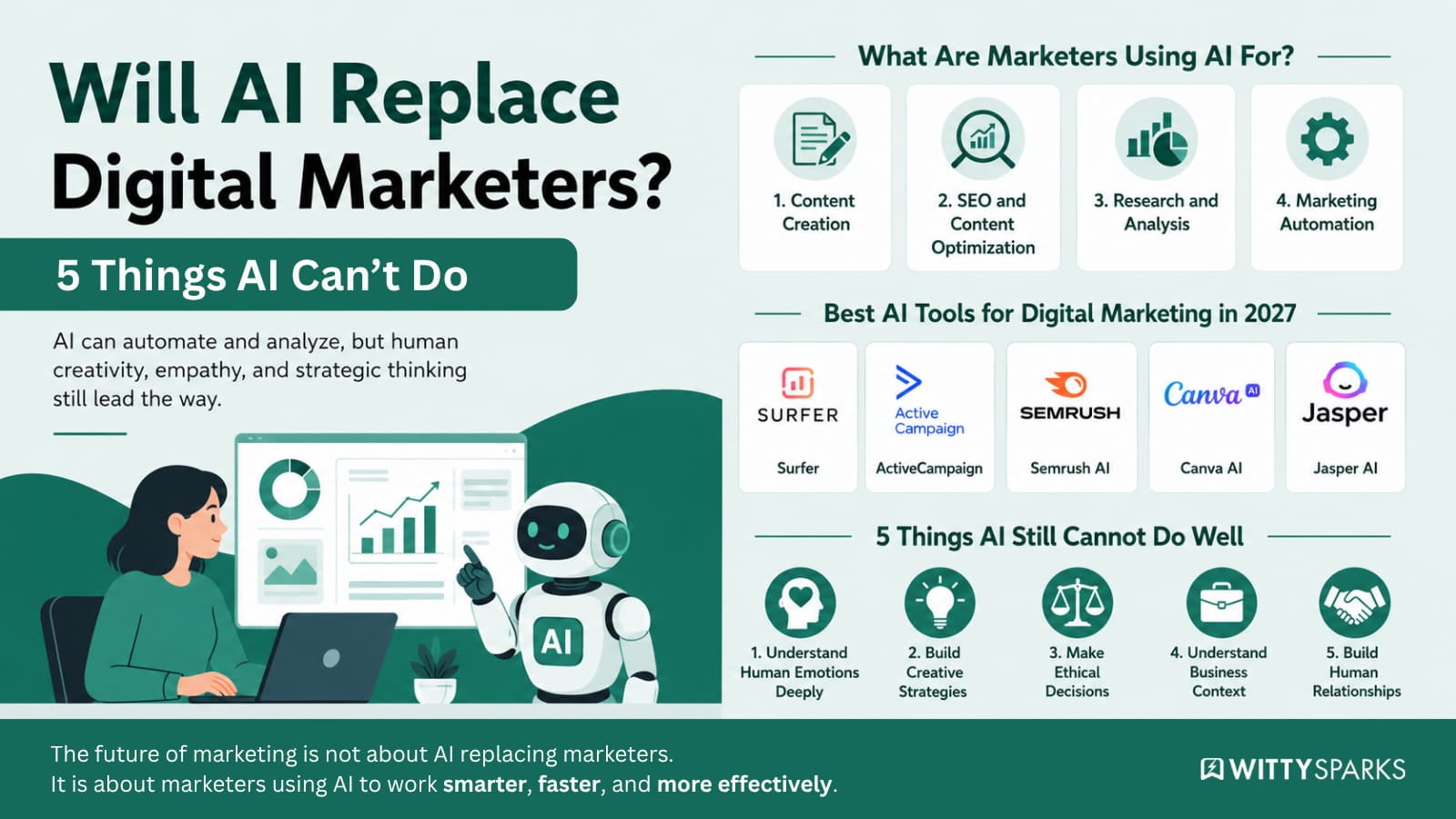

In 2024, 37% of marketers used AI daily. By 2025, that number had jumped to 60%. Most marketers now use AI for SEO and content creation. Tasks that once took hours, or even days, can now be completed in minutes with AI tools. As AI adoption continues to grow, marketers are asking an important question: Will AI replace digital marketers?
AI brings speed, convenience, and intelligence to marketing workflows. Tools like ChatGPT and Claude can handle many repetitive and time-consuming tasks with ease. But what about creativity? Can AI independently manage every aspect of marketing? Do businesses still need human expertise and strategic thinking? This blog answers these questions and explores the future of AI in digital marketing.
On this page
What Are Marketers Using AI For?
AI is already a part of the modern marketing workflow. Marketers use it to create content, optimize SEO, analyze data, conduct research, automate repetitive tasks, and generate campaign ideas.
According to a SurveyMonkey study, content optimization, content creation, brainstorming, automation, data analysis, and research are among the most common ways marketers use AI today. Let’s look at these use cases in more detail.
1. Content Creation
The fundamental pillar of any marketing campaign is content. As Bill Gates famously said, “Content is King.” Blogs, video scripts, social media posts, website copy, ad copy, and emails- almost every marketing activity relies on content. 50% use AI to create content, including blogs, social media posts, emails, and presentations.
In 2023, I was introduced to ChatGPT. It felt like a new toy, so I spent hours experimenting with it. One thing that immediately impressed me was its ability to generate crisp and coherent content. As a content strategist, my job involves conducting research, planning campaigns, executing them, and analyzing results. It didn’t take long for me to realize that AI could easily handle many basic content-writing tasks.
A good writer researches a topic, understands the industry, identifies the reader’s pain points, and communicates ideas clearly. Writers know when to simplify a complex topic and when to elaborate on it. Since AI tools have access to vast amounts of information, marketers now use them extensively for research and content generation.
Another critical marketing task is writing emails and ad copy. Marketers need messages that are persuasive without sounding overly salesy, concise without being vague, and engaging enough to drive conversions. AI is helping marketers create short, effective copy for emails, advertisements, and other marketing campaigns.
Will AI replace copywriters and content creators?
No! Though 45% use AI for brainstorming content ideas, AI is great at assisting. Though it has access to information on the internet, a good piece of content still needs that smart writing, that hook, and the ability to empathize. I honestly feel that writers should use AI as a helping hand. In fact, many companies have a new policy of no AI detection due to the monotonous writing of AI.
2. SEO and Content Optimization
SEO is another area where marketers are actively using AI. 51% use AI to optimize content such as SEO and email campaigns. Search engine optimization involves several activities, including content planning, content optimization, competitor analysis, internal linking, and content audits. AI tools can help speed up many of these tasks.
However, one common misconception is that AI can perform keyword research. In reality, AI tools can only suggest keywords based on the information they have been trained on. They do not have access to real-time search volumes, keyword difficulty scores, click-through rates, or ranking data.
For accurate keyword research, marketers still rely on dedicated SEO tools such as Ahrefs, Semrush, and Google Keyword Planner.
Once marketers identify the target keywords, AI becomes much more useful. It can suggest blog outlines, recommend related topics, identify content gaps, and help structure content around search intent.
AI can also analyze existing content and suggest improvements. It can recommend where to add keywords, improve readability, optimize headings, and strengthen content relevance. This helps marketers optimize content much faster than before.
That said, AI still cannot replace an experienced SEO professional. Search intent analysis, content strategy, backlink planning, technical SEO, and business-specific decisions continue to require human expertise. AI can assist with SEO, but it cannot own the entire process.
Will AI replace digital marketers and SEO executives?
No! AI can generate content, suggest keywords, and automate repetitive tasks, but it cannot understand business goals, customer psychology, search intent, or market dynamics the way humans can.
Successful marketing and SEO require strategic thinking, decision-making, creativity, and continuous adaptation, areas where human expertise remains essential.
3. Research and Analysis
As per a study, 40% of marketers use AI to conduct research. Research is another area where AI has become extremely useful for marketers. Whether you are studying a market, understanding customer behavior, or exploring a new industry, AI can significantly reduce the time required to gather information.
Marketers also use AI for competitor research. Instead of manually visiting multiple websites, AI tools can quickly summarize competitors’ products, positioning, content strategies, and messaging. This helps marketers understand the competitive landscape much faster.
AI is also helping marketers analyze large volumes of data. Campaign reports, customer feedback, survey responses, and website analytics often contain valuable insights. AI can identify patterns and summarize findings in a matter of seconds.
However, marketers should not blindly trust AI-generated research. AI can occasionally provide outdated information, miss important context, or make incorrect assumptions. Human validation remains essential before making business decisions.
Some of the most popular AI-powered research tools include Perplexity and NotebookLM. Marketers are also using AI-powered analytics tools such as GA4 Intelligence, Microsoft Clarity, HubSpot AI, Mixpanel, and Amplitude. These tools help identify trends, track customer behavior, analyze campaign performance, and uncover insights that would otherwise take hours to find manually.
Will AI replace digital marketers who conduct thorough research?
No! Why? The biggest reason is the lack of primary research. While writing copy for a D2C brand, I recently met my friends and asked them a few questions. I took insights from over 20 people and designed my copy strategy.
AI can’t do this. AI tools still struggle with accuracy, context, and verification. Tools like ChatGPT and Gemini can occasionally generate incorrect information, cite outdated sources, or present assumptions as facts.
4. Marketing Automation
As per the survey report by SurveyMonkey, 43% of marketers use AI to automate tasks and processes. Marketers spend most of their time performing repetitive tasks. Though tools like Mailchimp and HubSpot are leading the market, there are several tasks that still need human intervention. Marketers will relate to this point.
Marketing automation is one of the biggest reasons behind the rapid adoption of AI. Marketers are using AI to automate email campaigns, customer segmentation, lead nurturing, social media scheduling, and follow-up sequences. Tasks that once required hours of manual effort can now run automatically in the background.
AI is also helping marketers monitor campaigns and generate reports. Instead of manually analyzing hundreds of data points, marketers can quickly identify trends, spot anomalies, and understand campaign performance through AI-powered dashboards and insights.
However, automation works only when someone defines the strategy behind it. AI can decide when to send an email, but it cannot decide what the overall campaign objective should be. It can segment customers, but it cannot fully understand changing customer behavior, business priorities, or market conditions.
Will AI replace digital marketers with its automation skills?
No! AI can automate processes, but marketers still need to create strategies, define goals, understand customers, and make business decisions. AI Automation can execute a plan, but it cannot build one.
Best AI Tools for Digital Marketing in 2027
1. Surfer
Most marketers know how to create content. The real challenge is making sure people actually find it. That’s where Surfer comes in. It helps marketers plan, write, optimize, and track content from a single platform. Today, it is trusted by 150,000+ content creators, SEO professionals, agencies, and marketing teams.
Surfer – Rank Your Content With the Power of AI
A tool that merges content strategy, creation, and optimization into one process–to grow brands.
Save 20% on yearly plans.

Unlike traditional SEO tools, Surfer uses AI throughout the content creation process. It can generate content briefs, create article drafts, suggest headings, identify content gaps, recommend internal links, and optimize content in real time. This helps marketers spend less time on manual work and more time on strategy.
One of Surfer’s biggest strengths is content planning. It helps marketers build topical authority by identifying related topics, creating content clusters, and uncovering opportunities that competitors may have missed. Instead of guessing what to publish next, you get a clear roadmap backed by data.
The best part about Surfer is that it is adapting to the rise of AI search. It helps marketers track brand mentions and citations across AI platforms, monitor visibility gaps, and create content that is easier for AI systems to understand and reference.
As more people use AI tools to discover information, these capabilities are becoming increasingly important. Do you know how many times ChatGPT has suggested your brand name to its users? Do you know which keyword leads users to your website through Google AI Overview?
If you are looking for one of the best AI tools for digital marketing, Surfer is worth considering. It combines AI-powered content creation, SEO optimization, content strategy, and AI visibility tracking in a single platform, making it useful for writers, marketers, SEO professionals, and growing content teams alike. Click here for Surfer pricing details.
2. ActiveCampaign
Imagine having a marketing assistant who never forgets to send an email, follow up with a lead, update a CRM record, or nurture a prospect. That’s the problem ActiveCampaign solves. It is one of the most popular marketing automation platforms used by businesses across the world.
ActiveCampaign – Email Marketing and CRM
A software for customer experience automation (CXA) that combines email marketing, marketing automation, sales automation, and CRM categories.

At its core, ActiveCampaign helps marketers automate customer journeys. You can create workflows that automatically send emails, score leads, segment audiences, assign tasks, and trigger actions based on customer behavior. Once the workflow is live, much of the manual effort disappears.
In recent years, ActiveCampaign has added AI capabilities to make marketers even more productive. Its AI agents can help generate email content, suggest campaign improvements, create automations, and optimize customer communication. Instead of starting from scratch, marketers can use AI to accelerate execution.
ActiveCampaign is no longer just an automation tool. With Active Intelligence and AI-powered features, it can recommend actions, optimize customer journeys, and help marketers make smarter decisions. It is a great example of how AI is moving from simple automation to autonomous marketing. That said, businesses still need marketers to define objectives, understand customers, and ensure the technology is moving in the right direction.
If you are looking for one of the best AI tools for digital marketing, ActiveCampaign is a strong option. It combines AI, automation, email marketing, CRM, and customer journey management into a single platform, making it particularly useful for businesses that want to scale their marketing efforts. For ActiveCampaign pricing details, click here.
3. Semrush AI
If SEO is a major part of your marketing strategy, Semrush is a tool you simply cannot ignore. It started as an SEO platform, but today it helps marketers with keyword research, competitor analysis, content planning, rank tracking, backlink analysis, and much more.
Semrush – SEO and Marketing Tools
Get access to the top 55+ marketing tools.

Over the years, Semrush has added several AI-powered features to make marketers more productive. It can help generate content ideas, build content briefs, optimize articles, identify ranking opportunities, and uncover gaps in your content strategy.
One of Semrush’s biggest strengths is competitor intelligence. You can see which keywords your competitors rank for, where they get their traffic from, and what content performs best for them. This gives marketers valuable insights without spending hours on manual research.
Semrush is also useful for identifying problems before they impact rankings. From technical SEO issues to declining keyword positions, the platform continuously monitors performance and highlights areas that need attention.
If you are looking for one of the best AI tools for SEO optimization, Semrush is an excellent choice. It combines data, SEO intelligence, competitor research, and AI-powered recommendations to help marketers make smarter decisions. You can get pricing details for Semrush here.
Also, read: https://wittysparks.com/get-the-best-seo-solutions-with-semrush/
4. Canva AI
When people talk about digital marketing, they often focus on content writers and SEO professionals. But let’s not forget one important fact: marketers cannot do much without designers. Every social media post, presentation, ad creative, banner, infographic, and email visual depends on good design.
Canva – Design your content
A ready-made library of templates for creating graphic content.

This is where Canva AI is making life easier for design teams. Canva features like Magic Design, Magic Write, AI image generation, background removal, image editing, and design suggestions help designers create visuals much faster than before.
What makes Canva special is that it empowers both designers and non-designers. A marketer can quickly create a presentation, social media creative, or campaign mockup without waiting for a full design cycle. At the same time, professional designers can use AI features to speed up repetitive tasks and focus on creativity.
As a marketer, your job is not just to use AI yourself. It is also your responsibility to equip writers, designers, and other team members with tools that improve productivity. Canva AI is a great example of how AI can support creative teams without replacing them.
Today, Canva has evolved from a simple design platform into a complete creative workspace. Whether you are creating social media content, presentations, marketing assets, or quick design concepts, Canva AI can help your team move faster while maintaining quality. It is indeed one of the best AI tools for digital marketing that runs heavily on creative designs.
5. Jasper AI
Jasper feels less like an AI writing tool and more like a full marketing team packed into a single platform. Instead of giving you one chatbot and hoping for the best, it uses specialized AI agents that can help with planning, writing, optimizing, and launching campaigns.
Jasper – High-performance AI content generation
AI-based content creator trained by marketing experts for successful content marketing.
Rating: WittySparks 4.5, Trustpilot 4.0, G2 4.7

What I like about Jasper is that it doesn’t treat AI as a replacement for marketers. The platform is designed around human control. You set the strategy, brand voice, audience, and goals. Jasper’s agents handle the execution while staying within those guardrails.
For content teams, Jasper can take care of everything from blog posts and landing pages to email sequences, social media campaigns, ad copy, and campaign briefs. If you’re managing multiple channels, it can save a lot of time without making everything sound robotic.
Jasper has also expanded beyond content generation. It now supports SEO, AEO, and GEO workflows with tools for competitor analysis, entity mapping, content gap discovery, AI readiness scoring, and visibility optimization. That’s why many marketers consider it one of the most advanced AI marketing tools available today.
The biggest difference is that Jasper thinks in workflows, not prompts. Its agents can work together across different stages of marketing, while your team stays in control. For brands producing content at scale, that combination can be incredibly powerful. This is one of the best AI tools for digital marketers and content writers.
5 Things AI Still Cannot Do Well
1. Understand Human Emotions Deeply
AI can analyze words, patterns, and sentiment. But it still struggles to understand the emotions behind those words. It knows what people are saying, but not always why they are saying it. That’s a big limitation in marketing, where emotions often drive decisions more than logic.
For example, a marketer speaking to parents of infants, natural disaster survivors, or people who have lost their jobs brings empathy shaped by real conversations and lived experiences. AI can generate the message, but understanding the emotional weight behind it remains a distinctly human skill.
2. Build Creative Strategies
AI can generate hundreds of campaign ideas in seconds. But deciding which idea fits the brand, the audience, the timing, and the business goal is a different game altogether. Great marketing is not just about creating content. It is about making smart choices.
The best campaigns often come from connecting culture, psychology, customer behavior, and business objectives. That kind of strategic thinking still depends heavily on human judgment. AI can support the process, but marketers are the ones who decide where the brand should go next.
3. Make Ethical Decisions
Though AI is trained to follow instructions within ethical limits, it may get tricked by some overly smart users. It does not understand responsibility the way humans do. When a campaign touches sensitive topics, customer privacy, social issues, or brand reputation, someone still needs to decide what is appropriate and what crosses the line.
Marketers constantly make judgment calls that go beyond data and algorithms. They think about long-term trust, public perception, and brand values. AI can provide suggestions, but accountability will always rest with people.
4. Understand Business Context
Every business is different. A strategy that works for a SaaS company may completely fail for an IT company, school, or manufacturing firm. Successful marketers understand the industry, the customers, the competition, and the business goals before making decisions.
AI can process large amounts of information, but it does not truly understand the unique challenges, internal politics, budget constraints, or long-term vision of a business. That context often plays a major role in shaping successful marketing campaigns.
5. Build Human Relationships
Marketing is ultimately about people. It involves conversations with customers, meetings with clients, collaboration with teams, and relationships built over time. Trust is often the deciding factor behind a purchase, partnership, or long-term customer loyalty.
AI can automate communication, but it cannot replace genuine human connection. Whether it is understanding a client’s concerns, negotiating a partnership, or building a community around a brand, relationships still require empathy, trust, and human interaction.
Key Takeaways
- AI is helping marketers create content, optimize SEO, conduct research, analyze data, and automate repetitive tasks.
- AI can assist with keyword research, but marketers still need dedicated SEO tools for accurate search volume and ranking data.
- Research conducted by AI should always be validated, as AI tools can provide inaccurate, outdated, or incomplete information.
- Marketing automation tools can execute campaigns efficiently, but marketers are still responsible for strategy and decision-making.
- AI-powered platforms such as Surfer, ActiveCampaign, Semrush, Canva AI, and Jasper are transforming how marketing teams work.
- AI still struggles with human emotions, business context, relationship building, creative strategy, and ethical decision-making.
- The answer to “Will AI replace digital marketers?” is no. Marketers who learn to work with AI will have a significant advantage over those who don’t.
Conclusion
So, will AI replace digital marketers?
Based on everything we’ve discussed in this blog, the answer is no.
AI is transforming marketing at an incredible pace. It can generate content, automate campaigns, analyze data, optimize SEO, create designs, and even recommend marketing actions. These capabilities make marketers more productive and efficient than ever before.
However, marketing is much more than execution. It requires creativity, empathy, strategic thinking, ethical judgment, relationship building, and a deep understanding of business goals. These are areas where human marketers continue to play a critical role.
The future of marketing is not a battle between humans and AI. It is a collaboration between the two. Marketers who embrace AI will likely outperform those who ignore it. The real risk is not that AI will replace digital marketers.
The real risk is that digital marketers who use AI may replace those who don’t. If you want to be that smart marketer, start using the 5 best AI tools for digital marketing listed above. For more such content, follow WittySparks.
Frequently Asked Questions
Which Digital Marketing Jobs Are Most Vulnerable to AI?
Roles that involve repetitive and rule-based tasks are more likely to be impacted by AI. For example, basic content writing, simple ad copy creation, data reporting, and routine email marketing tasks can be partially automated. However, strategic, creative, and client-facing roles continue to require human expertise.
What Skills Should Digital Marketers Learn to Stay Relevant in the AI Era?
Digital marketers should focus on skills that AI cannot easily replicate, such as strategic thinking, consumer psychology, storytelling, branding, communication, and relationship building. Learning how to effectively use AI tools is also becoming an essential skill.
Can AI Create a Complete Marketing Strategy on Its Own?
AI can suggest ideas, identify trends, and recommend tactics based on available data. However, it cannot fully understand a company’s vision, market position, business goals, and long-term objectives. A successful marketing strategy still requires human judgment and decision-making.
Is It Better to Learn AI Tools or Traditional Digital Marketing First?
A strong understanding of traditional digital marketing should come first. Once you understand concepts such as SEO, content marketing, advertising, customer journeys, and analytics, AI tools become much more effective. Without marketing knowledge, it is difficult to evaluate whether AI-generated suggestions are actually useful.
Will Companies Hire Fewer Digital Marketers Because of AI?
Some companies may reduce hiring for highly repetitive roles, but demand for skilled marketers is likely to remain strong. As AI handles routine tasks, marketers can spend more time on strategy, creativity, customer experience, and business growth, making their role even more valuable.

Read more from Marketing