

In marketing, what matters the most is how your brand communicates with customers. Marketing automation helps brands scale email campaigns, automate repetitive tasks, nurture leads, and build structured customer journeys that once required massive manual effort.
But marketing in 2027 looks very different from marketing automation. Customers now expect hyper-personalized experiences, faster communication, smarter recommendations, and seamless engagement across multiple channels.
On this page
At the same time, marketing teams are drowning in dashboards, workflows, segmentation rules, optimization cycles, and endless operational tasks. Ironically, many businesses today use automation tools, yet still spend a huge amount of time manually managing the automation itself.
This is exactly why the demand for autonomous marketing is growing so rapidly. Businesses are no longer looking for platforms that simply execute instructions.
They increasingly want systems that can help optimize campaigns, predict customer behavior, recommend actions, personalize communication, and reduce operational complexity. The shift is slowly moving from “workflow automation” to “AI-assisted marketing execution.”
Some platforms, like ActiveCampaign, are already assisting businesses with personalized marketing. And while autonomous marketing is still evolving, one thing is becoming increasingly clear: in the coming years, marketers may not just compete on creativity or budget anymore. They may compete on how intelligently their marketing systems can learn, adapt, and optimize at scale.
ActiveCampaign – Email Marketing and CRM
A software for customer experience automation (CXA) that combines email marketing, marketing automation, sales automation, and CRM categories.

Studies suggest that marketers using AI-powered tools are saving nearly 13 hours every week while reducing operational expenses by an average of $4,739 per month. For mid-level enterprises to large-scale e-commerce companies, it is high time you start exploring Autonomous Marketing over marketing automation. Why? Let’s see:
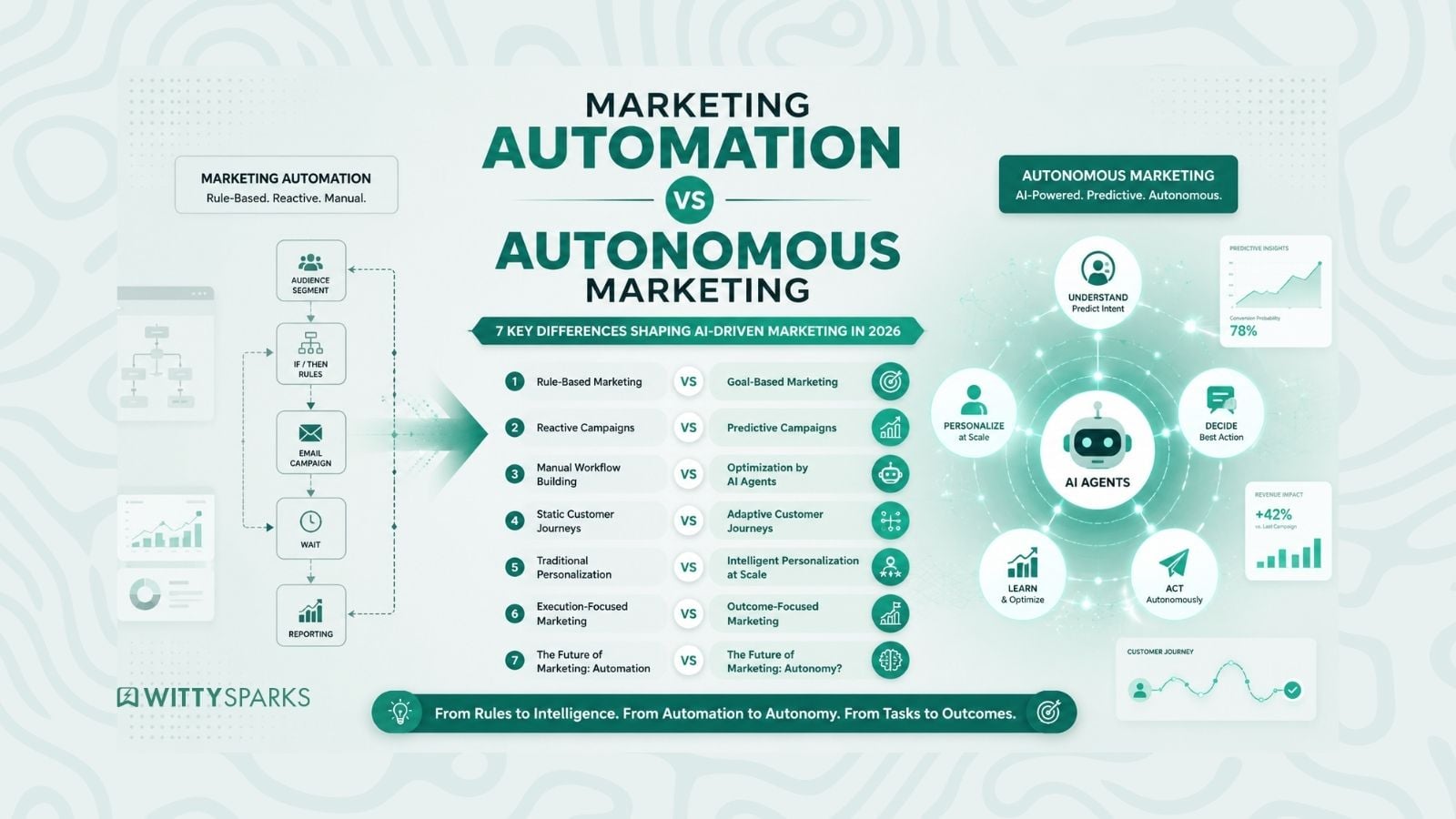
Marketing Automation vs Autonomous Marketing: 7 Key Differences
1. Rule-Based Marketing vs Goal-Based Marketing
Marketing Automation
Traditional marketing automation works on predefined rules and conditions created manually by marketers. Businesses set up workflows like “send a welcome email when a user signs up” or “send a discount coupon if the cart is abandoned for more than 2 days.” The software then follows these instructions exactly as configured.
This approach helped businesses automate repetitive marketing tasks at scale. But even though the execution became automated, marketers still had to build every workflow manually, define every condition, monitor campaign performance, and continuously optimize the system themselves.
Autonomous Marketing
Autonomous marketing shifts the focus from workflows to outcomes. Instead of manually controlling every step of the customer journey, marketers simply define the business objective itself, such as improving conversions, increasing webinar registrations, or reducing customer churn.
AI agents then design the best path to achieve that goal. Rather than simply executing instructions, this active intelligence can assist with audience targeting, campaign timing, personalization, and optimization dynamically. This is one of the biggest reasons autonomous marketing is being seen as the next evolution of traditional marketing automation.
Example
Imagine a company wants to increase webinar registrations. In traditional marketing automation, the marketing team would manually create workflows, segment users, schedule reminder emails, optimize timing, and continuously monitor campaign performance. Every step would still depend heavily on manual setup and decision-making.
In autonomous marketing, the marketer simply defines the goal: increase webinar signups. The AI agent can then identify the users most likely to register, personalize messaging for different audience groups, optimize sending times, and recommend the best follow-up actions automatically. The marketer still controls the strategy, but Active Intelligence takes care of the operational workloads.
2. Reactive Campaigns vs Predictive Campaigns
Marketing Automation
Traditional marketing automation is mostly reactive in nature. The system responds only after a customer performs a specific action. For example, an email workflow may trigger after someone opens an email, abandons a cart, clicks a button, or fills out a form. The automation reacts to customer behavior once the event has already happened.
This approach works well for structured workflows, but it still depends heavily on marketers creating conditions manually and continuously optimizing customer journeys over time. The system itself does not predict what the customer is likely to do next. It simply follows predefined instructions based on actions already completed. Such systems need complete manual intervention when an unusual condition appears.
Autonomous Marketing
Autonomous marketing introduces predictive capabilities into the process. Instead of waiting for users to take action first, AI agents can analyze engagement patterns, behavioral signals, browsing activity, and historical customer data to predict future actions and recommend smarter campaign decisions.
This allows Active Intelligence to become more proactive rather than reactive. AI can help identify high-intent users, optimize communication timing, personalize outreach dynamically, and recommend next-best actions before the customer even takes the next step.
Example
Imagine an online fashion brand preparing for a seasonal sale. In traditional marketing automation, reminder emails would only be triggered after a customer visits a product page or abandons their cart. The workflow reacts after the action has already happened.
In autonomous marketing, the marketing system, such as Active Intelligence, may identify users showing strong buying intent even before they abandon a cart. Based on browsing behavior, previous purchases, engagement history, and activity patterns, the AI-assisted platform can proactively send personalized recommendations, early sale alerts, or limited-time offers to improve the chances of conversion before the customer loses interest.
3. Manual Workflow Building vs Optimization by AI Agents
Marketing Automation
In traditional marketing automation, marketers are responsible for building almost every part of the workflow manually. From creating customer journeys and segmentation rules to setting delays, triggers, and campaign conditions, the entire structure depends on human setup and planning.
While automation platforms reduce repetitive execution work, optimization still remains largely manual. If you’ve ever used marketing automation, you’ve probably spent a significant amount of time continuously optimizing workflows just to unlock their full potential. This often leads to constant testing, tweaking, and operational workload.
Autonomous Marketing
AI has rapidly become a core part of modern marketing, with nearly 94% of marketers now integrating AI into their daily workflows. Autonomous marketing and AI agents reduce the burden of manual optimization. Yes, AI will make certain recommendations on its own to optimize your marketing campaign.
It can also optimize certain parameters automatically. Basically, it analyzes performance patterns, identifies inefficiencies, and recommends smarter optimization opportunities automatically.
AI agents can suggest better audience targeting, optimize send timing, improve campaign drip, and personalize journeys based on customer behavior. This allows marketers to spend less time managing workflows and more time focusing on strategy, creativity, and business outcomes. You can think of it as a smart assistant.
Example
Imagine a SaaS company running an onboarding email sequence for new users. In traditional marketing automation, the team would manually test subject lines, monitor engagement, optimize email timing, and adjust the workflow repeatedly based on campaign reports.
In autonomous marketing, the Active Intelligence can automatically identify which users are engaging less, determine the best timing for communication, personalize onboarding flows based on behavior, and recommend changes to improve conversion rates. Instead of manually optimizing every small detail, the marketer receives intelligent assistance throughout the process.
4. Static Customer Journeys vs Adaptive Customer Journeys
Marketing Automation
Traditional marketing automation usually follows fixed customer journeys designed manually by marketers. Once a workflow is created, every user entering that sequence experiences largely the same journey based on predefined conditions and triggers. While segmentation can make journeys more targeted, the structure itself often remains the same for all.
As customer behavior changes over time, maintaining these journeys can become increasingly complex and operationally heavy.
Autonomous Marketing
Autonomous marketing makes customer journeys feel less robotic and more responsive. Instead of forcing every user through the same fixed workflow, the system can adapt communication based on how people actually interact with your brand.
Someone highly engaged may receive deeper product recommendations, while a less active user may automatically receive lighter nudges or re-engagement content.
This creates marketing experiences that feel more natural instead of overly scripted. As AI becomes more deeply integrated into marketing platforms, brands are slowly moving away from rigid automation flows toward systems that can adjust, optimize, and personalize communication more intelligently over time.
This growing shift is one of the reasons concepts like ActiveCampaign’s Autonomous Marketing are gaining attention across many industries.
Example
Imagine an online learning platform promoting multiple professional courses. In autonomous marketing, the system can dynamically adapt the journey based on user behavior.
Someone repeatedly engaging with coding-related content may automatically receive technical webinar invites, programming resources, and developer-focused messaging, while another user interacting with branding content may receive creative case studies and marketing-focused recommendations instead.
5. Traditional Personalization vs Intelligent Personalization at Scale
Marketing Automation
Traditional marketing automation introduced basic personalization into campaigns. Businesses could segment users based on demographics, interests, purchase history, or customer actions and send targeted communication accordingly. This made campaigns feel more relevant compared to generic mass marketing.
However, most personalization still depended heavily on manually created audience segments and predefined workflows. Marketers had to continuously create separate campaigns, test messaging variations, and manually optimize communication for different customer groups.
Autonomous Marketing
Autonomous marketing takes personalization much further by using AI agents. Instead of relying only on static audience segments, the system can continuously analyze user behavior, engagement patterns, browsing activity, and intent signals to personalize messaging more intelligently.
With such systems, you can evolve customer experiences in real time based on how users interact with your campaigns, products, and content. AI-assisted personalization helps businesses deliver more contextual recommendations, smarter communication timing, and more relevant customer journeys.
Example
Let’s say a fashion eCommerce brand is promoting a seasonal collection. In traditional marketing automation, marketers may create separate workflows for men’s fashion, women’s fashion, luxury buyers, and discount-focused shoppers manually.
In autonomous marketing, the platform can continuously personalize communication based on customer behavior itself. A user frequently browsing premium products may automatically receive luxury-focused recommendations and early-access offers, while another user engaging mainly with discounted items may receive sale alerts and budget-friendly suggestions, without the marketing team manually creating dozens of separate journeys.
6. Execution-Focused Marketing vs Outcome-Focused Marketing
Marketing Automation
The primary purpose of marketing automation is to focus largely on execution efficiency, like automate repetitive tasks, such as sending emails, assigning leads, triggering workflows, or managing follow-up sequences.
The system helps marketers execute campaigns faster and more consistently. Though the automation helps with execution, the strategic optimization still depends heavily on human effort.
Autonomous Marketing
Autonomous marketing cares less about “Did the workflow run?” and more about “Did the campaign actually work?” That’s a huge shift. Traditional automation is excellent at executing instructions, but what about the performance? Autonomous marketing is a result-driven system where marketers get data-based insights and AI recommendations.
Example
Imagine a company running a webinar campaign. In an autonomous marketing system like ActiveCampaign, the focus shifts toward the outcome itself: getting more registrations. The system can automatically identify which audience segments are responding poorly, adjust communication timing, recommend better-performing messaging, and prioritize action-oriented copy. For example, “Register Now”, “Limited Seats Left”, or “20% Off for Early Birds”.
7. The Future of Marketing: Automation or Autonomy?
Marketing Automation
Marketing automation will continue to remain an important part of digital marketing because businesses still need reliable systems to automate repetitive communication and customer journeys. Email sequences, CRM workflows, lead nurturing, onboarding campaigns, and customer segmentation will continue playing a major role in modern marketing operations.
However, the expectations from marketing systems are changing rapidly. Businesses no longer want platforms that only execute instructions. They increasingly expect systems that can help optimize campaigns, improve targeting, personalize communication, and reduce operational complexity intelligently.
Autonomous Marketing
As per a report, 15% of marketers are experts in using AI agents to optimize their campaigns. Autonomous marketing represents the next stage in this evolution. Instead of replacing traditional automation completely, it builds on top of it by adding AI-assisted intelligence into campaign execution, optimization, personalization, and decision-making processes.
This is why conversations around autonomous marketing are growing rapidly across the industry. Platforms like ActiveCampaign are positioning this shift as a move from simple workflow automation toward more Active Intelligence marketing systems that actively assist marketers in achieving business goals rather than just executing predefined tasks.
Also, read How To Convert Cold Leads To Loyal Customers With Email Automation?
Key Takeaways
- Marketing automation follows predefined rules and workflows.
- Autonomous marketing focuses on achieving outcomes, not just executing tasks.
- Traditional automation is reactive. Autonomous marketing is predictive.
- AI helps optimize targeting, timing, personalization, and engagement.
- Marketers spend less time managing workflows manually.
- Human creativity still remains extremely important.
- Platforms like ActiveCampaign are driving the shift toward autonomous marketing.
- 2026 and 2027 may become defining years for AI-assisted marketing systems.
Final Words:
Marketing is entering a very strange and exciting phase right now.
For years, businesses competed on budgets, creative campaigns, and faster execution. But in 2026 and beyond, another layer is quietly becoming the real competitive advantage: how intelligently your AI agents can learn, adapt, personalize, and optimize at scale.
And no, this does not mean marketers are becoming irrelevant. If anything, human creativity, storytelling, strategy, and emotional understanding may become even more important in the AI era. The operational side of marketing is what’s changing.
Platforms like ActiveCampaign are already pushing this shift beyond typical marketing automation toward more intelligent, adaptive marketing systems.
For more insightful blogs, AI-driven marketing trends, branding insights, SEO strategies, and future-focused digital marketing discussions, follow and subscribe to WittySparks.
FAQs
Is autonomous marketing useful for eCommerce brands?
Absolutely. eCommerce businesses deal with massive amounts of customer behavior data every day. Autonomous marketing can help personalize offers, optimize timing, predict buying intent, and improve repeat purchases more efficiently.
What makes autonomous marketing different from basic AI features?
Basic AI features usually assist with isolated tasks like writing emails or generating subject lines. Autonomous marketing and AI agents focus on improving the overall marketing process through optimization, prediction, personalization, and smarter decision-making.
Will marketers need technical skills to use autonomous marketing platforms?
Not necessarily. Most modern platforms are trying to simplify AI adoption through natural-language workflows, visual automation builders, and AI agent recommendations designed for non-technical marketing teams.

Read more from Marketing