

For years, SEO was built around a fairly straightforward objective: get a page to rank on Google, earn the click, and turn that visitor into a customer.
That model is still important, but search behavior is changing.
People are increasingly asking AI systems questions instead of sorting through ten blue links. Someone looking for the best project management software, a reliable accounting platform, or a good email marketing tool may now ask ChatGPT for recommendations. Google is also placing AI-generated answers directly into search results through AI Overviews.
On this page
That creates a new challenge for brands.
It is no longer enough to ask, “How do I rank for this keyword?”
A more useful question is:
“How do I make my brand a credible answer when someone asks an AI system about my category?”
This is where AI search optimization comes in.
AI search optimization is the practice of improving a brand’s visibility across AI-powered search and answer experiences. It overlaps heavily with traditional SEO, but it also puts greater emphasis on brand authority, entity recognition, trustworthy information, structured content, third-party mentions, and the overall consistency of a brand’s online presence.
The good news is that this does not mean throwing away everything you know about SEO.
In many cases, the fundamentals remain the same. The difference is that you’re optimizing not only for a search engine’s ranking system, but also for systems that need to understand a topic well enough to generate an answer.
Let’s look at what that means in practice.
What Is AI Search Optimization?
AI search optimization refers to the process of making your website, brand, and content easier for AI-powered search systems to understand, evaluate, and potentially reference in their answers.
You may hear related terms such as Generative Engine Optimization (GEO), AI SEO, or answer engine optimization.
The terminology is still evolving, and there isn’t one universally accepted definition for each term. But the underlying idea is similar: instead of optimizing exclusively for traditional search rankings, marketers are trying to improve their chances of being surfaced in AI-generated responses.
Consider a traditional search.
A user might search: “best CRM for small businesses“
Google returns a collection of pages.
An AI assistant might instead receive: “I’m running a small business with five employees. Which CRM should I use and why?”
The expected experience is different.
The user wants an answer, not necessarily a list of links.
For a brand to appear in that answer, the AI system needs enough information to understand:
- What the company does
- Who its product is for
- What makes it different
- Whether other sources discuss the company
- Whether claims about the company appear credible
- How the company compares with alternatives
That makes brand understanding increasingly important.
Why Traditional SEO Still Matters
It is tempting to think that AI search means traditional SEO is becoming obsolete.
That’s an oversimplification.
A technically sound website, useful content, strong internal linking, relevant keywords, good user experience, and authoritative references can still provide an important foundation.
AI search doesn’t exist separately from the broader web ecosystem.
Managing that structure manually across dozens of posts gets tedious fast. Jason Tan shared how he built AI agents to automate internal linking, using a custom workflow that parses his archive sitemap, identifies contextual opportunities, and connects older posts directly to his latest articles without wasting weekends on manual updates.
AI systems need information to understand companies, products, industries, and topics. Much of that information comes from web content and other publicly available sources.
So the goal shouldn’t be to choose between SEO and AI search optimization.
Instead, think of AI search optimization as an extension of a strong SEO and brand strategy.
Traditional SEO asks:
Can search engines discover and rank this page?
AI search optimization adds another question:
Can AI systems understand this brand well enough to confidently include it in an answer?
That distinction changes how you approach content.
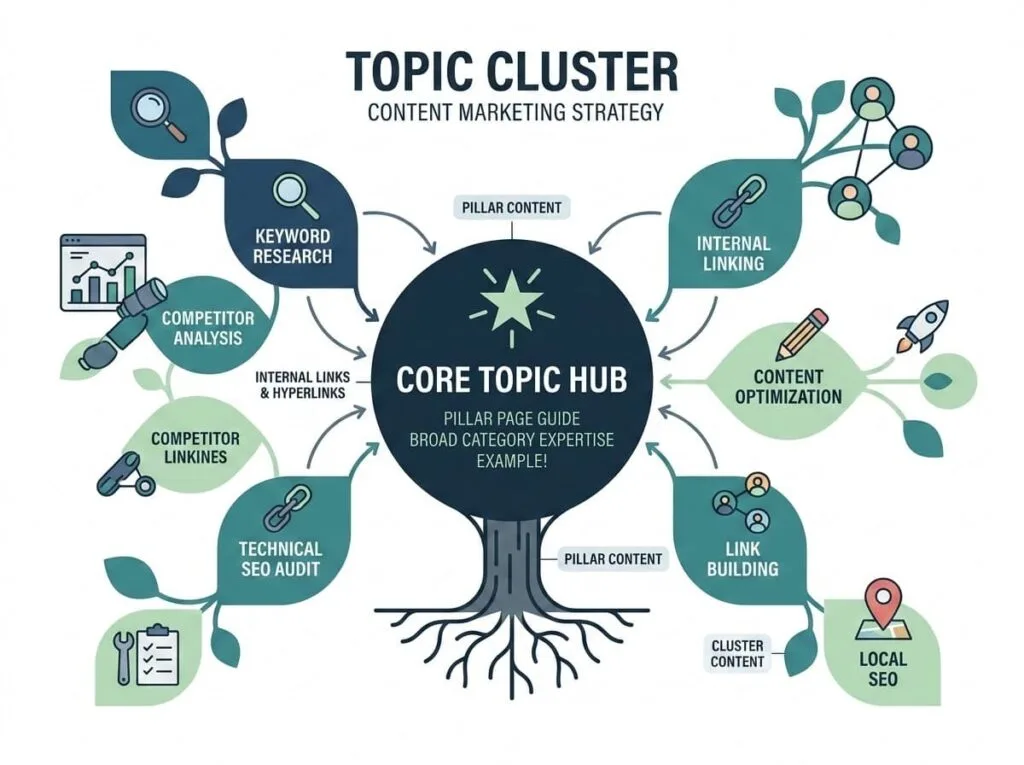
1. Build Strong Topical Authority
One of the biggest mistakes brands make is publishing a handful of articles around random keywords and expecting AI systems to view them as experts.
A stronger approach is to build depth around a defined subject.
Suppose you sell an SEO platform.
Instead of publishing ten disconnected articles such as:
- What is SEO?
- What is keyword research?
- What are backlinks?
- What is technical SEO?
You could build a broader content ecosystem around SEO workflows.
For example:
Core topic: SEO Strategy
Supporting topics
- Keyword research
- Competitor analysis
- Search intent
- Technical SEO
- Internal linking
- Content optimization
- Link building
- Local SEO
- SEO reporting
- SEO forecasting
- AI search optimization
Then connect these pages through logical internal links.
The same approach applies to other software categories. For example, a company offering a solution for direct mail automation software for small businesses can build a comprehensive content ecosystem around automated mailing workflows, personalized campaigns, direct mail APIs, print and mail automation, and customer communication.
For businesses researching direct mail automation software for small businesses, content that explains how automated mailing works, how campaigns can be personalized, and how businesses can streamline recurring mail campaigns can help establish stronger topical relevance. A resource such as direct mail automation software can be referenced naturally within this broader topic.
This helps create a clearer picture of what your website is about.
It also gives AI systems more context when they encounter your brand or content.
The objective isn’t simply to publish more.
It’s to publish comprehensively.
Ten highly relevant articles that genuinely cover a subject can be more useful than fifty thin pieces written simply to target keywords.
2. Create Content That Directly Answers Real Questions
AI systems are designed to respond to questions.
That means question-driven content can be particularly useful.
Instead of writing an article solely around a keyword such as “AI SEO,” think about the questions a potential customer might ask.
For example:
- What is AI search optimization?
- How does AI search differ from traditional Google search?
- How can a business appear in ChatGPT recommendations?
- Does SEO affect visibility in AI search?
- How do AI systems evaluate brands?
- What makes a website trustworthy to AI systems?
- How can companies optimize content for AI Overviews?
These questions can become sections within a comprehensive article or separate supporting resources.
The important part is not to manufacture awkward question headings everywhere.
Write naturally.
If someone would genuinely ask the question, answer it clearly.
A useful rule is:
Answer the question first. Add the nuance afterward.
If the reader has to go through 500 words of introduction before discovering the actual answer, the content isn’t particularly helpful.
3. Make Your Brand Easy to Understand
This sounds obvious, but many websites make it surprisingly difficult to determine what they actually do.
Visit a company’s homepage and ask yourself:
Could someone understand this business within ten seconds?
AI systems face a similar challenge.
Your website should clearly communicate:
- Brand name
- Product or service
- Primary category
- Target audience
- Main use cases
- Key differentiators
- Geographic focus, when relevant
For example, don’t rely exclusively on clever marketing language.
A headline such as: “Transform the way your team works.”
sounds polished, but it doesn’t explain much.
Something like: “Project management software for distributed marketing teams.”
provides substantially more context.
You can still have creative messaging elsewhere.
But your core positioning should be unambiguous.
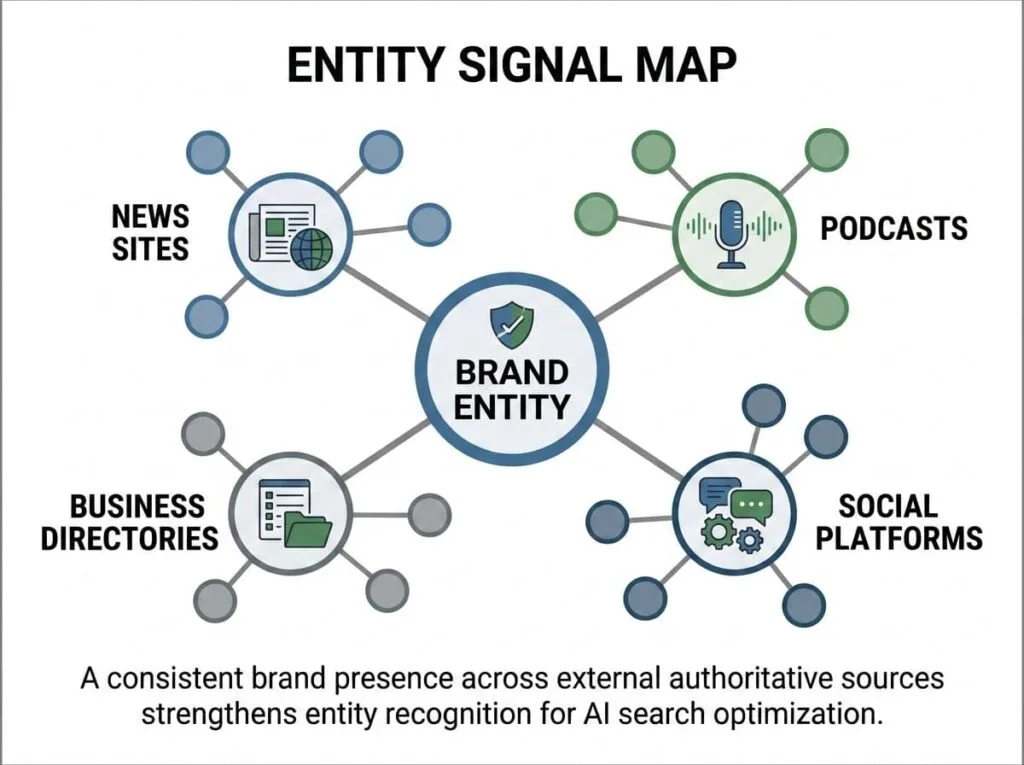
4. Strengthen Your Brand’s Entity Signals
AI search isn’t just about individual pages.
It’s also about entities.
An entity can be a company, person, product, organization, location, or other identifiable concept.
If your company is mentioned consistently across different reputable sources, AI systems have more information with which to understand that entity.
Think beyond your own website.
Your brand might appear on:
- Industry publications
- Business directories
- Review platforms
- Partner websites
- News websites
- Podcasts
- Interviews
- Conference websites
- Professional profiles
- Relevant comparison articles
The key is consistency.
Your company name, product description, founders, website, and category should not contradict each other across the web. This consistency should also extend to your social media profiles, where details such as your Instagram handle can play an important role in making your brand easier to recognize and remember. Learn more about the importance of an Instagram handle and how it can influence your brand’s online presence.
This is one reason brand-building and SEO increasingly overlap.
5. Earn Mentions From Relevant Third-Party Websites
One of the most useful things a brand can do is develop authority outside its own website.
Imagine two software companies.
Company A publishes 200 articles about how great its product is.
Company B publishes useful content but is also mentioned by respected industry publications, reviewed by customers, discussed by relevant websites, and included in legitimate industry comparisons.
Which company provides more external evidence of credibility?
The second one has a stronger story.
This doesn’t mean chasing mentions everywhere.
Relevance matters.
A mention from a respected publication in your industry can be more valuable than dozens of unrelated websites mentioning your company.
This is also where digital PR, partnerships, guest contributions, expert commentary, and genuine link-building efforts can become useful.
The objective should be to earn credible references, not simply accumulate links.
6. Create Original Information Worth Citing
If you want other websites and AI-generated answers to reference your brand, give them something worth referencing.
Original research is particularly useful.
For example, a company could publish:
- Industry survey results
- Customer research
- Original statistics
- Benchmark reports
- Annual industry studies
- Expert surveys
- Data visualizations
- Case studies
- Proprietary benchmarks
Imagine you publish a report analyzing 5,000 ecommerce websites and discover that pages with a particular internal linking structure tend to perform better.
Other writers can reference the study.
That creates secondary mentions.
Your original research becomes a source.
This is much stronger than publishing another generic article explaining “10 SEO tips.”
Ask:
What information can our company contribute that isn’t already available everywhere?
That question can lead to substantially stronger content.
7. Use First-Hand Expertise
AI-generated content has made the internet considerably more crowded.
As a result, generic content has become easier to produce and harder to differentiate.
A page saying:
“SEO is important because it helps businesses get more traffic.”
doesn’t demonstrate much expertise.
A page written by someone who has actually managed SEO campaigns can provide:
- Specific examples
- Real mistakes
- Unexpected results
- Practical workflows
- Industry observations
- Data
- Lessons from failures
- Screenshots
- Case studies
Those details make content more useful.
When creating content, ask:
What does someone who has actually done this know that someone researching the topic for 20 minutes doesn’t?
Put that information into the article.
That’s where much of the value lies.
8. Optimize for Search Intent, Not Just Keywords
Keyword optimization still matters, but the underlying intent matters more.
Consider:
“best accounting software”
The searcher probably wants comparisons.
A page explaining the definition of accounting software isn’t likely to satisfy them.
Likewise:
“how to automate invoices”
suggests that the user wants a practical guide.
And:
“QuickBooks alternatives”
signals comparison intent.
AI systems have become increasingly capable of understanding conversational context, so content should reflect the actual problem behind the query.
Before creating a page, ask:
What does the person actually want to accomplish?
Then build the page around that objective.
9. Structure Content So It Can Be Easily Understood
Long-form content doesn’t have to mean difficult-to-read content.
Use clear organization.
For example:
What Is AI Search Optimization?
Brief explanation.
Why Does AI Search Matter?
Explain the changing search experience.
How Can Brands Improve Visibility?
Provide actionable strategies.
Common AI Search Optimization Mistakes
Address frequent problems.
How to Measure Progress?
Explain practical metrics.
This structure benefits humans first.
It also makes the relationships between concepts clearer.
Use:
- Descriptive headings
- Short paragraphs
- Bulleted lists
- Tables when comparisons are useful
- Clear definitions
- Relevant examples
- Concise summaries
Don’t write for a machine at the expense of the reader.
The best optimization strategy is usually to make the content easier for both humans and machines to understand.
10. Don’t Ignore Technical SEO
AI search discussions sometimes become so focused on content and brand mentions that technical SEO gets forgotten.
That is a mistake.
Your site should still be:
- Crawlable
- Indexable
- Mobile-friendly
- Fast enough for users
- Secure
- Logically structured
- Free from major technical barriers
Pay attention to:
- Robots directives
- XML sitemaps
- Canonical tags
- Redirects
- Broken links
- Duplicate content
- JavaScript rendering
- Structured data
- Page experience
Technical SEO doesn’t guarantee that an AI system will mention your brand.
But technical problems can prevent important information from being properly discovered and understood in the first place.
11. Use Structured Data Where It Makes Sense
Structured data gives search engines additional information about the content on a page.
Depending on your website, relevant schema types may include:
- Organization
- Product
- Article
- FAQ
- Review
- LocalBusiness
- Person
- Event
Structured data shouldn’t be treated as a magic AI visibility switch.
It isn’t.
But accurate structured information can help search systems interpret entities and relationships more consistently.
The important word is accurate.
Don’t add markup simply because you want to manipulate search results.
Make sure the structured data genuinely reflects the visible content.
12. Improve Your Comparison and “Best Of” Presence
Here’s an interesting aspect of AI search.
Users frequently ask questions such as:
- What are the best SEO tools?
- What are the best alternatives to X?
- Which platform is better for small businesses?
- What software should a startup use?
- Which tools are worth paying for?
These questions naturally lead to recommendations.
Brands therefore need to understand how they are represented outside their own websites.
Search for your company alongside phrases such as:
- Best [category]
- [category] tools
- [product] alternatives
- [product] competitors
- [product] vs [competitor]
- Best [category] for small businesses
Look at what independent websites are saying.
Are product descriptions accurate?
Are important features missing?
Are outdated claims still circulating?
Are there legitimate publications where your company could contribute expertise?
This research can reveal opportunities for improving your overall online presence.
13. Think Beyond Google
Google is still enormously important, but AI search isn’t limited to Google.
Users may discover information through:
- ChatGPT
- Google AI experiences
- Microsoft Copilot
- Perplexity
- Other AI assistants and search products
Each system has its own architecture, data sources, retrieval mechanisms, and behavior.
There is no guaranteed formula that makes a brand appear everywhere.
This isn’t limited to software brands, either – local service industries are seeing the same shift, with home service providers increasingly needing a GEO strategy alongside traditional local SEO to stay visible when customers describe their problem to an AI assistant instead of typing a keyword.
That is why trying to “hack” a specific AI system isn’t a sustainable strategy.
Instead, build an online presence that is broadly credible.
If your brand has:
- Strong original content
- Clear positioning
- Positive customer experiences
- Relevant third-party mentions
- Expert contributors
- Useful resources
- Consistent business information
- Strong technical foundations
you are building assets that can benefit multiple discovery channels.
14. Measure AI Search Visibility Differently
Traditional SEO has familiar metrics:
- Rankings
- Organic traffic
- Impressions
- Click-through rate
- Backlinks
- Conversions
AI search adds another layer.
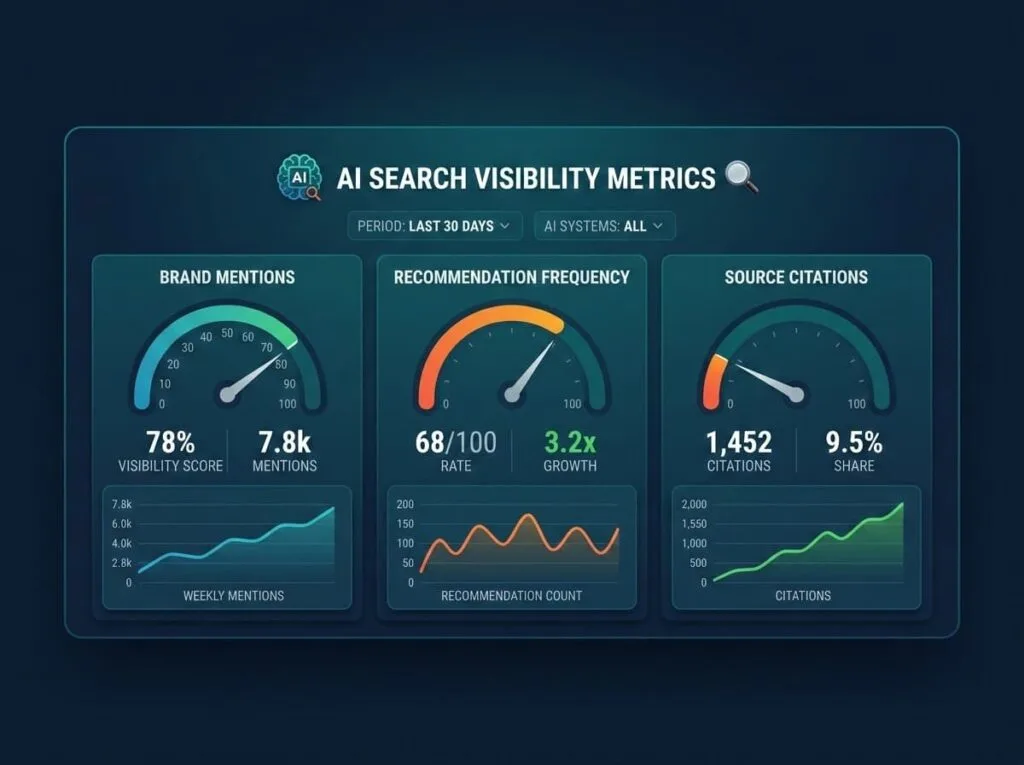
You may want to track:
Brand mentions
How frequently does your company appear when relevant AI systems are asked about your category?
Recommendation frequency
Is your product included among recommendations?
Brand positioning
When you’re mentioned, are you described accurately?
Competitor visibility
Which competitors appear more frequently?
Source citations
When AI-generated systems provide citations or references, which websites are being used?
Referral traffic
Are AI platforms sending visitors to your website?
Don’t obsess over a single metric.
AI search is evolving rapidly, so visibility should be viewed as a broader brand-discovery signal rather than a conventional ranking position.
15. Avoid Trying to Manipulate AI Responses
As AI search becomes more important, marketers will inevitably look for shortcuts.
Some will involve generating thousands of low-quality pages, manufacturing reviews, publishing artificial mentions, or attempting to manipulate AI systems with hidden instructions.
That is unlikely to be a durable strategy.
Search engines have spent years fighting manipulation.
AI systems will face the same problem.
Instead of asking:
“How can I trick an AI into mentioning my company?”
ask:
“What would make my company genuinely useful to recommend?”
That’s a much better strategic question.
If customers like your product, experts understand your category expertise, independent sources discuss your company, and your website provides useful information, you’re building legitimate reasons for your brand to appear.
Common AI Search Optimization Mistakes
Writing hundreds of generic AI-generated articles
More content doesn’t automatically create more authority.
If every article says roughly the same thing as hundreds of competing websites, it provides little differentiation.
Stuffing keywords everywhere
AI search isn’t a reason to abandon natural language.
Write for the question being answered rather than repeating a phrase unnaturally.
Focusing only on your own website
Your website is important, but your brand’s reputation exists across the wider web.
Third-party references matter.
Chasing every AI SEO trend
The terminology and tactics surrounding AI search are changing quickly.
Don’t rebuild your entire SEO strategy every time someone invents a new acronym.
Ignoring brand building
AI search makes brand recognition increasingly important.
SEO and brand marketing shouldn’t operate in separate silos.
A Practical AI Search Optimization Strategy
If you’re starting from scratch, you don’t need to implement everything at once.
A simple process could look like this.
Step 1: Identify your core categories
Write down the topics your company genuinely knows.
Step 2: Research conversational questions
Find the questions customers ask before, during, and after purchasing your product.
Step 3: Build topic clusters
Create comprehensive resources around those questions rather than isolated keyword pages.
Step 4: Strengthen your brand entity
Make sure your company information is consistent across your website and relevant third-party platforms.
Step 5: Publish original information
Develop research, data, case studies, and expert insights that others can reference.
Step 6: Build legitimate authority
Earn mentions through PR, partnerships, expert contributions, useful resources, and genuine relationships.
Step 7: Improve technical SEO
Make sure important content can be discovered, crawled, indexed, and understood.
Step 8: Monitor AI visibility
Regularly test relevant questions across major AI search experiences and record how your company is represented.
Step 9: Improve gaps
If competitors consistently appear where you don’t, investigate why.
You may discover gaps in content, authority, brand recognition, or third-party coverage.
The Future of SEO Isn’t About Choosing Between Google and AI
The biggest mistake brands can make is treating AI search as an entirely separate discipline.
The fundamentals are connected.
A company with a strong website, useful content, recognizable expertise, satisfied customers, credible mentions, and a consistent online presence already has many of the ingredients required for modern search visibility.
What changes is the way users interact with that information.
Instead of clicking five search results, a user might ask one question and accept a synthesized answer.
That means brands need to become more than pages that rank for keywords.
They need to become entities that search systems can understand and trust.
And that shift has a larger implication for marketers.
The goal of SEO has traditionally been to earn visibility.
The next evolution is earning inclusion in the answer.
Final Thoughts
AI search optimization isn’t about finding a secret prompt, inserting a magical phrase into your website, or publishing thousands of AI-generated articles.
It’s about building a brand that deserves to be discovered, understood, and referenced.
Start with the fundamentals: create genuinely useful content, demonstrate real expertise, maintain a technically healthy website, build topical authority, earn relevant third-party mentions, and make your brand information consistent across the web.
Then pay attention to how AI-powered search experiences represent your company.
Are they mentioning you?
Are they describing you correctly?
Are competitors appearing instead?
Are the sources behind those answers stronger than yours?
Those questions can turn AI search optimization from another marketing buzzword into a practical part of your SEO strategy.
The search landscape will continue to change. Specific platforms, interfaces, and algorithms will evolve. But the underlying principle is likely to remain remarkably stable:
Brands that consistently provide useful information and demonstrate genuine authority will have a better chance of being discovered – whether the user finds them through a traditional search result or an AI-generated answer.

Read more from SEO