

Key Takeaways
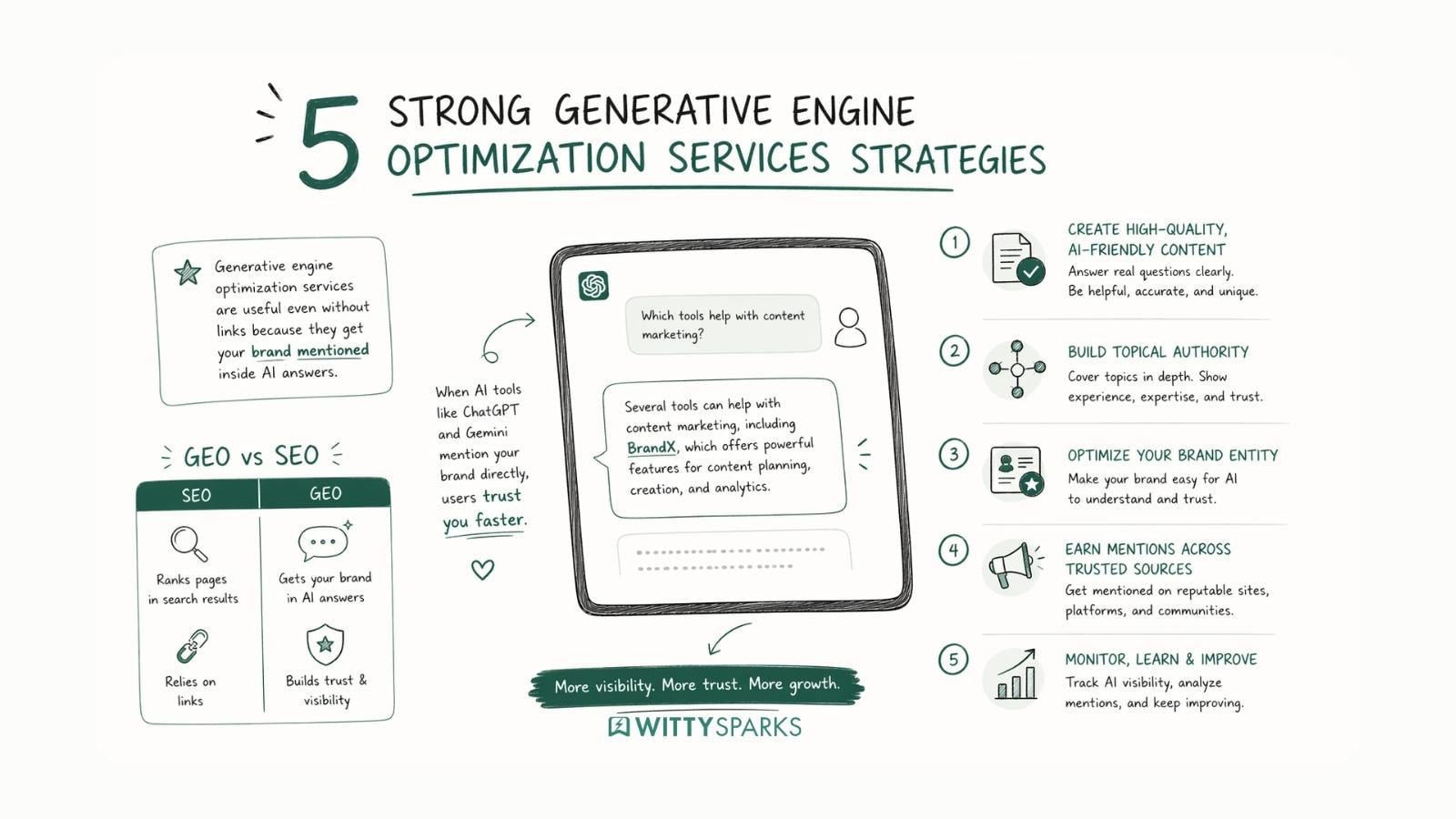
- Generative engine optimization focuses on getting your brand included in AI-generated answers, not just search rankings
- In the GEO vs SEO comparison, SEO drives traffic while GEO builds visibility and recall directly within answers
- AI tools prefer content that is clear, structured, and genuinely helpful, not keyword-heavy
- Building authority across multiple platforms increases your chances of being picked by generative engines
- The best strategy is to combine SEO and GEO to stay visible across both search engines and AI platforms
Search is changing fast. Earlier, SEO was all about ranking your website on Google. Now, generative engine optimization (GEO) is all about getting your brand mentioned in AI answers on platforms like ChatGPT, Perplexity, and Google Gemini.
On this page
That’s the basic GEO vs SEO definition. SEO brings clicks to your website. GEO brings your brand directly into the answer. This is a huge shift. It changes the entire ball game of organic marketing.
Since the AI overview has dropped organic traffic of almost all websites, brands are now running behind AI citations. 60% of Google searches do not end with a click! This shift happened as people are not searching for anything anymore. They are asking questions. Even Google is working as a chatbot.
Just ask a query, and you get the complete answer with more insights and source links. Hence, they expect clear, ready-to-use answers instead of scrolling through 10 links. If your brand is not part of those answers, you are invisible. This is a brutal truth.
In this blog, we will break down how generative engine optimization services work, how GEO vs SEO compares, and what you should actually focus on going forward.
TL;DR
- SEO = rank on Google
- GEO = get mentioned in AI answers
- Search is shifting to AI
- Visibility matters more than clicks
- Use both GEO + SEO
How Generative Engines Like Claude, Perplexity, ChatGPT and Google Gemini Work?
Generative engines don’t work like Google search. Google shows you a list of links. You click, read, compare, and then decide.
AI tools like Claude, Perplexity, ChatGPT and Google Gemini do something different. They read tons of data from across the internet and then give you a direct answer in seconds. No clicking. No browsing. Just one clean response.
These engines don’t “rank” websites. They pick information from multiple sources and combine it into one answer. That means your website link may never show up, but your content or brand can still be used inside the answer.
Generative engines look for:
If your content checks these boxes, AI is more likely to use it while generating answers. Now, how to win the trust of generative engines? That’s exactly where generative engine optimization services come into the picture.
The way SEO companies used to help brands with rankings, AI is now helping brands by referring to their names as Subject Matter Experts.
Also, read: 6-step LLMO checklist
Why GEO is the Future of Digital Marketing?
1. Search Behavior is Changing Fast
People don’t want to go through multiple blogs anymore. They want quick answers.
Instead of typing keywords and opening multiple tabs, users now ask direct questions on platforms like ChatGPT and Google Gemini. They expect quick, clear, and complete responses in one place. This is exactly where generative engine optimization starts becoming important.
This shift is pushing brands to rethink their strategy. SEO alone is not enough anymore. If your content is not designed for AI answers, you are missing out on visibility where users are actually spending time.
2. Visibility is Moving from Links to Mentions
Earlier, success meant ranking on Google and getting clicks. Now, success means getting mentioned in AI-generated answers. Even if users don’t visit your website, they still see your brand name. That is the core idea behind generative engine optimization services.
In GEO vs SEO, SEO focuses on traffic, while GEO focuses on presence. And in many cases, being part of the answer builds more trust than just being one of the links.
3. Early Movers Will Dominate AI Visibility
Right now, not many brands are actively working on GEO. Most businesses are still stuck in traditional SEO strategies like keyword stuffing and backlink building. This gives a huge advantage to those who start investing in generative engine optimization early.
Just like early SEO adopters dominated Google rankings years ago, early GEO adopters will dominate AI-generated answers. This is not a trend. This is the next phase of digital marketing.
4. AI Prefers Authority, Not Just Optimization
Search engines can be influenced by technical tricks. AI cannot be fooled that easily. Even a brand with no website and no heavy content generation can dominate generative engines. There is no trick to it. Pure smartness wins.
Generative engines prefer content that is clear, consistent, and authoritative. They look for brands that genuinely know their subject, not just pages optimized for keywords. This is why generative engine optimization services focus more on building topical authority than chasing rankings.
Also, read: How to rank in ChatGPT?
GEO vs SEO: Key Differences
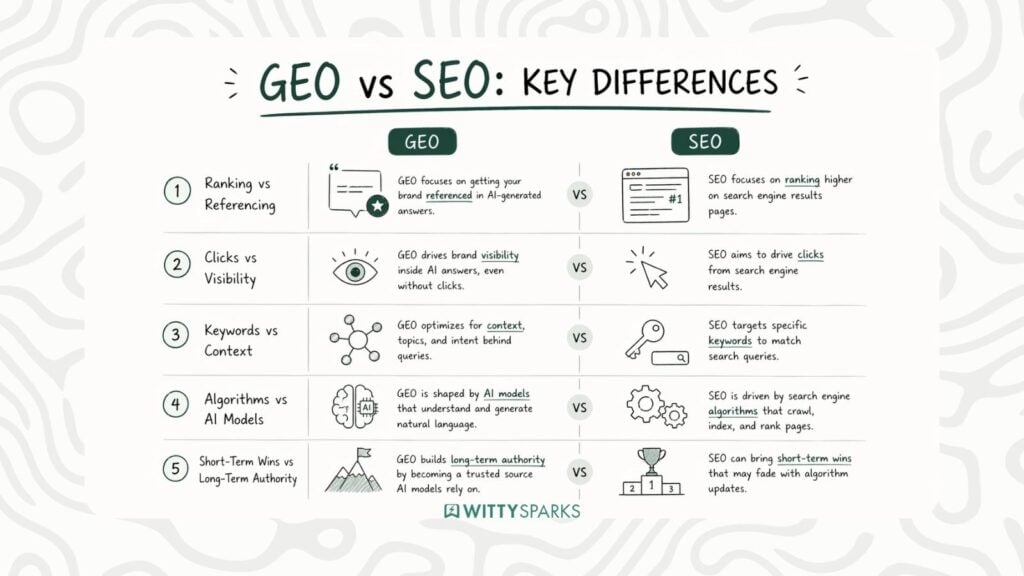
In the GEO vs SEO comparison, SEO can sometimes be tactical. GEO is more strategic. It is about becoming a reliable source that AI trusts and uses repeatedly.
1. Ranking vs Referencing
SEO is focused on ranking your website on search engines like Google. You optimize pages, build backlinks, and try to appear in the top results so users click your link. The higher you rank, the more traffic you get. It is a position-based game.
GEO works differently. It is not about being on top of a list. It is about being part of the answer itself. Generative engine optimization focuses on making your content so clear and valuable that AI tools pick it while generating responses.
Example:
If someone searches “best marketing agency in the UK,” SEO helps you rank on Google. But with GEO, tools like ChatGPT may directly mention your agency in the answer without showing any list of links.
2. Clicks vs Visibility
In SEO, everything depends on clicks. Even if you rank well, your success depends on whether users click your link and visit your website. Traffic becomes the main metric to measure performance.
In GEO, clicks are not necessary. Your brand can appear inside AI-generated answers even if the user never visits your site. Generative engine optimization services focus on building visibility and recall, not just traffic.
Example:
A user asks Google Gemini for “best marketing strategies for startups.” If your brand is mentioned in the answer, the user already sees you as an expert, even without clicking anything.
Tip: Try to generative genuine help guides and share less known tricks. Maximum users ask queries. Very few search for services.
3. Keywords vs Context
SEO relies heavily on keywords. You find the right keywords, place them in headings and content, and optimize your page accordingly. This helps search engines understand what your page is about.
GEO focuses more on context and intent. AI understands full questions, not just keywords. So instead of repeating keywords, your content needs to answer real questions in a clear and structured way.
Example:
Instead of writing a blog filled with “generative engine optimization services” multiple times, a GEO approach would explain what it is, how it works, and when to use it in a natural flow so AI can easily pick and present it.
4. Algorithms vs AI Models
SEO algorithms have evolved over the years. These algorithms are complex to understand. It is a myth that SEO is all about keyword stuffing. It is more about quality content, keywords, alt text, backlinks, and works based on search engine algorithms.
GEO works with AI models like ChatGPT, Google Gemini, Claude and Copilot. These models do not rank pages. They read, understand, and combine information from multiple sources to generate one final answer.
They might add one of your insights and rest of others’. Presenting the brand as an expert is the ultimate goal of generative engine optimization services.
Example:
In SEO, your blog might rank #31 on Google. In GEO, your insights from that same blog could be picked and merged with other sources to form a complete answer shown to the user.
5. Short-Term Wins vs Long-Term Authority
SEO can give relatively faster results if done correctly. With proper keyword targeting and backlinks, you can start seeing rankings and traffic in a few months.
GEO is more about long-term authority. Generative engine optimization builds your brand presence across multiple platforms so AI sees you as a reliable source over time. It is less about quick wins and more about consistent visibility.
Example:
A new blog might rank on Google within months through SEO. But to be consistently mentioned in AI answers, your brand needs repeated signals like strong content, mentions, and authority across the web.
Key Strategies Used in GEO Services
1. Answer-First Content Creation
Generative engine optimization starts with one simple rule: answer the question clearly. Instead of long introductions and keyword-heavy writing, content is structured to give direct, useful answers quickly.
This makes it easier for AI tools to pick and use your content while generating responses. Good GEO content is simple, well-structured, and written in a way that feels like a ready-made answer, not just an article.
2. Building Topical Authority
GEO is not about one blog ranking. It is about owning a topic. Generative engine optimization services focus on creating multiple pieces of content around a single subject so your brand becomes a trusted source.
When AI sees consistent, high-quality information across your content, it starts recognizing your brand as an authority and is more likely to reference it.
3. Brand Mentions Across Platforms
AI does not rely on your website alone. It looks at your presence across the internet. That is why GEO focuses on getting your brand mentioned in blogs, media articles, forums, and other platforms like Reddit and Quora.
The more consistent and credible your brand mentions are, the higher the chances that AI models will trust and include your brand in their answers.
4. Clear and Structured Content Formatting
AI prefers content that is easy to understand. This means using clear headings, short paragraphs, and logical flow.
Generative engine optimization ensures your content is structured in a way that AI can quickly scan, understand, and extract key information from. If your content is confusing or cluttered, it is less likely to be used in AI-generated responses.
5. Consistency and Accuracy of Information
One of the most important parts of GEO is consistency. Your brand information, messaging, and expertise should be the same across all platforms. If there are conflicting details, AI may ignore your content.
Generative engine optimization services focus on maintaining accurate, consistent, and reliable information so that AI models see your brand as trustworthy and dependable.
Final Words
Search is clearly evolving, and the shift from SEO to GEO is already happening. SEO still matters. It helps you rank, get traffic, and build your online presence. After all, GEO uses Google to learn about any topic.
GEO takes it one step further. It helps your brand become part of the actual answer. That is where real visibility is moving today.
So when you think about GEO vs SEO, it is not about choosing one over the other. It is about adapting to how people search now. Smart brands are already combining both. They are ranking on Google and getting mentioned inside AI tools at the same time.
If you want to stay relevant, you need to start thinking beyond clicks. You need to focus on visibility, authority, and trust. That is exactly what generative engine optimization services are designed to build.
Platforms like WittySparks are already adapting to this shift by focusing on content that not only ranks but also gets picked by AI engines. The sooner you start, the bigger your advantage will be.
Frequently Asked Questions
How long does it take to see results from generative engine optimization?
GEO is not instant. Since it depends on building authority and consistency, it usually takes a few months before AI starts picking your content regularly. The more consistent your presence, the faster the impact.
Does GEO require technical changes on the website?
Not necessarily. While basic structure and clarity help, GEO is more about content quality, consistency, and how well your information is presented. It is less technical compared to traditional SEO.
Can GEO work without creating a lot of content?
No. Consistent content is important for GEO. You don’t need hundreds of blogs, but you do need focused, high-quality content that builds authority over time across your niche.
Images in this post are generated using ChatGPT.

Read more from SEO