
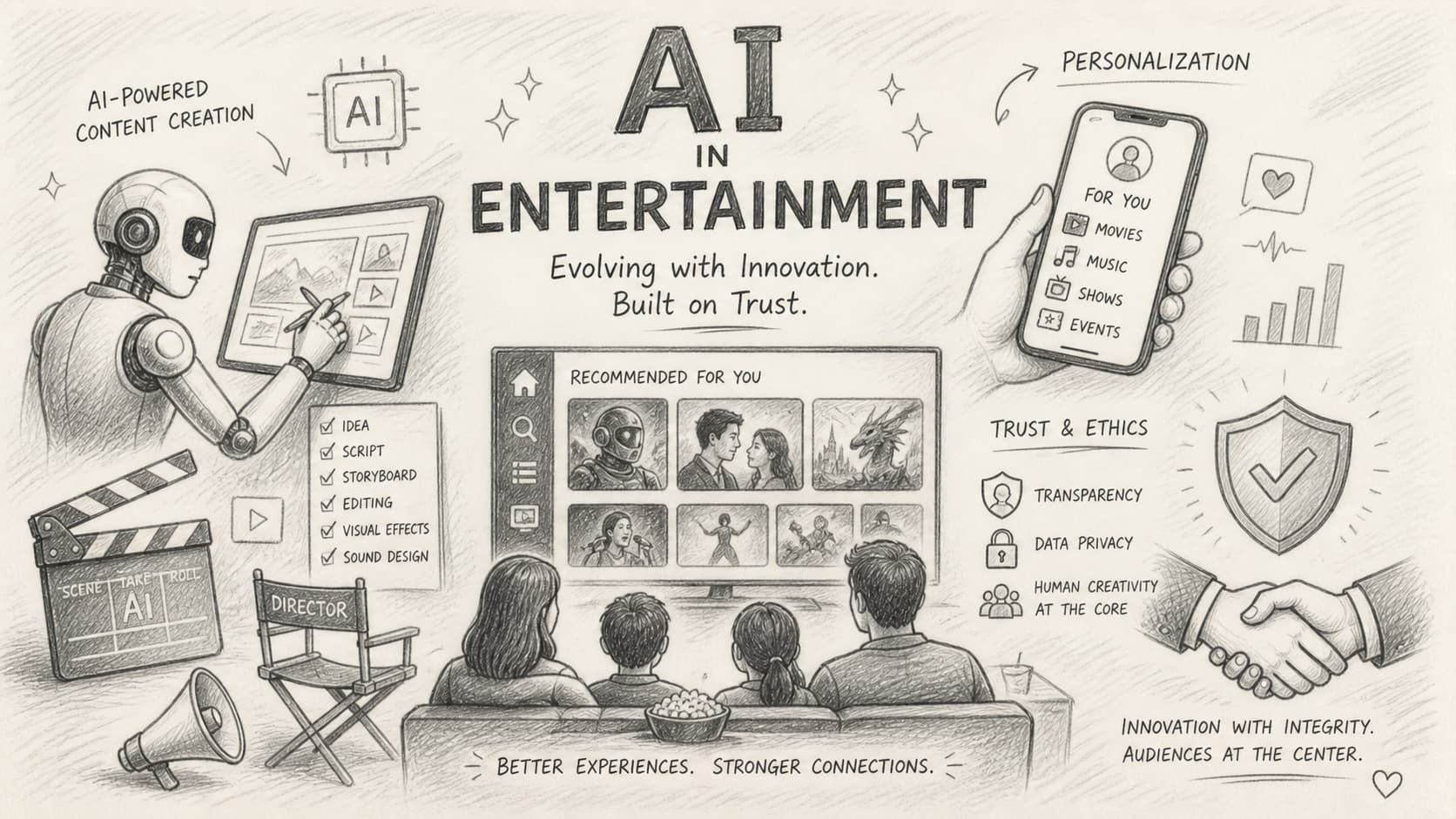

Technology continues to play an essential role in entertainment. The integration of AI technology into the entertainment industry is the next step for the industry. This can be seen in how Netflix knows more about you than you know about yourself, how games become more interactive, and even how music applications recommend songs based on your mood.
On this page
But there’s another side to this story. As AI becomes part of everyday production and distribution, questions about privacy, ownership, and trust arise more frequently. In 2026, the real challenge isn’t just using AI well. It’s using it responsibly.
Let’s look at where AI is making the biggest difference, what it means for businesses, and how companies can move forward without crossing lines they shouldn’t.
What Is AI in Entertainment?
At its core, AI in entertainment refers to systems that can spot patterns, learn from data, and make decisions or predictions without being told exactly what to do. That could mean recommending a show, generating music, improving animation, or even helping write scripts.
Also Read: How are Mobile Apps Changing the Entertainment Industry?
Often, the role of AI remains unseen, behind the scenes. You won’t always recognize its influence, but it’s there, affecting what you read, listen to, and entertain yourself with. Its purpose is not to take away creativity but to enhance and accelerate it.
Key Areas Where AI Is Making an Impact
Film and Video Production
AI has applications throughout the entire production process, from start to finish. In pre-production, it may be included in the script to predict audience reaction, select actors, and edit during post-production.
Visual effects companies use AI algorithms to automate tasks such as rotoscoping, background creation, color grading, and reducing timelines.
In some cases, it is all about making plans and taking into account previous experience. The AI technology can analyze past ticket sales and view streams to develop a more efficient budgeting and distribution plan.
Music Creation and Composition
Music has become one of the most visible uses of AI. Algorithms can generate new melodies, remix tracks, and even mimic certain styles. While human musicians still lead the creative process, AI often acts as a co-creator.
For producers, this means faster experimentation. For artists, it opens new ways to explore sound. But it also raises questions about originality, which the industry is still figuring out.
Gaming and Interactive Media
This is where the true prowess of AI becomes evident. With better NPC interaction, along with stories that evolve depending on the choices of the player, games have benefited greatly from artificial intelligence.
With several games today, AI adjusts the difficulty level on the spot. When a player is having trouble playing, it adapts accordingly. In contrast, when a player finds it too easy, it increases the difficulty.
Streaming Apps and Content Recommendations
If you’ve ever wondered how streaming apps always seem to get you, that’s all because of AI at work. Recommendation engines analyze viewing history, time of day, preference, and even how long you watch certain scenes.
And this is where AI and data protection become a real concern. These systems rely on user data, which means companies must be clear about what they collect, how they use it, and how they keep it safe.
If you’re building or expanding these kinds of platforms, investing in solid entertainment software development early can make a big difference. It’s not just about features. It is about performance, trust, and long-term reliability.
Virtual Influencers and Digital Avatars
Virtual influencers have gone beyond a passing phase; they are now fully-fledged digital entities that can interact with fans, form brand partnerships, and build entire communities.
Some brands prefer virtual influencers because they’re predictable and available 24/7. Others use them for experiments, immersive storytelling, or marketing campaigns. Either way, they’re reshaping how audiences interact with digital characters.
Business Benefits of AI for Entertainment Companies
Faster Production Cycles
A huge victory in that case would be speed. The use of artificial intelligence will save significant time by automating redundant tasks such as editing, tagging, sorting videos, or even working on soundtracks. That allows creative teams to concentrate on storytelling.
Also Read: Top 8 Mobile Applications That use Artificial Intelligence
In practice, this means shorter production schedules and quicker time-to-market. For fast-moving platforms, that speed can be the difference between being forgotten and being trending.
Cost Efficiency and Scalability
AI also helps manage budgets. By optimizing resources, predicting demand and automating workflows, companies reduce waste and avoid unnecessary spending.
This is especially useful for studios and startups that want to scale without ballooning costs. Instead of hiring massive teams for every project, businesses can use AI to support smaller, more focused crews.
Improved Audience Experience
At the end of the day, it’s all about the audience. AI helps deliver content that feels personal, timely, and relevant. Viewers are more likely to stay, subscribe, and recommend platforms that seem to understand their tastes.
And when audiences feel seen, they stick around.
How Entertainment Businesses Can Get Started with AI?
Getting started with AI doesn’t mean overhauling everything at once. In fact, it usually works best when introduced step by step.
Start with clear goals. Do you want better recommendations? Faster editing? Smarter marketing? Once you know what you’re solving for, the right tools become easier to find.
Next, make sure your data is clean, secure, and compliant. With growing AI regulation in media and entertainment, businesses can’t afford to be careless. You’ll also want to train your teams. AI works best when people understand what it can and can’t do. That knowledge helps teams use tools effectively and avoid over-reliance.
The Laws around data storage, consent, and privacy are tightening and ignoring them leads to more than just fines. It damages trust; this is where the strong technical support matters.
Many companies choose to consult specialized developers who understand both compliance requirements and AI systems. It’s not just about building tools, but it’s about building them the correct way.
Also, you’ll want to train your teams. AI works best when people understand what it can and can’t do. That knowledge helps teams use tools effectively and avoid over-reliance.
Finally, test and adjust. AI systems learn over time, and so should your strategy. Monitor performance, gather feedback, and refine your approach as you go.
Concluding Lines
Entertainment in the future will have to do with AI. AI plays a part in all aspects, whether it be recommendations or fast processing. However, in our quest to innovate, we must consider that keeping the data will become more crucial than ever. For instance, in 2026, to succeed in entertainment, AI alone will not be enough; it will depend on how it is used.
Featured image is created using ChatGPT.

Read more from Entertainment