

AI marketing automation is getting smarter. But creating emails faster or generating campaign ideas isn’t enough. The bigger opportunity is AI that actually understands your business and helps decide what needs attention next.
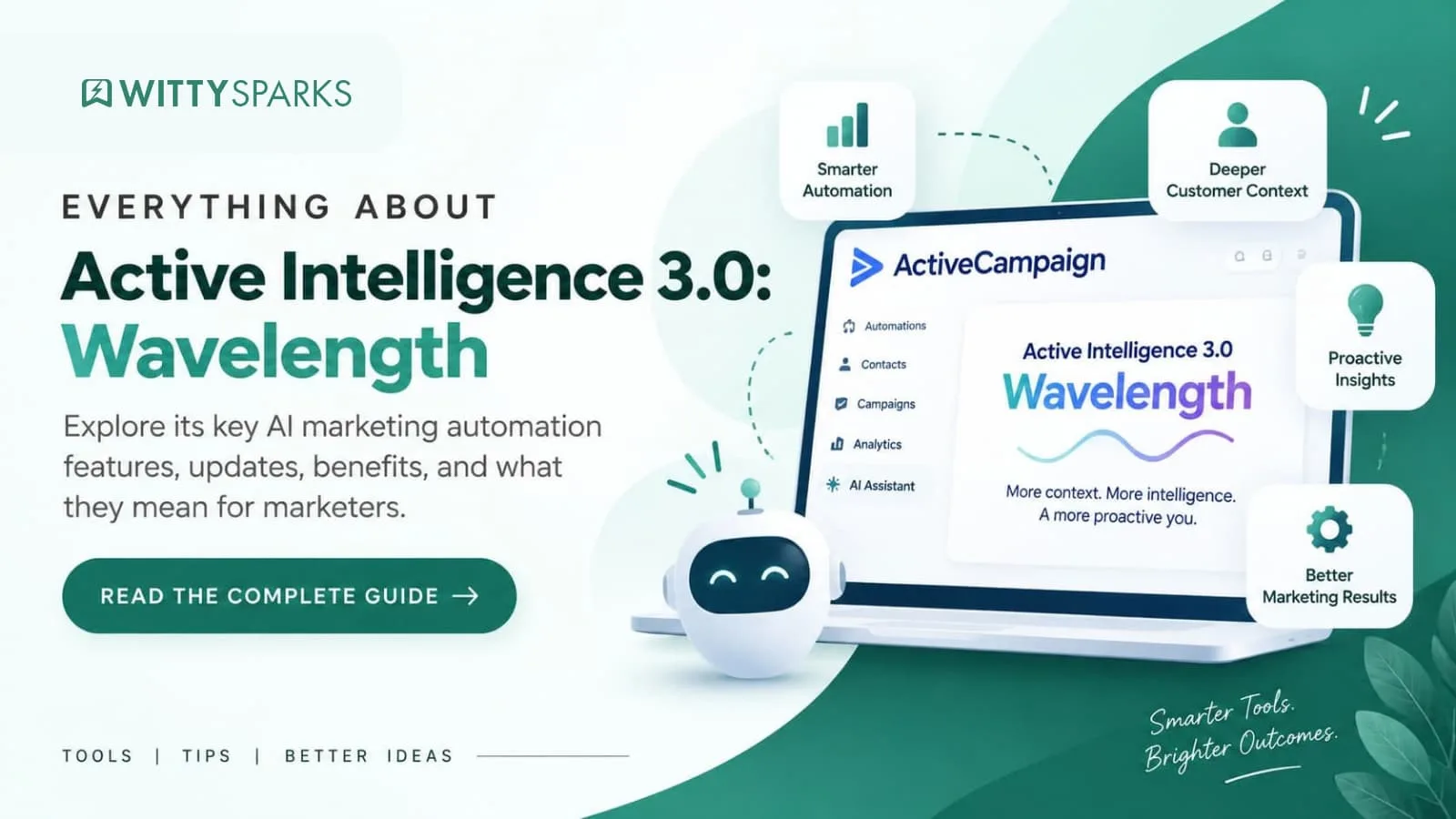
That’s the idea behind Active Intelligence 3.0: Wavelength, ActiveCampaign’s latest evolution of its AI-powered marketing capabilities. It uses the context within your ActiveCampaign account, along with relevant external signals, to provide more proactive and business-specific support.
On this page
With ActiveCampaign Wavelength, AI can help spot opportunities, surface issues, build campaigns, monitor performance, and take on recurring marketing tasks instead of waiting for a new prompt every time.
So, what exactly has changed with Active Intelligence 3.0, and how useful are these updates for marketers? Let’s take a closer look.
What Is Active Intelligence 3.0: Wavelength?
Active Intelligence 3.0: Wavelength is ActiveCampaign’s latest AI update. And this time, the focus is on making AI more proactive. With Wavelength, AI marketing automation has become more interesting.
Wavelength looks at what is already happening in your ActiveCampaign account, including your campaigns, automations, audiences, performance data, and brand context. It can also bring relevant external signals into the picture.
So, you don’t necessarily have to tell it what to look for every single time. It can spot something that deserves attention, bring it to you, suggest what you could do next, and help you act on it.
Say one of your campaigns needs attention. Instead of you checking the numbers, taking those insights elsewhere, deciding what to change, and then coming back to execute it, Wavelength is built to connect more of that process inside ActiveCampaign.
That’s really the big idea behind Active Intelligence 3.0. ActiveCampaign wants its AI to know your marketing well enough to be useful without needing a detailed prompt every time.
What’s New in Active Intelligence 3.0: Wavelength?
Active Intelligence 3.0 arrives with several updates, but they all point towards the same goal: making AI more aware of your marketing and more capable of acting on that knowledge.
In this blog, I have mentioned some of the major ActiveCampaign Wavelength updates marketers should know about.
1. Proactive recommendations and Scheduled Tasks
One of the biggest changes is that Active Intelligence does not always need to wait for a prompt.
Wavelength can proactively surface opportunities and areas that may need attention based on what is happening in your account. Scheduled Tasks take this a step further by letting you set recurring AI-powered work.
For example, you can schedule Active Intelligence to review your campaign performance regularly and highlight useful insights. This way, AI keeps working on specific tasks without waiting for you to prompt it every time.
2. Deeper account context and memory
Good marketing recommendations depend on good context. Wavelength builds that context by learning from what is already happening in your ActiveCampaign account.
It looks at your account history, audience, campaigns, content performance, automations, and platform usage. Its adaptive memory also learns from activities such as sends, engagement, and workflows, so its guidance can become more specific over time.
You can strengthen this context further with Brand Kit, custom instructions, and memory. Together, these help Active Intelligence understand not just what you are doing, but also how your business and marketing work.
So instead of starting with the same broad advice every time, Wavelength can use what it already knows about your account to offer more relevant recommendations.
3. Campaign creation becomes more connected
Wavelength also expands what AI can help marketers create and execute.
The Unified Campaign Agent brings campaign creation into a more connected workflow. Instead of separately handling every part of a campaign, marketers can work with Active Intelligence to move from an idea towards actual campaign execution.
Wavelength can also assist with content and image generation while referencing existing marketing campaign and brand context.
This is where the broader AI marketing automation angle becomes important. The goal is not simply to generate another email. It is to connect planning, creation, execution, and follow-up more closely.
4. Better visibility into your automations
Building automations is only half the job. Marketers also need to know whether those automations are actually working as intended.
Wavelength introduces capabilities such as Automation Insights and Automation Health to help marketers understand their existing automation setup and identify areas worth reviewing.
That can be particularly useful for accounts that have accumulated a large number of automations over time. Instead of manually inspecting everything, marketers can use Active Intelligence to get a clearer picture of where attention may be needed.
5. External signals can add more context
Wavelength doesn’t rely only on what’s happening inside your ActiveCampaign account. It can also look at relevant external signals to understand the bigger picture.
This includes changes and mentions related to your brand, website, competitors, industry, and the broader market. Wavelength can connect these signals with what it already knows about your account and surface timely campaign opportunities.
For marketers, this means less time treating market research and campaign planning as two separate tasks. External developments can become useful context for deciding what to act on and when.
6. AI Actions Library expands what AI can do
The AI Prompt Block is now called the AI Actions Library. It gives marketers reusable AI actions that they can add to their workflows.
ActiveCampaign is also phasing out AI Activities as these newer AI capabilities take over.
Wavelength also supports MCP, which allows Active Intelligence to connect with external tools and information sources.
So, is Wavelength actually a big upgrade?
Potentially, yes, but not simply because it has more AI features.
The bigger change is how these features work together. Wavelength can learn from your account, spot something that needs attention, suggest the next step, and even handle recurring tasks on a schedule. It can also monitor marketing performance and automation health and bring important findings to your attention.
So, this update goes beyond adding more AI tools. ActiveCampaign is trying to make its AI a more proactive part of everyday marketing.
But there’s one thing to keep in mind. Not every Wavelength capability is available to every account. ActiveCampaign is still rolling out these updates, and availability can vary by account and capability.
So, if you’re exploring ActiveCampaign Wavelength, check which features are currently available in your account before deciding what you can actually use today.
ActiveCampaign – Email Marketing and CRM
A software for customer experience automation (CXA) that combines email marketing, marketing automation, sales automation, and CRM categories.

What Does Active Intelligence 3.0 Mean for Marketers?
1. Spend less time repeating the same AI tasks
You don’t have to start from scratch every time you use Active Intelligence. Adaptive memory learns how your account works over time, while Scheduled Tasks let you automate recurring work such as insights, reports, and follow-ups. You can set the cadence based on your campaign or reporting needs.
2. Get recommendations based on your actual marketing
Wavelength can use your account history, audience, campaign performance, content, automations, brand, and platform usage as context. It can also identify content and automation patterns that have worked in the past. This gives its recommendations more evidence from your own marketing instead of treating every campaign the same way.
3. Spot issues and opportunities earlier
Wavelength can monitor marketing performance and automation health in the background. It can flag areas that need attention and turn the findings into clear recaps with relevant data, analysis, and suggested next steps. This can help teams catch problems or opportunities without manually checking everything themselves.
4. Move from insight to action faster
Wavelength doesn’t stop at showing you what happened. It can also prepare campaign drafts and suggest next steps based on your account history and performance. That shortens the gap between spotting an opportunity and actually doing something about it.
5. Manage more marketing work without losing context
These capabilities can be especially useful when you manage several campaigns, automations, or even multiple client accounts. For partners managing multiple client accounts, Wavelength can help scale their expertise while keeping recommendations specific to each client.
Key Takeaways
- Active Intelligence 3.0: Wavelength makes ActiveCampaign’s AI more proactive and context-aware.
- It learns from your campaigns, audiences, automations, performance, brand, and other account activity.
- Scheduled Tasks can handle recurring work without requiring the same prompt every time.
- Wavelength can monitor performance, spot issues and opportunities, and suggest what to do next.
- External signals can add context from your brand, competitors, industry, and broader market.
- Wavelength connects AI insights with marketing actions, but feature availability can vary by account.
Final Thoughts
Active Intelligence 3.0: Wavelength shows an interesting shift in AI marketing automation. Instead of focusing mainly on generating content faster, ActiveCampaign is pushing towards AI that understands what is happening in a business, spots what needs attention, and helps marketers act on it.
At WittySparks, we think the more interesting part is not any single Wavelength feature. It is how ActiveCampaign is trying to connect context, recommendations, execution, and ongoing monitoring within one system.
Of course, the real test will be how well these capabilities work in everyday marketing and how quickly they become widely available across ActiveCampaign accounts.
For now, Wavelength gives us a good glimpse of where marketing AI could be heading: less time spent telling AI what to look at, and more AI that already understands enough context to know where it can help.
Frequently Asked Questions
Can Wavelength compare campaign performance with industry benchmarks?
Yes. Its Industry Benchmarks capability can compare open and click performance with relevant benchmarks. This helps marketers understand whether a campaign result is an isolated outcome or something worth paying closer attention to.
Can Active Intelligence 3.0 translate marketing emails?
Yes. AI Email Translations can turn an existing email into versions for additional languages within the campaign workflow. This can make it easier to adapt the same campaign for audiences across different markets.
Can Wavelength analyse an entire campaign instead of individual assets?
Yes. Its Multi-Asset Analysis looks at the copy, imagery, and structure together. This helps marketers review how well the different elements work as one complete campaign rather than analysing each asset separately.

Read more from Marketing