
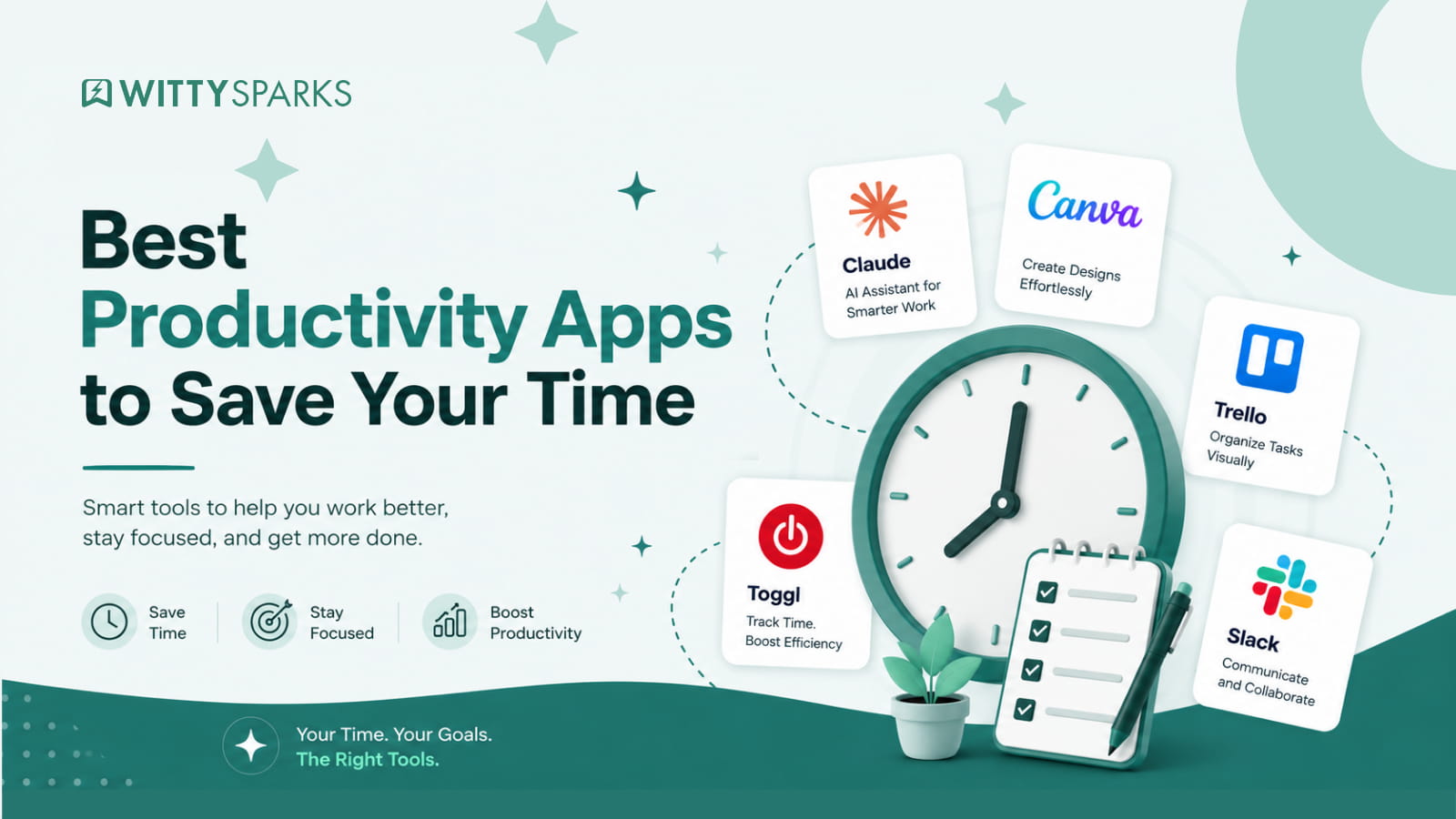

My entrepreneur friends keep asking me about the tools I use to manage all my tasks. As an entrepreneur, I manage multiple projects, and for each, I need to do some research, marketing, email work, meetings, etc. I use some smart tools like Claude, Canva, Trello, Toggl, and Slack, which are some of the best productivity apps professionals like me rely on.
If you want to save time and stay organized in 2027, you need to try these productivity apps. Most of these are free! Whether you are managing projects, attending meetings, collaborating with teams, or tracking your work hours, the right tools can help you get more done without feeling overwhelmed.
The challenge is that there are hundreds of productivity tools available today, and not all of them deliver real value. Some add unnecessary complexity, while others genuinely help streamline daily tasks and improve efficiency. In this blog, we will explore the best productivity apps that can help professionals, freelancers, and business owners work smarter, save time, and stay focused on what matters most.
On this page
1. Claude in 2027
You must be thinking, what’s so new in this? We have all been using AI, especially ChatGPT and Claude, for several tasks like email writing, marketing strategy, research, etc. What’s so special in 2027?
Well, let me tell you that Claude is very different than ChatGPT. If ChatGPT is your everyday assistant, Claude is the colleague you call when the task gets serious.
Startup founders, consultants, marketers, and business owners are increasingly using Claude for
- Research-heavy work
- Competitor analysis
- A website audit
- A content strategy
- A web page design
- Social media marketing
Upload the files and let Claude do the heavy lifting. What would normally take hours can often be done in minutes.
Claude has a Brahmastra called “Cowork”. Let’s understand what the hype is about. You get a project that has multiple small modules. You can’t keep entering prompts every time and wait for Claude to do the work. Cowork is basically a supporting tool that conveys your prompts to Claude even when you are asleep!
That’s how you can automate any lengthy or time-consuming task.
→ Upload your files
→ Upload a file with your prompt saved as .md
→ Assign a task
→ Claude researches and analyzes the information
→ Creates reports, presentations, strategies, or audits
→ Saves the final output in your project workspace.
Claude is also becoming a popular tool for website planning. Share a few competitor websites, explain your goals, and Claude can suggest page structures, content ideas, user journeys, and wireframe recommendations. For startups, this can replace days of back-and-forth discussions.
That is why many professionals now consider Claude one of the best productivity apps available today. It helps you move from “What should I do next?” to “Here’s the plan. Let’s execute.” That’s why it has almost 19 million monthly active users.
Example: Planning a website redesign? Upload your current website, share three competitor links, and ask Claude for a complete audit PPT. Within minutes, you’ll have recommendations for content, design, user experience, and conversions – all in one place.
2. Canva
Creating presentations, social media posts, reports, flyers, and marketing materials can take hours. Canva To-Do list helps professionals create these assets without relying on a designer for every small task.
Canva is user-friendly and simple. You can start with a ready-made template and customize it in seconds. Whether you need an Instagram post, a client presentation, a business proposal, or a company brochure, Canva has templates for almost every use case.
Canva shared that their tool helped Expedia Group save 7,800 design hours annually! You can imagine the cost Canva is saving. If you are an entrepreneur, you know the importance of a single hour saved.
Over the last few years, Canva has evolved far beyond graphic design. It now includes AI-powered features for generating images, editing visuals, removing backgrounds, writing content, creating presentations, and even turning ideas into ready-to-use designs.
I don’t know any content creator or startup founder who doesn’t use Canva. It can significantly reduce design costs and turnaround time. Instead of waiting days for revisions, teams can quickly create and update marketing assets whenever required.
That is why Canva continues to be one of the best productivity apps for professionals. It helps teams move from idea to execution faster while keeping content visually consistent across channels.
Example: Need a client presentation by tomorrow? Choose a Canva template, add your content, use AI to refine the design, and create a polished presentation in a fraction of the time it would take using traditional design tools.
Canva – Design your content
A ready-made library of templates for creating graphic content.

3. Trello
Great projects take teams to build. And to make those teams work properly, you need some best productivity tools like Trello. Trello is a visual project management tool. It helps bring everything into one place.
You can create boards, assign tasks, set deadlines, add checklists, and track progress with a simple drag-and-drop system. Everyone knows what needs to be done and what is already completed.
Trello is especially useful for startups, agencies, and remote teams. Whether you are managing a website launch, content calendar, marketing campaign, or client project, Trello keeps work organized without adding unnecessary complexity.
One of the reasons Trello remains popular is its flexibility. You can use it to manage a team of fifty people or simply organize your own daily tasks. The setup is simple, and most users can start using it within minutes.
That is why Trello continues to be one of the best productivity apps for professionals. It reduces confusion, improves accountability, and helps teams move projects forward without endless follow-up messages.
Example: Imagine your team is launching a new website. Instead of tracking updates through emails and WhatsApp messages, you can create a Trello board with stages like Content, Design, Development, Testing, and Launch. Everyone can see the project’s status at a glance.
4. Toggl
Being busy does not always mean being productive. Many professionals spend their entire day working, yet struggle to understand where their time actually goes. That is where Toggl can help.
Toggl is a time-tracking tool that records how much time you spend on different tasks and projects. With a single click, you can start tracking your work and generate reports that show exactly how your day is spent.
This is especially useful for freelancers, agencies, consultants, and business owners. It helps identify time-consuming activities, improve project planning, and estimate future work more accurately.
Many teams also use Toggl to understand project profitability. If a task that was expected to take two hours consistently takes six, you can spot the problem early and make better decisions.
That is why Toggl remains one of the best productivity apps for professionals. It helps you work smarter, improve efficiency, and make better use of your time.
Example: Suppose you are managing content for multiple clients. By using Toggl, you can track how much time is spent on research, writing, editing, and meetings. Over time, these insights can help you improve planning and avoid overloading your schedule.
5. Slack
A quick question. How many times have you searched through old emails or WhatsApp chats to find a file, message, or client feedback? For many teams, this happens almost every day.
Slack brings all workplace communication into one place. Instead of managing conversations across emails, calls, and messaging apps, teams can create dedicated channels for projects, departments, or clients.
The platform also integrates with hundreds of business tools. From Trello and Google Drive to Zoom and Canva, Slack helps teams stay updated without constantly switching between applications.
This becomes especially valuable for remote and hybrid teams. Important discussions stay organized, files remain easy to find, and everyone can access project updates whenever required.
That is why Slack continues to be one of the best productivity apps for modern workplaces. It reduces communication gaps, improves collaboration, and helps teams spend less time searching for information.
Example: Imagine your agency is managing five clients at the same time. Instead of mixing conversations in emails and WhatsApp groups, you can create a separate Slack channel for each client. This makes communication cleaner, faster, and easier to track.
Key Takeaways:
- The best productivity apps are the ones that solve your everyday work challenges, not the ones with the most features.
- Claude can help with research, business audits, strategy planning, and website design, etc.
- Canva makes it easy to create aesthetic presentations, social media posts, and marketing materials without design expertise.
- Trello helps teams stay organized by tracking tasks, deadlines, and project progress in one place.
- Toggl shows exactly where your time goes, helping you improve productivity and plan work more effectively.
- Slack keeps team communication organized and reduces the need to search through emails and chat threads.
- Using the right combination of tools can help professionals save time, stay organized, and focus on high-impact work.
Conclusion
Finding the best productivity apps is not about using the most tools. It is about using the right tools. A startup founder may benefit from Claude, a marketing team may rely on Canva and Trello, while a freelancer may find Toggl indispensable. The key is to choose tools that solve your everyday challenges and fit naturally into your workflow.
The good news is that we are living in an era where AI and automation can handle many repetitive tasks for us. From research and planning to design and project management, there is a tool for almost everything. The challenge is not finding tools. The challenge is using them wisely.
At WittySparks, we believe technology should make work simpler, not more complicated. The best productivity apps are the ones that help you save time, stay organized, and focus on meaningful work instead of routine tasks.
And finally, a friendly reminder: no productivity tool can magically make you productive if you spend three hours scrolling through Instagram Reels and YouTube Shorts every day. The tools can help, but you still have to show up and do the work.
Frequently Asked Questions
Should small businesses invest in paid productivity tools?
It depends on your needs. Many productivity tools offer free plans that are sufficient for small teams. As your business grows, paid plans can help unlock advanced features, integrations, and collaboration options.
How many productivity apps should a team use?
There is no fixed number. The goal is to avoid tool overload. If you can manage effectively with a handful of tools, do not buy other tools. Invest that money in other important tasks.
Are AI productivity tools secure for business use?
Most leading productivity platforms offer security features such as encryption, access controls, and data protection measures. However, businesses should always review privacy policies before uploading sensitive information. If you run a finance firm, you should probably avoid overusing AI.
How do I choose the right productivity app for my work?
Start by identifying your biggest challenge. If you struggle with research, consider an AI tool. If task management is the issue, use a project management platform. The best choice is the one that solves your most frequent problem.

Read more from Productivity